Construction methods / Pavements
Asphalt paving
Asphalt paving is the mechanical placement and compaction of a hot-mixed or warm-mixed combination of graded mineral aggregates, fillers, and bituminous binder to form a bound structural or functional pavement layer. Cost and programme duration are governed by matching continuous plant dispatch and haulage cycle times with the paving and roller train, while managing traffic possession windows, layer thickness rules, and strict thermal compaction limits.
- Material transferContinuity of mix delivery determines how often the paver stops.
- ScreedMeasure paving width and thickness against the issued layer design.
- RollerThe compaction train must keep up with the paving front.
Overview
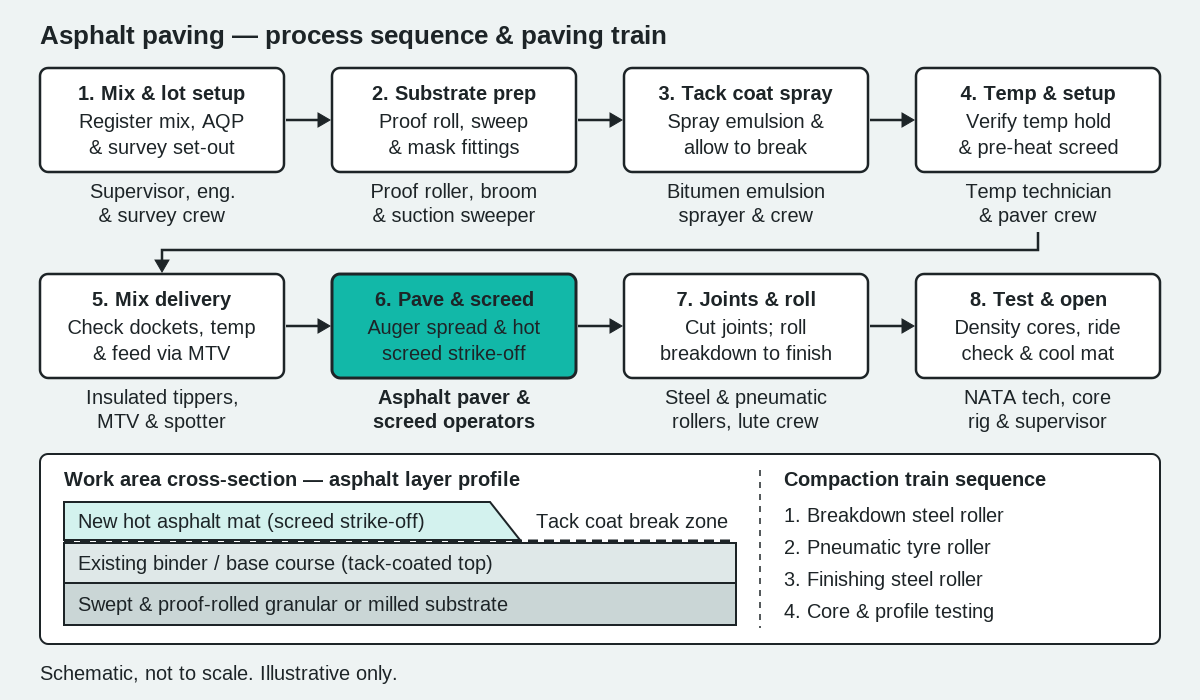
Across Australian road networks, municipal streets, heavy-duty industrial hardstands, and airfields, asphalt is laid in controlled layers—comprising corrective regulation courses, base courses, intermediate binder courses, and wearing courses—to provide structural load distribution, skid resistance, ride quality, and surface waterproofing. Before placing the mix, the prepared substrate is swept clean and sprayed with a bituminous emulsion tack coat to establish interfacial shear bonding between layers. Heated asphalt is dispatched in insulated tipping trucks or live-bottom flow trailers, discharged directly into a self-propelled paver hopper or via a Material Transfer Vehicle (MTV), spread laterally by augers, and struck off by a heated vibrating or tamping screed. Immediately behind the screed, a coordinated roller train of steel-wheeled vibratory or static breakdown rollers, pneumatic-tyred rollers, and steel-wheeled finishing rollers consolidates the mat to its target air-void content and profile before the binder cools below its workable compaction temperature window.
Where the method applies
- Motorways, arterial highways, and heavy-duty freight corridors requiring full-depth or deep-strength structural asphalt layers using Dense Graded Asphalt (DGA), High Modulus Asphalt (EME2), or Stone Mastic Asphalt (SMA) wearing courses.
- High-stress urban intersections, climbing lanes, and bus lanes using heavy-duty dense-graded mixes with polymer-modified binders (PMBs) or multigrade bitumens engineered to resist rutting, shoving, and shear deformation under heavy braking and turning loads.
- High-speed carriageways requiring surface drainage, water spray reduction, and tyre-pavement noise reduction via Open Graded Asphalt (OGA) wearing courses.
- Pavement rehabilitation and mill-and-fill overlays, including structural or functional resurfacing over cold-planed existing asphalt, crack-retarding Crumb Rubber Asphalt treatments, and shape correction (regulation) layers over deformed pavements.
- Local government streets, commercial car parks, and shared paths requiring light-duty dense-graded asphalt or coloured wearing courses such as laterite asphalt.
Asphalt paving does not suit low-volume rural roads specified for unbound granular pavements with sprayed bituminous chip seals, nor areas subject to severe stationary point loads, chemical or fuel spillage, or extreme static shear (such as container stacking yards, toll booths, and refuelling aprons), where jointed or continuously reinforced rigid concrete pavements are typically used. It also cannot proceed over unsound, saturated, or deflecting substrates without prior proof rolling and rectification, or during rain or below specified minimum pavement and ambient temperatures.
Sequence of work
- Mix design registration, quality plan approval, and lot set-out. The supervisor and engineers confirm that nominated asphalt mix designs for each layer and aggregate size are registered and accepted by the road authority, submit the Asphalt Quality Plan (AQP) and Inspection and Test Plan (ITP), and survey-mark lane edges, layer thicknesses, and joint offsets before work commences.
- Substrate preparation and proof rolling. Ground crew and plant operators complete underlying cold-planing, crack sealing, or basecourse trimming, proof roll the substrate to verify the absence of deformable weak spots, and sweep the surface with a mechanical rotary broom and suction sweeper until clean, dry, and free of loose material.
- Protection of street furniture and utility fittings. Ground crew mask and protect pit lids, drainage grates, kerbs, bridge expansion joints, and existing line markings ahead of sprayer operations.
- Tack coat application and break. The sprayer operator applies the nominated bituminous emulsion tack coat uniformly across the prepared substrate and along vertical faces of cold longitudinal and transverse joints at the AQP application rate, allowing the emulsion to break (turn from brown to black as water evaporates) before any haul truck or paver trafficking.
- Pavement temperature verification and paver setup. The temperature technician measures and logs pavement surface and ambient temperatures to release the pre-paving temperature hold point, while the paver and screed operators position the paver onto starting blocks or the existing transverse butt joint, pre-heat the screed plate, and configure automatic grade and slope controls.
- Asphalt delivery, receipt inspection, and transfer. The spotter and docket clerk receive tarped, insulated haul trucks at the workfront, verify delivery dockets (mix designation, batch time, mass), and check mix discharge temperatures before tipping into the paver receiving hopper or through a Material Transfer Vehicle (MTV) to remix the material and isolate the paver from truck bump impacts.
- Mechanical spreading and screed strike-off. The paver operator advances the paver at a steady speed matched to plant supply, maintaining a consistent head of material across the auger chamber while the screed operators control the vibrating or tamping screed to strike off the mat to the required uncompacted surcharge thickness, with lute hands dressing edges minimally without broadcasting coarse aggregate.
- Transverse and longitudinal joint construction. Rake and lute hands form neat transverse start and finish butt joints using a straightedge and cut-back into full-depth compacted material, while longitudinal joints are compacted immediately by overlapping the hot mat onto the adjacent cold lane, crowding the joint where required, and rolling prior to main-mat breakdown rolling.
- Breakdown, intermediate, and finishing rolling. Roller operators execute the documented rolling pattern within the workable compaction temperature window, using steel-wheeled vibratory or static breakdown rollers close behind the screed, pneumatic-tyred intermediate rollers (for dense-graded mixes where applicable) to knead and seal the matrix, and steel-wheeled finishing rollers in static mode to remove roller marks.
- In-situ compaction testing, surface tolerance checks, and opening to traffic. The NATA-accredited materials testing technician conducts progressive non-destructive density monitoring, extracts cores or performs nuclear/electromagnetic density lot testing once cooled, and verifies surface profile with a straightedge or profilometer before the supervisor opens the pavement to traffic once cooled to the specified safe trafficking temperature.
Typical crew and plant
| Role or machine | What it does | Notes |
|---|---|---|
| Paving Supervisor / Foreperson | Oversees workfront safety, delivery coordination, temperature compliance, and lot sign-off. | Coordinates plant dispatch rate with site progress. |
| Paver Operator & Screed Operators (1 to 2) | Paver operator controls alignment, travel speed, hopper wings, and conveyor/auger feed; screed operators manage screed extensions, uncompacted mat depth, crown/crossfall, joint overlap, and grade control sensors. | Maintains continuous forward motion and consistent auger head. |
| Roller Operators (typically 2 to 4) & MTV Operator | Roller operators run breakdown, intermediate pneumatic, and finishing rollers to the nominated pattern; MTV operator runs the Material Transfer Vehicle and coordinates truck docking. | Number of roller operators depends on mat width and mix type; MTV operator used when an MTV is deployed. |
| Rake Hands / Lute Hands / Screwperson (2 to 4) | Manage transverse tie-ins, longitudinal joint preparation, pit surrounds, and handwork areas. | Avoid broadcast scattering of coarse aggregate across the mat. |
| Tack Coat Sprayer Operator, Sweeper Operator & Spotter / Docket Clerk | Sweeper and sprayer operators clean the substrate and apply emulsion ahead of the train; spotter directs reversing haul trucks, records dockets, and logs discharge and mat temperatures. | Mandatory temperature logging for every truck load. |
| Materials Testing Technician (NATA-accredited) | Performs in-situ density testing, loose mix sampling, and core extraction. | Required for statistical lot compliance under AS/NZS 2891 series. |
| Self-propelled Asphalt Paver & Material Transfer Vehicle (MTV) | Tracked or wheeled paver with heated vibrating/tamping screed and automatic levelling controls (sonic ski, averaging beam, or 3D total station/GNSS); self-propelled remixing MTV unit. | MTV decouples truck tipping from the paver where specified on highway or continuous runs. |
| Tandem Steel-Wheeled Rollers & Multi-Tyred Pneumatic Rollers | Vibratory/oscillatory steel-wheeled rollers (with water-mist spraybars and coco mats/scrapers) perform breakdown and finishing passes; pneumatic rollers (with tyre skirts and wetting systems) provide intermediate kneading compaction. | Pneumatic rollers are used on dense-graded mixes, not typically on SMA or OGA where binder drain-down or stone crushing could occur. |
| Bitumen Emulsion Sprayer, Mechanical Sweeper & Asphalt Haulage Fleet | Calibrated distributor truck or towable sprayer with hand lance; suction road sweeper and rotary broom; insulated rigid tippers, truck-and-dog combinations, semi-tippers, or live-bottom flow trailers with thermal tarpaulins. | Ancillary tools include plate compactors, pedestrian trench rollers, lute rakes, straightedges, thermometers, core rig, and density gauges. |
Productivity drivers
- Asphalt plant output and haulage fleet balance. Paver output cannot exceed the steady-state production rate of the supplying batch or drum plant or the cycle capacity of the haulage fleet; under-supply forces the paver to stop and wait, creating thermal cool spots and transverse screed settlement marks.
- Layer thickness and paving width. Thicker structural base layers consume substantially higher tonnage per linear metre than thin wearing courses, meaning haulage and plant capacity typically govern thick-lift paving whereas roller coverage and screed travel speed govern thin-lift surfacing.
- Site geometry and handwork complexity. Long, unobstructed highway runs allow continuous paving with minimal stops, while urban cul-de-sacs, roundabouts, median islands, blister kerb tie-ins, and high densities of service pits reduce shift output due to frequent paver repositions and manual raking.
- Traffic staging and possession windows. Night-shift possessions on live motorways or arterial roads lose substantial shift hours to traffic control establishment, cold-planing handovers, and mandatory mat cooling time before reopening to traffic.
- Mix type and compaction temperature window. Stone Mastic Asphalt (SMA), Open Graded Asphalt (OGA), and mixes incorporating polymer-modified binders require strict temperature control and specific rolling regimes, constraining maximum paver forward speed so breakdown rollers maintain coverage immediately behind the screed.
- Use of a Material Transfer Vehicle (MTV). Decoupling truck tipping from the paver hopper eliminates truck exchange delays at the paver and supports continuous forward motion.
Published references
Only figures that come from a source are listed. Everything else is a driver, not a number.
| Reference | Figure and basis | Status |
|---|---|---|
| Austroads Guide to Pavement Technology Part 4B: Asphalt (AGPT04B-25) (https://austroads.gov.au/) | No numeric productivity figures were found in the opened source; covers qualitative technical guidance on asphalt manufacture, delivery balance, placement, and compaction train coordination. | Confirmed |
| Main Roads WA Specification 504: Dense Graded Asphalt Wearing Course (https://www.mainroads.wa.gov.au/) | No numeric productivity figures were found in the opened source; covers specification governance for continuous paving, MTV usage, and environmental constraints. | Confirmed |
| Queensland TMR MRTS30 Asphalt Pavements (https://www.tmr.qld.gov.au/) | No numeric productivity figures were found in the opened source; covers specification governance for lot control, temperature limits, and rolling process compliance. | Confirmed |
Quality and hold points
- Mix design registration and acceptance (Hold Point, e.g. TMR MRTS30 Hold Point 1 & TN148). Production and paving cannot commence until the nominated asphalt mix design and constituent material certificates (aggregates, filler, binder, RAP proportion) are registered and accepted by the Administrator.
- Asphalt Quality Plan (AQP) and rolling pattern submission. The Contractor must submit the AQP nominating tack coat emulsion grade, spray rates, plant configuration, joint layout, and compaction procedures before paving begins.
- Substrate proof rolling and pre-pave surface inspection (TMR MRTS30 Clause 8.9). Verifies that the underlying granular base or milled asphalt surface is structurally sound, dry, swept clean, and within level tolerances prior to tack coating.
- Non-conforming layer thickness proposal (Hold Point, TMR MRTS30 Hold Point 5). Placement of asphalt in a layer thickness outside the specified nominal size range (such as in tie-ins or corrective courses) requires prior release by the Administrator.
- Pavement surface temperature compliance (Hold Point, TMR MRTS30 Clause 8.7 Hold Point 6). Asphalt placement must not commence or continue unless the measured pavement surface temperature and ambient/wind conditions meet the specified minimum limits for the mix.
- Delivery and mat temperature logging. Mix temperatures must be measured and recorded for every truck load at discharge or at the paver distribution auger to verify compliance with the compaction window.
- Loose mix production testing (AS/NZS 2891 series). Loose mix is sampled in accordance with AS/NZS 2891.1.1 and tested for binder content and aggregate grading (AS/NZS 2891.3.3), maximum density (AS/NZS 2891.7.1 / 7.3), and laboratory gyratory or Marshall volumetric properties (AS/NZS 2891.2.2 / AS/NZS 2891.5).
- In-situ air voids, relative compaction, and surface tolerance testing. Homogeneous work lots are verified using extracted pavement cores (AS/NZS 2891.1.2), bulk density testing (AS/NZS 2891.9), or calibrated field density gauges (AS/NZS 2891.14.2 / 14.5), alongside straightedge, laser profilometer (International Roughness Index), and core thickness checks.
Risks and controls
- Premature cooling of the asphalt mat from cold ambient/surface temperatures, wind, or haul delays: Causes high in-situ air voids, poor aggregate interlock, permeability, rapid oxidation, early ravelling, or lot rejection. Control by enforcing Hold Point 6 surface temperature checks, using insulated and tarped trucks, matching plant dispatch to paver progress, deploying an MTV, keeping breakdown rollers close behind the screed, and using approved Warm Mix Asphalt (WMA) additives where permitted.
- Thermal or mechanical aggregate segregation: Creates coarse, open-textured "bony" patches that trap water and ravel prematurely under traffic. Control by avoiding completely emptying the paver hopper between loads, not dumping cold hopper wings into the auger, maintaining a uniform head of material on the augers, and using an MTV to remix material before the paver.
- Defective tack coat (insufficient, excessive, or trafficked before breaking): Leads to delamination, slippage cracking, or shoving between layers if under-applied or dirty, or binder flushing and bleeding if over-applied. Control by sweeping and drying the substrate thoroughly, calibrating sprayer bar nozzles, verifying AQP emulsion spray rates, and preventing haul trucks from driving on unbroken tack coat.
- Poor longitudinal or transverse joint compaction: Leaves low density along joint lines that allows water ingress, longitudinal cracking, and fretting. Control by cutting back cold joints to sound full-thickness asphalt, tacking vertical joint faces, maintaining correct screed overlap on hot-to-cold joints, and staggering longitudinal joints between successive pavement layers.
- Plant or roller breakdown mid-shift: Results in uncompacted mix cooling on the road or stranded haul trucks requiring disposal. Control by maintaining standby compaction plant on site as required by the AQP and completing pre-start mechanical checks on paver screed heaters, augers, and roller water spray systems.
- Reversing haul trucks and live traffic interfaces: Poses collision risks between haul trucks, ground crew, and public road users. Control by enforcing dedicated truck spotters, physical delineation barriers, positive communication protocols, and speed-reduced traffic management zones.
Programming and weather
- Predecessor completion and sign-off: Subgrade and unbound granular basecourse construction (or cold-planing of existing asphalt under DTP Section 402 or MRWA Specification 508), underground utility installation, kerb and channel construction, proof rolling, and prime or primerseal curing over granular bases must be completed and signed off before paving.
- Shift duration and logistics build-up: Shift output is built up from net available paving hours after deducting traffic control setup, substrate preparation, tack coat break time, and mandatory mat cooling time, matched against plant batching capacity and truck cycle times.
- Multi-layer joint offsetting and staging: Where base, intermediate, and wearing courses are programmed across multiple stages, longitudinal and transverse joints must be offset vertically between successive layers; temporarily trafficked intermediate layers require thorough sweeping and re-tacking before the final wearing course is laid near project completion.
- Successor activities and opening to traffic: Following compaction, programme time must allow for pavement cooling to the specified safe trafficking temperature, core extraction and core-hole reinstatement, temporary and permanent line marking, raised reflective pavement markers (RRPMs), loop detector cutting, and barrier removal.
- Ambient, surface temperature, and wind chill limits: Thin wearing courses (such as OGA, SMA, and thin dense-graded overlays) and polymer-modified binders cool rapidly and carry higher minimum road surface temperature thresholds under TMR MRTS30 Clause 8.7 and MRWA Specification 504 than thick dense-graded base courses.
- Seasonal and night-shift constraints: Winter night shifts in southern Australian states or elevated tableland regions frequently fall below specification placement temperatures for PMB and thin wearing courses, requiring planners to schedule final wearing courses into warmer daytime possessions or spring and summer months.
- Rainfall and surface moisture restrictions: Paving cannot commence on wet or damp surfaces or when rain is imminent (TMR MRTS30 Clause 8.9), and bituminous emulsion tack coats require dry conditions to break cleanly.
Estimating considerations
- Primary measurement units for asphalt supply and placement: Under Australian civil measurement standards (such as Queensland TMR MRS30), asphalt is measured and paid either by mass in tonnes (t) derived from certified weighbridge delivery dockets or by area in square metres (m²) of a nominated compacted thickness.
- Tack coat, surface preparation, and joint measurement: Tack coat is either deemed included in the asphalt paving unit rate or measured separately by sprayed area (m²) or volume of residual binder/emulsion applied (Litres); sweeping is typically included in the paving rate, whereas cold-planing tie-in rebates and edge profiling are measured by area (m²) or linear metre (m).
- Volumetric-to-mass conversion using registered bulk density: When converting drawing take-off volumes (area multiplied by nominal thickness in m³) into tonnes, estimators must apply the specific mix's compacted bulk density from the registered mix design (AS/NZS 2891.9) rather than a generic factor, noting that laterite or high-slag aggregates have substantially higher particle densities than standard basalt or granite mixes.
- Wastage, surcharge, and shape correction allowances: Allow for additional tonnage consumed by underlying basecourse level tolerances (where the substrate sits near the lower permissible bound), paver hopper dump waste, transverse joint cut-backs, and unrecoverable chute or truck remnants.
- Minimum plant call-out, shift penalties, and low-tonnage lots: Account for fixed asphalt plant warm-up, crew establishment, and mobilisation costs per shift; small fragmented tie-in stages or short night-shift possession windows incur much higher plant and labour resources per tonne than continuous full-shift highway runs.
- Haulage cycle times and standing allowances: Build up truck fleet numbers from realistic round-trip cycle times including plant loading, urban congestion, weighbridge queueing, and on-site waiting buffer so the paver never starves for mix.
- Material Transfer Vehicle (MTV) specification mandates: Check project annexures (such as MRWA Annexure 504C) at tender stage to confirm whether an MTV is mandatory, allowing for MTV hire, heavy low-loader floatage, and the dedicated operator.
- NATA testing, coring shifts, and warranty obligations: Allow for NATA-accredited laboratory lot testing across the AS/NZS 2891 suite, traffic management for follow-up coring and reinstatement shifts, and commercial risk allowances for pay-adjustment formulas or performance warranties (such as TMR Technical Note 168).
Specifications and standards
Checked 11 November 2026. Each document was looked up in catalogue and regulator listings; many agency PDFs could not be opened in full. Rows marked Confirmed were found to exist as described. Rows marked Not verified were not found or not checked. Clause-level statements, tolerances, temperatures, distances and similar figures in the text are typical values and are unverified unless a row cites the rule. Confirm the current edition of any document before relying on it.
| Document | What it covers for this method | Status |
|---|---|---|
| AS 2150 — Asphalt – A guide to good practice (https://www.standards.org.au/) | Overarching Australian Standard guidelines for component materials, mix properties, manufacture, transport, spreading, compaction, and finished surface tolerances for hot and warm mix asphalt. | Confirmed |
| AS/NZS 2891 Series — Methods of sampling and testing asphalt (https://www.standards.org.au/) | Mandatory laboratory and field test methods including Parts 1.1 (sampling loose asphalt), 1.2 (coring), 2.1 & 2.2 (sample preparation and gyratory compaction), 3.3 (binder content and grading), 5 (Marshall compaction), 7.1 & 7.3 (maximum density), 9 (bulk density), 12.1 (dynamic creep), and 14.2 & 14.5 (field density, density ratio, and air voids). | Not verified |
| AS 2008 — Bitumen for pavements (https://www.vic.gov.au/) | Australian material standard governing paving-grade bitumens used in asphalt manufacture. | Not verified |
| Austroads AGPT04B-25 (Edition 3.0, September 2025) — Guide to Pavement Technology Part 4B: Asphalt (https://austroads.gov.au/) | Australasian technical guide covering constituent selection, mix design (DGA, SMA, OGA, GGA, EME2), RAP integration, manufacture, placement, and compaction. | Confirmed |
| Queensland TMR — MRTS30, MRS30, MRTS32, MRTS17, MRTS18, MRTS101, MRTS102, MRTS103, TN148 & TN168 (https://www.tmr.qld.gov.au/) | Queensland technical and measurement specifications for asphalt pavements, High Modulus Asphalt (EME2), binders, aggregates, RAP, fillers, mix design registration, and asphalt warranty. | Confirmed |
| Transport for NSW (TfNSW) — QA Specifications R116 (IC-QA-R116), R117, R118, R119, 3152, 3211 & TD 00018 (https://www.transport.nsw.gov.au/) | NSW specifications for heavy-duty and light-duty dense graded asphalt, crumb rubber asphalt, open graded asphalt, aggregates, binders/fillers, and high RAP usage. | Confirmed |
| Department of Transport and Planning (Victoria) — Sections 407, 402, 404, 405 & 417 (https://www.vic.gov.au/) | Victorian standard specifications for Dense Graded Asphalt, cold planing, Stone Mastic Asphalt, Regulation Gap Graded Asphalt, and Open Graded Asphalt. | Not verified |
| Main Roads Western Australia (MRWA) — Specifications 504, 508, 510 & ERN 12 (https://www.mainroads.wa.gov.au/) | WA specifications and guidance for Dense Graded Asphalt wearing course, cold planing, asphalt intermediate course, surfacing selection, and laterite asphalt. | Not found |
| South Australia (DIT), Tasmania (State Growth), Northern Territory (DIPL) & ACT road authority asphalt specifications | Jurisdictional road authority specifications for asphalt paving in SA, TAS, NT, and ACT. | Not verified |
Only documents confirmed to exist carry the status Confirmed. Check the current edition before relying on any document.
Sources and review
| Source | Used for | Status |
|---|---|---|
| Austroads — Guide to Pavement Technology Part 4B: Asphalt, AGPT04B-25, Edition 3.0, 2025 (https://austroads.gov.au/) | Overview of asphalt layers, mix types (DGA, SMA, OGA, EME2), compaction train coordination, and qualitative productivity drivers. | Confirmed |
| Standards Australia — AS 2150 Asphalt – A guide to good practice (https://www.standards.org.au/) | Tack coat break, paver screed strike-off, longitudinal and transverse joint construction, rolling sequence, and segregation controls. | Confirmed |
| Standards Australia / Standards New Zealand — AS/NZS 2891 Series: Methods of sampling and testing asphalt (https://www.standards.org.au/) | Loose mix production testing, core extraction, bulk and maximum density determination, and in-situ air voids and field density compliance. | Not verified |
| Department of Transport and Main Roads (Qld) — MRTS30, MRS30, MRTS32, MRTS17, MRTS18, MRTS101–103, TN148 & TN168 (https://www.tmr.qld.gov.au/) | Mandatory hold points (mix registration, layer thickness, surface temperature), tack coat Clause 8.9, measurement units, and warranty considerations. | Confirmed |
| Transport for NSW (TfNSW) — QA Specifications R116, R117, R118, R119, 3152, 3211 & TD 00018 (https://www.transport.nsw.gov.au/) | Applicability across heavy-duty, light-duty, crumb rubber, and open graded asphalt courses, and lot-based statistical quality testing. | Confirmed |
| Department of Transport and Planning (Vic) — Standard Specification Sections 407, 402, 404, 405 & 417 (https://www.vic.gov.au/) | Mill-and-fill rehabilitation predecessors, joint compaction governance, and AS 2008 bitumen reference. | Not verified |
| Main Roads Western Australia (MRWA) — Specifications 504, 508, 510 & ERN 12 (https://www.mainroads.wa.gov.au/) | Material Transfer Vehicle (MTV) operations, continuous paving requirements, weather constraints, and laterite asphalt applications. | Not found |
Items marked Not verified have not been checked against a primary source. Research notes.
Library navigation
Plant and method index · Discipline work packages · Survey conformance and lot release