Construction methods / Earthworks
Bulk earthworks
Bulk earthworks reshapes existing terrain to design formation levels through large-scale excavation, hauling, placement, moisture conditioning, and compaction for infrastructure and building pads. Major cost and schedule drivers include cut-to-fill balancing, haul distances and haul road rolling resistance, material classification, and moisture management to achieve specified dry density.
- Cut faceMeasure excavation on the agreed bank-volume basis.
- Articulated truckThe return and loading cycle limits the haul spread.
- Placed liftSurvey the compacted fill before releasing the next lift.
Overview
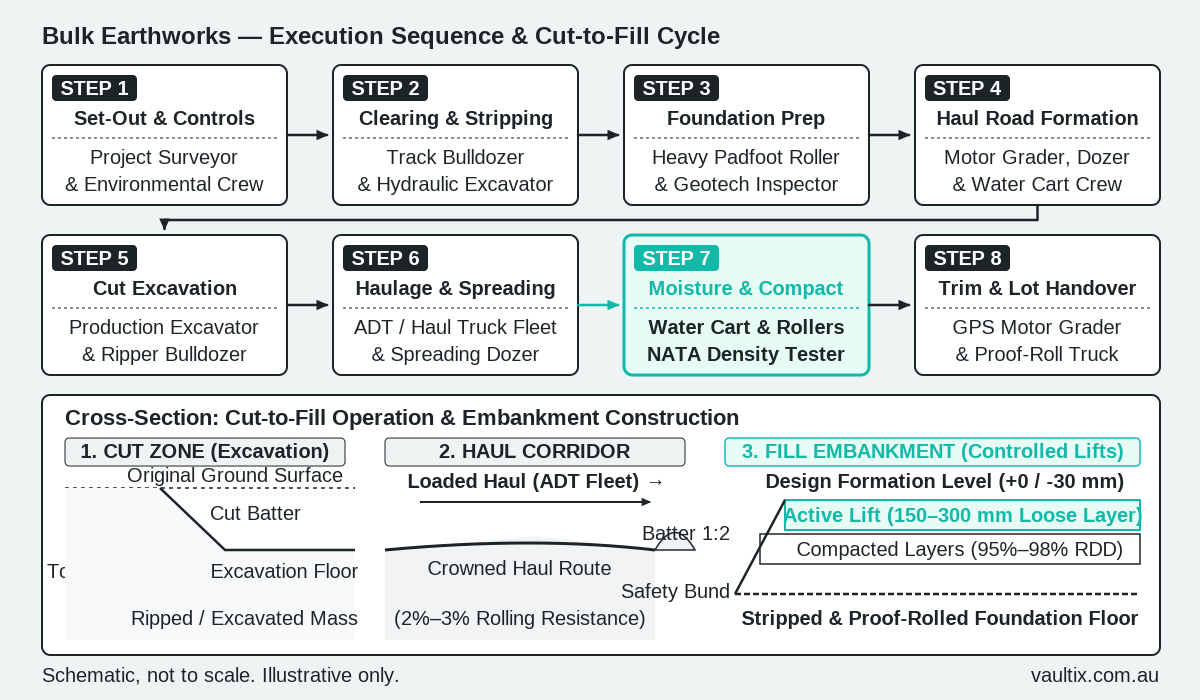
Bulk earthworks involves the large-scale excavation, hauling, placement, conditioning, and compaction of soil and rock to reshape existing terrain to designed formation levels. In Australian civil infrastructure and commercial land development, bulk earthworks constitutes the primary foundation works for road corridors, rail formations, industrial building pads, residential subdivisions, and water-retaining structures. The operational scope encompasses site preparation and topsoil stripping, mass haul cut-and-fill balancing to minimise off-site spoil or borrow, placement in controlled uniform layers, and in-situ moisture conditioning towards optimum moisture content through aerating or water cart application. Heavy mechanical compaction is applied to achieve specified relative dry density ratios, followed by fine trimming and proof rolling to establish a stable subgrade, supported by engineered haul routes designed to sustain fleet cycling and safety.
Where the method applies
- Linear transport infrastructure: highway and motorway embankments, railway formations, airport runways, and taxiways requiring continuous subgrade preparation over long alignments.
- Industrial and commercial building pads: mass platform benching for warehouse distribution centres, logistics hubs, and commercial estates.
- Residential land subdivisions: broad-acre cut-to-fill earthmoving, lot benching, and road reserve formation.
- Resources and industrial infrastructure: mine infrastructure areas (MIA), heavy plant pads, and access corridor earthworks.
- Water retaining structures: bulk embankment dams, retention basins, tailings storage facilities, and flood mitigation levees.
- Borrow pit extraction: controlled mass extraction and winning of structural fill from approved off-alignment borrow areas.
- Mass spoil repositories: systematic placement, moisture control, compaction, and capping of mass surplus or unsuitable spoil dumps.
Bulk earthworks does not suit detailed footing and service trenching, deep urban basement excavations requiring structural retention, or soft estuarine deposits requiring deep ground improvement. These situations require detailed excavation with trench shoring boxes, deep retention systems such as soldier piles or diaphragm walls, or specialised ground improvement techniques including dynamic compaction and wick drains.
Sequence of work
- Pre-start survey, set-out, and environmental controls. Baseline survey control, clearing limits, and boundary fences are established by project surveyors, followed by installation of primary sediment basins, diversion bunds, cut-off drains, and silt fences. Operational readiness of environmental controls and boundary set-out pegs is verified prior to ground disturbance.
- Clearing, grubbing, and topsoil stripping. Surface vegetation, root balls, and organic topsoil are stripped across cut and embankment footprints using excavators and track bulldozers, then stockpiled in low-profile berms. Stripping depth is inspected to confirm complete removal of organic matter without contaminating structural fill material.
- Foundation preparation and proof rolling. The exposed natural foundation floor is excavated to stable subgrade level, removing all unsuitable organic material or uncontrolled fill. The floor is scarified, conditioned, and compacted, then proof rolled under geotechnical supervision to verify no pumping, soft spots, or shear failure before placing fill.
- Haul road establishment and drainage. Dedicated haul roads linking major cut zones to embankment fill areas are formed by track bulldozers and motor graders with crowns, side drains, and granular running courses. Road geometry, drainage shed, and rolling resistance are checked to ensure routes withstand heavy axle loading and wet weather.
- Cut excavation and material sorting. Cut profiles are excavated using hydraulic excavators, bulldozers, or tractor-scrapers, ripping rock horizons where encountered. Material is segregated at the cut face to direct structural fill to embankments, select fill to upper subgrade, and unsuitable or acid sulfate soils to designated spoil repositories.
- Material haulage. Excavated soil and rock are hauled along established routes using matched fleets of articulated dump trucks or rigid-frame haul trucks under one-way traffic management. Haul corridors, crossing points, and safety bunds are inspected continuously for rutting, surface degradation, and traffic safety.
- Spreading and layer thickness control. Tipped material is spread immediately into loose lifts of 150 mm to 300 mm thickness using track bulldozers or motor graders. Layer depth is checked against compactor capability, and the fill platform is graded to maintain a 2% to 4% cross-fall to shed rainfall.
- Moisture conditioning. In-situ moisture of the loose lift is tested against laboratory Optimum Moisture Content (OMC). High-capacity water carts apply water uniformly for dry material, followed by disc harrowing or rotary mixing, while overly wet soils are disc harrowed and cross-ripped for solar and wind aeration until target moisture is confirmed.
- Compaction and quality verification. Heavy vibrating smooth-drum rollers, padfoot compactors, or pneumatic multi-tyred rollers compact the layer systematically from low to high side with overlapping passes. Field dry density ratio is verified by a NATA-accredited technician using nuclear moisture-density gauges before the next layer is placed.
- Final trimming, subgrade testing, and handover. The completed structural formation or cut floor is trimmed by a GPS-guided motor grader to design tolerances (per the specification; MRTS04 gives plus or minus 25 mm individual and plus or minus 10 mm average at subgrade level). Final proof rolling, survey level verification, and deflection testing are completed for formal lot sign-off before handover to pavement construction.
Typical crew and plant
| Role or machine | What it does | Notes |
|---|---|---|
| Hydraulic excavator (mass excavation) | Excavates native material in cut zones, sorts material at the face, and loads haulage units | Fitted with mass-excavation booms and matched buckets; operates from stable benches. |
| Articulated dump truck (ADT, 6x6) | Transports bulk earth and rock over rough, steep, or soft haul routes between cut and fill | Provides high all-wheel-drive traction in civil subdivisions and soft ground conditions. |
| Rigid-frame haul truck | Carries high-payload bulk material over long, well-maintained haul roads | Best suited to major infrastructure corridors and large borrow pits with low rolling resistance. |
| Track bulldozer | Rips hard ground, pushes mass cuts (slot dozing), clears vegetation, and spreads tipped fill | Equipped with single or multi-shank rippers and semi-U or universal blades. |
| Wheel tractor-scraper | Excavates, self-loads or push-loads, hauls, and spreads thin, uniform loose lifts | High-production bulk earthmover on broad alignments; often assisted by push-bulldozers. |
| Motor grader | Spreads fill, trims final subgrade to tight levels, shapes cross-falls, and maintains haul roads | GPS machine-guidance controls finished formation levels within +0 mm / -30 mm tolerances. |
| Heavy padfoot compactor | Kneads and compacts cohesive clay and silt fill materials in controlled loose layers | Pad feet penetrate and compact from the bottom of the lift upward; self-propelled or towed. |
| Smooth-drum vibrating roller | Compacts granular and cohesionless fills, seals surfaces before rain, and rolls subgrades | Operates in variable amplitude and frequency modes; essential for sealing fill at end of shift. |
| Multi-tyred roller (pneumatic) | Kneads surface voids, finishes subgrade surfaces, and conducts rolling deflection checks | Ballasted wheel loads provide uniform surface sealing across granular and select layers. |
| Water cart | Applies moisture to loose fill layers and sprays haul roads for dust suppression | Equipped with pressurised spray bars, gravity dribble bars, and front-mounted batter cannons. |
| Earthworks superintendent and foreperson | Directs daily site operations, balances fleet ratios, manages haul traffic, and enforces safety | Monitors excavator cycle times and haul truck queues to maintain production balance. |
| GITA technician and project surveyor | Executes Level 1 geotechnical oversight, nuclear gauge density testing, and set-out surveys | Provides NATA-accredited field testing and 3D terrain model sign-off for lot certification. |
Productivity drivers
- Haul distance and route profile. Longer travel distances directly increase haul cycle times; steep adverse grades escalate cycle duration, require lower gear operation, and increase fuel consumption.
- Haul road rolling resistance. Well-maintained, hard-packed haul surfaces maintain 2% to 3% rolling resistance for high fleet travel speeds, whereas rutted, unmaintained tracks exceed 8% to 12%, halving haul speed.
- Material swell and load factors. In-situ bank material expands into loose volume upon excavation, reducing the bank volume payload carried per truck body or scraper bowl and requiring higher haul volumes.
- Loading tool matching and bunching. An imbalance between loading tool output and haul truck capacity results in excavator idle time during truck shortages or truck queuing delays when units bunch.
- Bucket and body fill factors. Material composition dictates bucket fill efficiency, ranging from lower fill factors in blocky blasted rock (0.7 to 0.8) to high fill factors in well-graded sandy clay (0.95 to 1.1).
- Moisture conditioning demands. Fills placed well outside Optimum Moisture Content require time-consuming water truck passes and rotary mixing to hydrate, or extensive discing and aeration passes to dry out.
- Layer thickness and compactive effort. Excessive loose layer depth prevents compactive energy from reaching the lower portion of the lift, requiring extra roller passes or causing density test failures.
- Operating efficiency multiplier. Production planning must apply realistic job-efficiency factors (such as a 50-minute operating hour, or 0.83 factor) to account for operator breaks, refuelling, and minor delays.
Published references
Only figures that come from a source are listed. Everything else is a driver, not a number.
| Reference | Figure and basis | Status |
|---|---|---|
| Caterpillar Performance Handbook (Edition 49) | Theoretical hourly production formulas derived from machine cycle time, payload, material swell, and rolling resistance; no universal blanket productivity figures are published. | Not verified |
| Austroads Guide to Pavement Technology Part 8: Pavement Construction | Compaction principles, layer thickness, and moisture criteria for road formations; no fixed hourly productivity figures are published in national guidelines. | No figure found (negative finding, not a document) |
| Queensland TMR MRS04 General Earthworks | Measurement specification defining the measurement of earthworks work items in cubic metres (check the basis for each item); no statutory contractor production rates published. | Confirmed |
Quality and hold points
- Pre-clearing and environmental control verification. Joint inspection of survey boundary pegs, clearing lines, and operational readiness of sediment basins prior to any ground disturbance.
- Post-stripping ground surface survey. Mandatory submission and verification of a 3D digital terrain survey model of the stripped ground surface before cut excavation or fill placement starts.
- Foundation inspection and unsuitable material removal. Geotechnical inspection of the stripped foundation floor to identify and excavate unsuitable organic or soft material before placing fill.
- Cutting floor subgrade and proof rolling. Inspection of cut subgrade levels, CBR and plasticity index verification, and proof rolling under a loaded heavy vehicle before placing pavement or select layers.
- Fill layer compaction compliance. Lot-based compaction testing by a NATA-accredited technician confirming specified dry density ratio for each placed lift before proceeding with the next layer.
- Field density testing frequency. Minimum testing frequencies under AS 3798 Table 8.1 (1 test per 2,500 m², 1 test per 500 m³, or 3 tests per lot) to ensure statistical compaction integrity.
- Upper subgrade / Selected Material Zone (SMZ) sign-off. Conformance testing of select material properties (grading, CBR, PI) and final subgrade lot approval prior to pavement handover.
- Acid sulfate soils encounter. Mandatory immediate work halt and notification upon encountering suspected acid sulfate soils, followed by field and laboratory testing before any disturbance.
Risks and controls
- Geotechnical variability and unexpected ground conditions. Unforeseen rock horizons or soft clay pockets cause plant mismatch and foundation failure; controlled by reviewing borelogs, advance test pitting, maintaining standby ripper dozers, and executing subgrade undercuts.
- Moisture saturation from heavy rainfall. Waterlogged fill and haul roads lead to subgrade pumping and project shutdowns; controlled by grading fill platforms with 2% to 4% cross-falls, crowning haul routes, sealing open lifts with smooth-drum rollers before rain, and active sump pumping.
- Haul road degradation and vehicle collision. Rutted roads and poor visibility risk haul truck rollover and equipment damage; controlled by establishing dual-lane widths (minimum 3x vehicle width), constructing half-wheel-height safety bunds, and enforcing radio communication.
- Sediment runoff and environmental breach. Uncontrolled storm runoff from bare earthworks causes siltation of downstream waterways; controlled by staging clearing limits, pre-commissioning sediment treatment basins, and installing contour diversion banks.
- Volumetric variance from uncalibrated bulk and shrink factors. Imbalances between bank cut and compacted fill result in costly spoil export or borrow import; controlled by early laboratory density testing, mass haul diagram reconciliation, and regular drone surveys.
- Excessive dust generation and visibility hazards. Dry, windy conditions generate dust clouds that breach environmental licenses and create collision hazards; controlled by continuous water cart spraying along active haul corridors and enforcing site speed limits.
Programming and weather
- Duration build-up logic. Production schedule duration is built from total cut-to-fill mass haul volumes, loading tool cycle times, matched haul fleet capacities, daily loose placement targets, and compactive pass requirements adjusted by operational efficiency factors.
- Prerequisite approval gates. Earthworks cannot commence until environmental management plans, cultural heritage clearances, boundary set-out, and pre-start utility asset relocations are formally signed off.
- Early works drainage dependencies. Installation of clean-water diversion bunds and sediment treatment basins must achieve operational certification before broad-acre clearing or topsoil stripping begins.
- Internal sequential constraints. The production cycle must progress through a strict linear sequence: stripping, foundation inspection and proof rolling, haul road commissioning, bulk cut-to-fill placement, and final subgrade trimming.
- Critical-path successor activities. Completed subgrade lot sign-off and proof rolling is the critical-path predecessor to pavement subbase placement, deep stormwater drainage, and structural piling works.
- Rainfall sensitivity and hauling shutdown thresholds. Cohesive clay subgrades are sensitive to moisture ingress; rainfall exceeding 10 mm to 15 mm typically forces hauling shutdowns on unsealed haul routes to prevent subgrade pumping and severe rutting.
- Climatic seasonality and regional calendar effects. In tropical and subtropical Queensland, mass bulk earthworks must be scheduled during the dry season (April to November), whereas southern states experience low winter evaporation rates that prolong material drying cycles.
- Wind, heat, and evaporative moisture loss. Hot, windy summer weather accelerates surface moisture loss from spread layers, requiring continuous high-volume water cart spraying to prevent layer desiccation and crusting.
Estimating considerations
- Volumetric measurement unit separation. Bills of quantities must distinguish between Bank Cubic Metres (BCM) for cut excavation, Loose Cubic Metres (LCM) for haulage and loose layer spreading, and Compacted Cubic Metres (CCM) for placed embankment.
- Bulking and shrinkage factor allowances. Estimators must determine verified bulking factors (LCM/BCM) and shrinkage factors (CCM/BCM) based on geotechnical test data rather than blanket assumptions to avoid mass haul volume shortfalls.
- Mass-haul centroid-to-centroid analysis. Haul cycle durations and fuel consumption allowances must be calculated using centroid-to-centroid haul distances, incorporating vertical grade resistance and circuit return loops.
- Haul road construction and ongoing maintenance. Budgets must allow for initial haul road construction with crushed rock or granular capping, daily motor grader maintenance, dust suppression watering, and post-project road decommissioning.
- Water sourcing, extraction permits, and delivery. Estimators must price commercial water access, extraction licenses, standpipe connections, and dedicated water cart operating hours matching climatic evaporation rates.
- Rock excavation classification boundaries. Contract documentation must clearly define contractual boundaries between rippable rock (ripped by heavy bulldozers) and non-rippable rock requiring drill-and-blast or heavy hydraulic breakers.
- Subgrade undercut and unsuitable material contingencies. Allowances must be included for excavating, spoiling, and replacing pockets of soft or unsuitable foundation material identified during proof rolling.
- Testing frequencies and Level 1 GITA supervision. Take-offs must budget for NATA-accredited testing laboratory rates, required nuclear gauge test frequencies per placed lot under AS 3798 Table 8.1, and continuous Level 1 geotechnical inspection.
- Erosion and sediment control maintenance. Allowances must cover ongoing maintenance of environmental controls, including periodic desilting of sediment basins, repairing contour bunds, and placing batter erosion protection.
Specifications and standards
Checked 11 November 2026. Each document was looked up in catalogue and regulator listings; many agency PDFs could not be opened in full. Rows marked Confirmed were found to exist as described. Rows marked Not verified were not found or not checked. Clause-level statements, tolerances, temperatures, distances and similar figures in the text are typical values and are unverified unless a row cites the rule. Confirm the current edition of any document before relying on it.
| Document | What it covers for this method | Status |
|---|---|---|
| Queensland TMR MRTS04 (General Earthworks) | Specification for excavation, embankment placement, moisture conditioning, compaction criteria, and mandatory hold points for road corridors. | Confirmed |
| Queensland TMR MRS04 (General Earthworks) | Specification for measurement and payment of earthworks items by Bank Cubic Metres (BCM) and Compacted Cubic Metres (CCM). | Confirmed |
| Transport for NSW QA Specification R44 (Earthworks) | NSW road authority requirements for highway formation, cut floor subgrade treatment, selected material zones (SMZ), and quality hold points. | Confirmed |
| VicRoads Standard Section 204 (Earthworks) | Victorian specification governing road formation excavation, structural embankment construction, and material classification. | Confirmed |
| Standards Australia AS 3798-2007 | Guidelines on earthworks for commercial and residential developments, specifying compaction criteria (Table 5.1) and field testing frequencies (Table 8.1). | Confirmed |
| Standards Australia AS 1289 Series | Standard methods of testing soils for engineering purposes: standard compactive effort (5.1.1), dry density ratio (5.4.1), and nuclear gauge field testing (5.7.1). | Confirmed (clause wording to be corrected: 5.7.1 is Hilf density ratio, 5.8.1 is the nuclear gauge) |
| Austroads Guide to Pavement Technology Part 8: Pavement Construction | National Australian guide establishing principles for road subgrade earthworks, moisture conditioning, and compaction verification. | Not verified |
Only documents confirmed to exist carry the status Confirmed. Check the current edition before relying on any document.
Sources and review
| Source | Used for | Status |
|---|---|---|
| TMR MRTS04 General Earthworks | Specification requirements for road excavation, placement, moisture conditioning, and hold points. | Confirmed |
| TMR MRS04 General Earthworks (Measurement) | Measurement and payment definitions for BCM and CCM earthworks quantities. | Confirmed |
| Transport for NSW QA Specification R44 Earthworks | NSW road authority specifications for subgrade preparation, selected material zones, and mandatory hold points. | Confirmed |
| VicRoads Standard Section 204 Earthworks | Victorian road formation, cut-to-fill excavation, and structural embankment standards. | Confirmed |
| Standards Australia AS 3798-2007 | Guidelines on earthworks for commercial and residential developments, compaction criteria, and testing frequencies. | Confirmed |
| Austroads Guide to Pavement Technology Part 8 | National Australian principles for road subgrade compaction and equipment selection. | Not verified |
| Caterpillar Performance Handbook (Edition 49) | Machine cycle time formulas, blade and bucket fill factors, swell factors, and rolling resistance principles. | Not verified |
Items marked Not verified have not been checked against a primary source. Research notes.
Library navigation
Plant and method index · Discipline work packages · Survey conformance and lot release