Construction methods / Structures
Precast girder bridge decks
Precast girder bridge deck construction combines factory-cast prestressed concrete girders with a cast-in-place composite concrete deck slab and traffic barriers to form short-to-medium span bridge superstructures without ground-supported falsework. Cost and duration are driven by heavy crane pad setup, over-dimensional haulage and corridor possession windows, and elevated formwork, steelfixing, and night concrete pour sequences.
- Launching gantryMoving and setting the gantry contributes to each erection cycle.
- GirderTrack each fabricated beam from delivery to its accepted position.
- Bearing seatSurvey seat position and level before releasing the span.
Overview
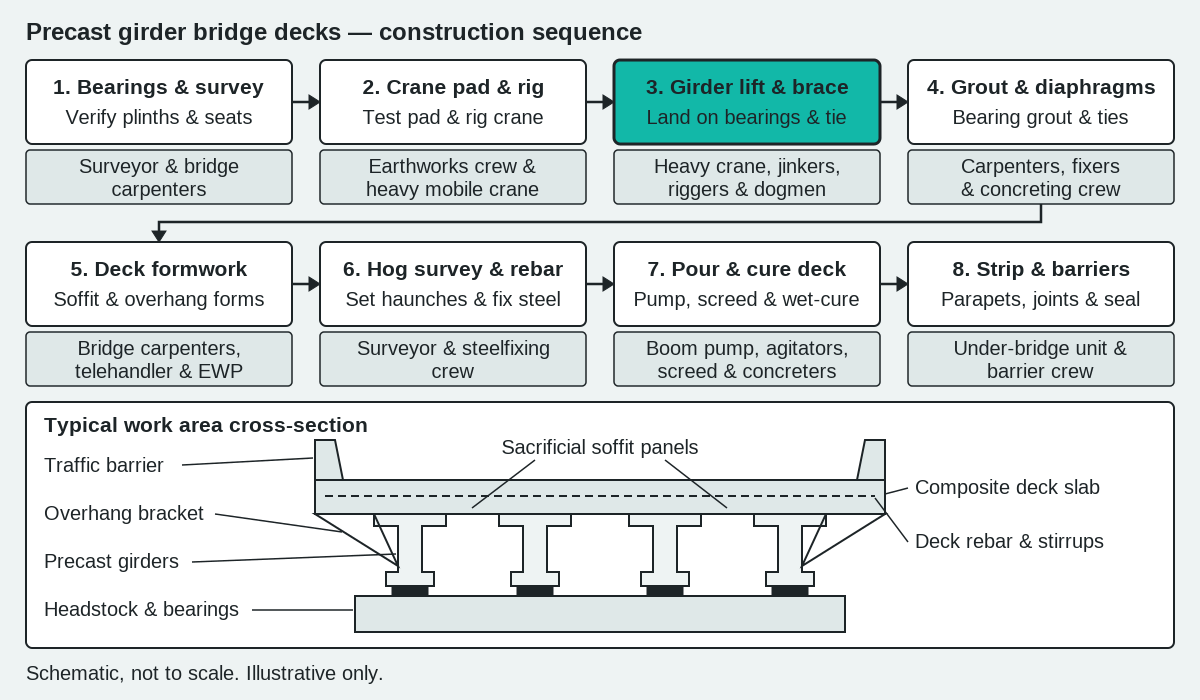
Precast girder bridge deck construction is the standard superstructure method for short-to-medium span road, rail, and waterway bridges across Australia. Factory-manufactured pretensioned or post-tensioned concrete girders—such as Super-T girders, I-girders, or plank units—are transported to site by steerable jinker and lifted by crane onto elastomeric, pot, or spherical bridge bearings seated on completed piers and abutments. Once the girders are landed, surveyed, and laterally braced, sacrificial permanent soffit formwork panels are installed between the girder flanges, and cantilevered falsework brackets are erected along the outer edge girders to form the deck overhangs. Reinforcing steel is fixed across the deck and tied into the projecting girder shear stirrups to achieve composite structural action once the cast-in-place concrete deck slab is poured and cured. The superstructure is finished with cast-in-place or precast concrete traffic barriers, expansion joints, and deck waterproofing or wearing surface preparation.
Where the method applies
- Highway, arterial, and rural road bridges where single-span or multi-span crossings suit standard pretensioned Super-T girders, I-girders, or precast deck plank units.
- Over-traffic road and motorway crossings where full-span ground falsework is prohibited and girders must be erected during short road closures.
- Live rail corridor overpasses where girders are landed during scheduled track possessions and the deck is formed above using sacrificial soffit panels between girder flanges.
- Creek, river, and estuarine waterway crossings where eliminating in-stream falsework reduces flood washout exposure and environmental disturbance.
- Repetitive multi-span viaducts where standardised girder geometry, modular sacrificial formwork, and repeatable deck pour sequences reduce falsework and labour learning curves.
- Urban and regional bridge replacements where factory precasting runs in parallel with on-site piling, abutment, and pier construction to compress overall site duration.
This method does not suit long clear spans exceeding road transport or crane lifting limits, tightly curved horizontal alignments where chorded straight girders create excessive overhang variations, or sites without haulage access or crane pad footprint. In those cases, planners typically select balanced cantilever or incrementally launched box girders, curved structural steel trough girders, or—for very short low-clearance crossings—precast reinforced concrete box culverts and cast-in-place flat slabs.
Sequence of work
- Substructure handover, survey verification, and bearing installation. Surveyors and bridge carpenters verify as-built levels, alignment, and concrete compressive strength of abutment shelves and pier headstocks, prepare mortar pads or plinths, set holding-down bolts, and install elastomeric, pot, or spherical bridge bearings to design levels and orientation before girder delivery.
- Crane pad earthworks, testing, and crane mobilisation. Earthworks crews construct, compact, and proof-test engineered crane working platforms and outrigger pads, after which the crane crew mobilises the mobile hydraulic or crawler crane, assembles counterweights and boom configurations, and checks rigging and spreader beams against the certified lift plan.
- Precast girder delivery, lifting, and temporary bracing. Riggers, dogmen, and crane operators receive precast girders on steerable jinkers, inspect members for transit damage or excessive sweep and hog, attach certified lifting clutches to cast-in anchors, slew girders onto the bearings, and install engineered temporary lateral bracing before releasing the crane hooks.
- In-situ diaphragms and bearing grouting. Steelfixers, carpenters, and concreters fix reinforcement and erect formwork for cast-in-place end and intermediate cross-girders (diaphragms) and complete mortar, epoxy bedding, or sleeve grouting at bearing interfaces to lock in lateral stability.
- Sacrificial soffit formwork and cantilever edge formwork. Bridge carpenters supported by a telehandler or pick-and-carry crane place sacrificial soffit formwork panels on mortar or foam bedding strips between girder top flanges and hang cantilevered overhang brackets, edge forms, screed rails, and perimeter edge-protection walkways along the exterior girders.
- Girder hog survey and scabbling verification. The engineering surveyor measures top-of-girder levels along each span to capture actual precast hog (camber) and calculate required haunch thicknesses for design slab depth and road grading, while crews verify top flange roughness and clean around projecting shear stirrups.
- Deck slab and barrier starter reinforcement. Steelfixers fix bottom and top mats of longitudinal and transverse deck reinforcement on bar chairs, tie into projecting girder shear stirrups, install cast-in service conduits, drainage scuppers, and expansion joint anchorage steel, and tie starter bars for the traffic barriers.
- Pre-pour inspection and composite deck concrete pour. Following pre-pour survey, cover checks, and cleanliness sign-off, the concreting crew places structural bridge deck concrete via mobile boom pump in the engineered pour sequence, compacts with immersion vibrators, screeds with a mechanical roller or truss screed, and applies the specified broomed or tined finish.
- Deck curing and cantilever formwork stripping. Concreters immediately apply aliphatic alcohol evaporation retarder followed by continuous wet curing with saturated hessian and polythene sheeting or approved curing membranes; once minimum stripping strength is verified, carpenters strip the exterior cantilever brackets and edge forms using elevated work platforms or under-bridge access units.
- Traffic barrier construction and deck completion. Barrier crews fix reinforcement and pour in-situ concrete parapets using steel moulds (or crane precast barrier shells into place and stitch-grout them to the deck), then install steel traffic rails, expansion joints, and deck waterproofing ahead of asphalt wearing course placement.
Typical crew and plant
| Role or machine | What it does | Notes |
|---|---|---|
| Heavy mobile all-terrain crane or crawler crane (with Crane Operator, Lift Director, Riggers, and Dogmen) | Unloads precast girders from steerable jinkers and slews them onto bridge bearings using certified spreader beams and lifting clutches. | Single-crane or tandem dual-crane lift configuration depends on girder mass, span length, and crane pad radius. |
| Prime movers with steerable jinkers or extendable trailers | Transports long pretensioned or post-tensioned girders from the precast factory to site under over-size/over-mass permits. | Requires pilot or police escorts and site demurrage allowance during unloading and rigging cycles. |
| Engineering Surveyor | Sets out bearing pedestals, checks landed girder alignment and seating contact, and surveys girder hog profiles to set deck haunches and screed rails. | Critical for ensuring minimum structural deck thickness and finished road surface grading. |
| Formwork Leading Hand and Bridge Carpenters | Installs bearings, temporary lateral girder bracing, sacrificial soffit panels, cantilevered overhang brackets, edge forms, and perimeter edge protection, and strips temporary falsework. | Supported by a telehandler or pick-and-carry crane operator and dogman for materials handling. |
| Steelfixing Leading Hand and Steelfixers | Fixes diaphragm cages, bottom and top deck reinforcement mats, continuity bars over piers, expansion joint anchorages, and traffic barrier starter bars. | Ties deck steel into projecting girder shear stirrups for composite structural action. |
| Mobile concrete boom pump, transit agitators, and Concreting Crew | Pumps, places, vibrates, screeds (using a mechanical truss or roller screed), finishes, and wet-cures the composite deck slab and traffic barriers. | Specifications frequently require a standby boom pump and backup immersion vibrators on site during deck pours. |
| Elevated Work Platforms (EWPs) and under-bridge access equipment | Provides safe access for installing temporary bracing, fitting and stripping exterior cantilever overhang brackets, and finishing deck edges. | Under-bridge inspection and stripping units are used where spans cross water or live corridors. |
Productivity drivers
- Lifting configuration and crane pad geometry. Whether all girders in a span can be landed from one crane pad setup or require relocating the crane between spans (or coordinating dual-crane tandem lifts) directly drives crane establishment, re-rigging, and demobilisation time.
- Corridor possession windows. Lifting girders over live rail tracks or motorways restricts effective crane hook time to short night or weekend possessions, increasing standby time for cranes, haulage jinkers, and rigging gangs.
- Girder profile and temporary lateral bracing complexity. Wide-flange Super-T girders seated closely together require narrow sacrificial soffit strips and minimal bracing, whereas slender I-girders require engineered temporary bracing frames to be installed before the crane hook can be released.
- Deck overhang width, bridge skew, and cast-in services. Wide cantilevers, skewed abutments and piers, and dense cast-in items (drainage scuppers, electrical conduits, expansion joint blockouts, and barrier anchorages) increase carpenter and steelfixer hours per square metre of deck.
- Staged deck pour sequencing versus continuous pours. Specifications or structural designs that require staged pours—such as placing positive mid-span zones before negative pier zones—introduce extra construction joints, stop-ends, scabbling, curing wait times, and multiple concrete pump setups.
- Traffic barrier construction method. Craning precast concrete parapet shells onto the cured deck reduces on-deck cycle time compared with jump-forming and pouring cast-in-place concrete barriers in short segments.
Published references
Only figures that come from a source are listed. Everything else is a driver, not a number.
| Reference | Figure and basis | Status |
|---|---|---|
| Opened public Australian road authority specifications (TMR MRTS75, TMR MRTS77, TfNSW B80, TfNSW B150) | No published commercial productivity figures were found in opened primary sources. State bridge specifications prescribe technical, quality, and hold point requirements rather than production rates; estimators must build up durations from site-specific cycle times and the productivity drivers above. | No figure found (negative finding, not a document) |
Quality and hold points
- Precast girder factory release and delivery inspection. Hold point verifying concrete transfer and lifting compressive strength, dimensional tolerances (including sweep and hog/camber records), and close-out of any factory non-conformances before transport and lifting onto the structure.
- Substructure as-built survey and bearing installation sign-off. Hold point confirming pedestal and plinth levels, bearing test certificates, correct bearing orientation (fixed, guided, or free sliding), and mortar pad compressive strength prior to landing girders.
- Erection methodology and temporary works certification. Hold point requiring a chartered professional engineer's design certificate covering the crane lift plan, crane pad geotechnical bearing verification, lifting clutches, and temporary girder stability bracing before girder erection begins.
- Post-erection girder survey and hog check. Witness or hold point survey of landed girders to verify bearing seating contact, web verticality, and actual hog profiles along each beam so haunch heights and screed rails can be adjusted to achieve minimum structural deck thickness.
- Pre-pour inspection of deck slab and diaphragms. Mandatory hold point checking sacrificial and cantilever formwork, falsework certification, reinforcement bar size, spacing, and tie-down, concrete cover, cleanliness and roughness of girder top flanges, cast-in items, approved concrete mix design, pour sequence plan, and curing gear on site.
- Formwork stripping and construction loading on deck. Hold point verifying that cast-in-place deck and diaphragm concrete has reached the specified compressive strength before stripping cantilever brackets or allowing construction plant and barrier loads onto the bridge deck.
Risks and controls
- Crane overturning or outrigger settlement during girder lift. Soft subgrade near abutment backfill or creek banks or exceeding rated lift radius can destabilise cranes; control by undertaking geotechnical investigation, constructing a CPEng-certified crane pad verified by plate load testing or proof rolling, and strictly enforcing lift plan radius and counterweight limits.
- Lateral buckling or rollover of slender precast girders. Long prestressed girders have low lateral flexural and torsional stiffness before diaphragm and deck integration; control by keeping girder webs vertical during transport and lifting, using certified spreader beams, and installing engineered temporary bracing before unhooking cranes.
- Lifting insert failure or concrete spalling during lift. Incompatible lifting clutches, damaged cast-in anchors, excessive sling angles, or insufficient concrete strength can cause anchor pull-out; control by verifying concrete strength certificates, matching proprietary clutches to cast-in anchors, and keeping sling angles within design limits with spreader beams.
- Falls from height or falling objects onto live traffic or rail corridors. Open gaps between girders before soffit panel placement and work on deck overhangs create fall and dropped-object hazards; control by installing sacrificial soffit panels progressively behind girder placement using fall-arrest systems and fitting perimeter edge protection with toe-boards and containment screens on cantilever brackets.
- Plastic shrinkage and early thermal cracking of the exposed bridge deck. Wind, high ambient temperatures, and low humidity across an elevated deck accelerate moisture loss; control by monitoring site evaporation rates continuously, scheduling pours at night or early morning in warm weather, spraying aliphatic alcohol immediately behind screeding, and applying continuous wet curing promptly.
- Deficient deck slab thickness or reinforcement cover non-conformance. Variations in precast girder hog (camber) or elastic girder deflection under wet concrete can reduce slab thickness or top cover; control by surveying full girder hog profiles after landing and adjusting haunch bedding strips and screed rails for calculated dead-load deflection.
Programming and weather
- Off-site precast manufacture lead time. Shop drawing approval, mould booking, casting, curing, and specified minimum concrete age or creep/hog monitoring periods must be programmed well ahead of site girder erection.
- Substructure and bearing readiness (Finish-to-Start). Abutment shelves, pier headstocks, and bearing mortar pads must be poured, cured to specified bearing strength, and surveyed before girder erection can start.
- Heavy haulage access and crane pad certification (Finish-to-Start). Haul tracks and engineered crane pads must be constructed, compacted, and certified prior to crane mobilisation and counterweight assembly.
- Internal span-by-span superstructure chain. Girder erection and temporary bracing lead into bearing grouting, cast-in-place diaphragms, sacrificial soffit formwork, and cantilever edge formwork (Finish-to-Start on single spans, or lagged Start-to-Start across multi-span viaducts), followed by hog survey, deck steelfixing, deck concrete pour, and wet curing.
- Curing gate before stripping and barriers (Finish-to-Start). Cantilever falsework stripping and heavy plant access for traffic barrier construction cannot proceed until deck concrete achieves specified compressive strength, followed by approach slabs, waterproofing, asphalt wearing course, expansion joint seals, and guardrails.
- Wind sensitivity. High wind speeds stop crane lifting of large-sail-area precast girders and sacrificial formwork panels and increase evaporation rates across the open deck during concrete pours.
- Temperature and night-shift calendar effects. Hot or dry weather breaches maximum concrete placement temperature and evaporation limits in bridge specifications, routinely requiring deck pours to be scheduled at night, while cold weather slows concrete strength gain and delays formwork stripping.
- Rain and seasonal flood exposure. Rain halts concrete deck pours, epoxy bearing installation, and structural welding; on waterway bridges, wet-season flood rises can submerge in-channel crane pads and access tracks if girder erection is not programmed within the dry season.
Estimating considerations
- Temporary crane pads and heavy haulage access tracks. Standard bridge schedules rarely include a separate pay item for crane pads; estimators must allow for imported structural fill, geotextile, geotechnical testing, CPEng certification, and post-lift pad removal and reinstatement in preliminaries or the girder erection item.
- Over-size/over-mass (OSOM) transport permits, escorts, and jinker standby. Long precast girders require transport permits, pilot and police escorts, temporary removal of roadside signage, and jinker demurrage allowances while trailers wait on site during rigging and lifting cycles.
- Precast girder supply and erection measurement. Precast girders are typically measured per each (No.) or per linear metre (m) by girder type for supply, and per each (No.) for transport and erection including craneage, rigging, and temporary lateral bracing, while bridge bearings are measured per each (No.) by type and capacity.
- Variable deck haunch volume and concrete waste. Upward girder hog and elastic deflection under wet concrete mean the volume required in variable-depth haunches over the girder flanges exceeds the nominal uniform slab thickness shown on drawings; add haunch and pump-line waste allowances to the net cubic metre (m³) deck concrete take-off.
- Sacrificial soffit panels versus strippable cantilever formwork. Measure sacrificial soffit panels between girders and cantilevered overhang brackets along outer girders in square metres (m²), noting that some state measurement rules (such as Queensland TMR MRS77) deem formwork to be included within the cubic metre rate for deck concrete.
- Reinforcing steel take-off and accessories. Deck, diaphragm, and barrier reinforcement is measured net in tonnes (t) from bar bending schedules; estimators must add allowances for heavy-duty bridge bar chairs, tie wire, support frames, and rolling margin.
- Out-of-hours concrete supply and standby pumping plant. Night-time bridge deck pours require allowances for batch-plant after-hours opening surcharges, night-shift labour penalties, lighting towers, and a mandatory standby concrete boom pump where specified.
- Traffic barriers and parapet measurement. Concrete traffic barriers are measured per linear metre (m) or cubic metre (m³) and must include steel parapet mould hire or precast shell craneage, starter bar alignment, joint sealants, and curing.
Specifications and standards
Checked 11 November 2026. Each document was looked up in catalogue and regulator listings; many agency PDFs could not be opened in full. Rows marked Confirmed were found to exist as described. Rows marked Not verified were not found or not checked. Clause-level statements, tolerances, temperatures, distances and similar figures in the text are typical values and are unverified unless a row cites the rule. Confirm the current edition of any document before relying on it.
| Document | What it covers for this method | Status |
|---|---|---|
| AS 5100.1, AS 5100.2, AS 5100.4 & AS 5100.5 — Bridge design | National bridge design standard covering scope and general principles (Part 1), design loads (Part 2), bridge bearings and deck joints (Part 4), and structural concrete and prestressed girder design (Part 5). | Not verified |
| AS 3850 Series — Prefabricated concrete elements | Design of cast-in lifting inserts, lifting clutches, transport restraint, and temporary erection bracing for prefabricated concrete elements. | Not verified |
| Austroads AP-G108-25 — Standardised Bridge Barrier Design Guidelines | National guidelines for bridge traffic barrier containment levels and standardised cast-in-place and precast parapet detailing. | Confirmed |
| TMR MRTS75 & MRS75 — Supply and Erection of Prestressed Concrete Girders (QLD) | Queensland specification and measurement standard for manufacture, transport, storage, crane erection, temporary bracing, and loading of prestressed bridge girders. | Confirmed |
| TMR MRTS77 & MRS77 — Bridge Deck (QLD) | Queensland specification and measurement standard for sacrificial soffit formwork, deck reinforcement, concrete placement, finishing, and curing of composite bridge decks. | Confirmed |
| TMR MRTS70, MRTS71, MRTS72, MRTS73, MRTS81 & MRTS81A (QLD) | Queensland bridge specifications covering structural concrete (MRTS70), reinforcing steel (MRTS71), precast concrete manufacture (MRTS72), prestressed concrete members (MRTS73), and elastomeric, pot, and stainless steel bridge bearings (MRTS81/81A). | Confirmed |
| TfNSW QA Specification B80 — Concrete Work for Bridges (NSW) | New South Wales specification governing bridge concrete mixes, formwork, reinforcement fixing, evaporation controls, deck pours, and wet curing. | Not verified |
| TfNSW QA Specification B110, B115 & B150 (TS 01740) (NSW) | New South Wales specifications for supply of pretensioned precast members (B110), non-pretensioned precast members (B115), and crane erection, temporary stability certification, and hog management of pretensioned girders (B150). | Not verified (document number could not be found) |
| VicRoads / DTP Sections 610, 611 & 620 (VIC) | Victorian bridge specifications governing structural concrete (Section 610), steel reinforcement (Section 611), and manufacture, lifting anchors, and handling of precast concrete units (Section 620). | Confirmed |
Only documents confirmed to exist carry the status Confirmed. Check the current edition before relying on any document.
Sources and review
| Source | Used for | Status |
|---|---|---|
| TMR Technical Specification MRTS75: Supply and Erection of Prestressed Concrete Girders | Girder transport, bearing placement, temporary lateral bracing, hold points, deck loading restrictions, and MRS75 measurement basis. | Confirmed |
| TMR Technical Specification MRTS77: Bridge Deck | Sacrificial soffit formwork, composite deck reinforcement, concrete placement and finishing, curing, and MRS77 measurement basis. | Confirmed |
| TMR Specifications Category 2: Bridges, Marine and Structures | Verification of MRTS70, MRTS71, MRTS72, MRTS73, MRTS75/MRS75, MRTS77/MRS77, MRTS81, and MRTS81A titles and scope. | Confirmed |
| TfNSW QA Specification B80: Concrete Work for Bridges | Bridge deck concrete placement, girder top flange preparation, evaporation rate controls, wet curing, hold points, and references to B110, B115, and AS 5100. | Not verified |
| TfNSW QA Specification B150 (TS 01740): Erection of Pretensioned Precast Concrete Members | Chartered engineer certification hold points, crane erection stability, temporary girder bracing, and hog survey adjustments. | Not verified (document number could not be found) |
| TfNSW Country Bridge Solutions — Construction Guide | Practical bridge superstructure sequence, bearing installation, and modular precast girder deck applicability. | Not verified |
| VicRoads / DTP Technical Specification Section 620: Precast Concrete Units | Precast unit curing, lifting anchor requirements, keeping girder webs vertical during handling, and cross-references to Sections 610 and 611. | Confirmed |
| Austroads AP-G108-25: Standardised Bridge Barrier Design Guidelines | Cast-in-place and precast concrete bridge traffic barrier and parapet detailing. | Confirmed |
| Austroads ABC2017-132-17: Revision of Australian Standard AS 5100 | Verification of AS 5100 Bridge Design standard parts and scope. | Not found |
| Safe Work Australia Code of Practice: Precast, Tilt-Up and Concrete Elements in Building Construction | Statutory guidance on crane working platforms, rigging, lifting clutches, temporary bracing, and AS 3850 compliance. | Not verified |
Items marked Not verified have not been checked against a primary source. Research notes.
Library navigation
Plant and method index · Discipline work packages · Survey conformance and lot release