Construction methods / Pavements
Rigid concrete pavement
Rigid concrete pavement forms a high-stiffness structural slab that distributes heavy axle and point loads across the subbase through flexural bending action. Cost and programme duration are driven by batch plant delivery continuity, slab thickness, reinforcement and jointing complexity (PCP, JRCP, CRCP, or SFCP), mandatory trial pavement hold points, and weather constraints on placement and sawcutting windows.
- Slipform paverFeed and positioning affect achievable lane output.
- Slab edgeSurvey line, level and tie-ins by paving lot.
- Joint and cure frontCoordinate joint work and curing release with the paving sequence.
Overview
Rigid concrete pavement construction involves batching, transporting, placing, compacting, finishing, texturing, curing, and jointing structural Portland or blended cement concrete layers to form high-stiffness road bases, heavy-duty industrial hardstands, airport aprons, and intermodal pavements. Unlike flexible asphalt or unbound granular pavements, a rigid concrete slab distributes traffic wheel loads over a broad area through its flexural stiffness and bending action. Australian road authority specifications cover four structural configurations: Plain Concrete Pavement (PCP) using closely spaced transverse contraction joints and longitudinal tied joints; Jointed Reinforced Concrete Pavement (JRCP) using internal steel reinforcement between dowelled joints; Continuously Reinforced Concrete Pavement (CRCP) without regular transverse contraction joints; and Steel Fibre Reinforced Concrete Pavement (SFCP). In heavy-duty highway construction, the concrete base rests on a Lean-Mix Concrete Subbase (LMC) separated by a debonding treatment so the base slab moves without reflective cracking. Placement uses either continuous track-mounted slipform pavers or surveyed fixed side forms.
Where the method applies
- Heavy-duty motorways, freeways, and national highways carrying high cumulative commercial vehicle axle loadings where long structural design life and low structural maintenance intervention are required under Austroads AGPT02.
- Slow-moving, channelised, or heavy braking zones—including bus lanes, bus rapid transit corridors, signalised intersections, toll plazas, crawler lanes, and heavy vehicle rest areas—where high shear stresses cause rutting or shoving in flexible asphalt.
- Industrial hardstands, port container yards, reach-stacker pads, airport aprons, and intermodal logistics terminals subjected to high static point loads and fuel or hydraulic fluid spills.
- Road tunnels and bridge approaches where non-combustible pavement surfacing and minimal maintenance lane closures are required.
- Long, uniform-width mainline carriageways, highway shoulders, and airfield taxiways with clear crawler track and haul truck access suited to continuous slipform paving.
- Irregularly shaped slabs, variable-width tapers, gore areas, roundabouts, tight intersections, short tie-in runs, and infill bays around utility pits suited to fixed-form paving.
Rigid concrete pavement does not suit subgrades subject to large ongoing differential settlement (unless founded on ground improvement or piled embankments), inner-urban streets requiring frequent utility trench excavation and reinstatement, or low-volume rural roads with constrained capital budgets where flexible unbound granular or asphalt pavements are the usual alternative. Zero-slump Roller-Compacted Concrete (RCC) placed with asphalt pavers and residential driveways governed by AS 3727.1 also follow separate construction methods.
Sequence of work
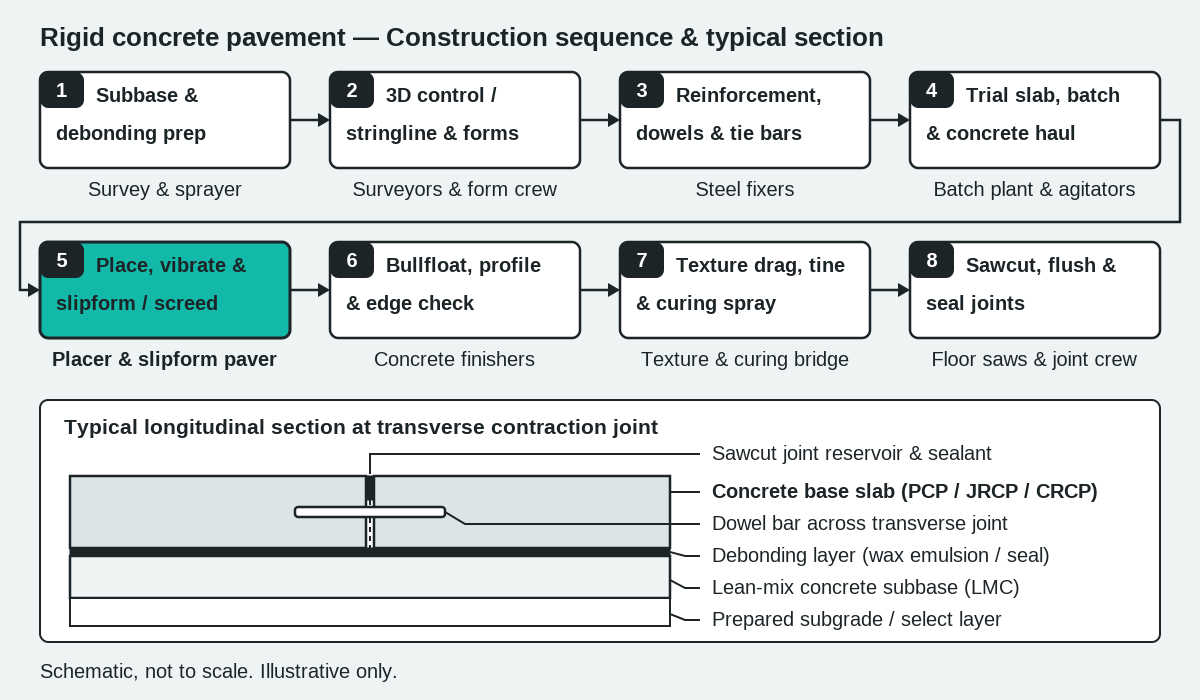
- Subbase verification and debonding preparation. The paving engineer and survey crew verify that the underlying Lean-Mix Concrete Subbase (ATS 3520, MRTS39, or R82) meets level, thickness, strength, and curing requirements, then sweep the surface clean and apply the specified wax emulsion or bituminous sprayed seal debonding layer.
- Survey set-out, stringlines or 3D control, and formwork installation. Surveyors establish alignment and finished pavement levels, erecting tensioned guide stringlines or calibrating 3D total-station/GNSS machine guidance for slipform crawler tracks, or setting, levelling, pinning, and oiling rigid side forms for fixed-form bays.
- Reinforcement, dowel bar, and tie bar installation. Steel fixers place and secure AS/NZS 4671 bar or mesh reinforcement on approved bar chairs for JRCP or CRCP, anchor pre-assembled transverse dowel cradles at surveyed joint locations (unless a mechanical dowel bar inserter is used), and check dowel alignment, debonding coating, and longitudinal tie bars before release.
- Trial mix and field trial pavement. Prior to mainline production, the full paving crew constructs a mandatory trial pavement section using the registered AS 1379 mix design, batch plant, haul fleet, paving train, texturing bridge, and curing rig to verify compaction, edge stability, dowel position, surface texture, and sawcutting compliance.
- Batching, transport, and concrete delivery. A registered wet-mix or dry-mix batch plant produces special-class pavement concrete and dispatches it in agitator trucks or rear-tipping haul trucks, with QA technicians checking delivery docket times, concrete temperature, and slump at the discharge point.
- Concrete placement, internal compaction, and forming. Concrete is discharged evenly ahead of the slipform paver (via a placer/spreader, side-feeder, or direct tipping) where the auger distributes the head and internal hydraulic poker vibrators compact the mix under the conforming extrusion plate, or between fixed side forms where vibrator hands use immersion pokers around edges and dowels ahead of a vibrating truss or roller screed.
- Surface floating and edge or profile checking. Behind the slipform oscillating beam and super-smoother—or behind the fixed-form screed—concrete finishers work the plastic surface with long-handled bullfloats and checking straightedges to close surface voids, correct minor profile deviations, and verify slab edge verticality without adding water.
- Surface texturing. As the surface water sheen dissipates, operators impart the specified microtexture and macrotexture under ATS 3530, MRTS40, R83, or DTP Section 503 using a longitudinal hessian or artificial turf drag followed by transverse or longitudinal tining from a self-propelled texturing bridge or hand rake.
- Curing compound application. Immediately after texturing, the curing operator applies a uniform, continuous membrane of AS 3799 liquid curing compound (such as wax emulsion or hydrocarbon resin) through hooded spray nozzles across the top surface and exposed slipformed slab edges, checking the sprayed application rate in litres per square metre.
- Sawcutting, joint cleaning, and joint sealing. Once the concrete reaches the sawcutting hardness window, saw operators cut transverse contraction and longitudinal weakened-plane joints with diamond-blade floor saws to specified depth, flush out slurry, allow the joint reservoir to dry, and install backer rods with preformed compression seals or liquid silicone/elastomeric sealants (AGPT04C, DTP Section 703).
Typical crew and plant
| Role or machine | What it does | Notes |
|---|---|---|
| Mobile wet-mix or dry-mix batching plant | Batches special-class pavement concrete to AS 1379 tolerances with consistent moisture and temperature control | Often dedicated on-site for slipform highway projects; fitted with chilled water or ice dosing for hot-weather paving |
| Concrete agitator trucks or rear-tipping haul trucks | Transports fresh concrete from the batch plant to the paving front | Fleet size matched to batch plant output and haul cycle time; tippers used only where permitted for low-slump slipform mixes |
| Placer/spreader or belt side-feeder | Receives concrete from haul trucks on the adjacent shoulder and distributes it evenly ahead of the slipform paver | Required on CRCP or dowelled lanes where haul trucks cannot drive directly over reinforcement and dowel cradles on the subbase |
| Track-mounted slipform paver | Spreads, internally vibrates, extrudes, and screed-finishes low-slump concrete in a continuous pass without fixed rails | Guided by tensioned stringlines or 3D total-station/GNSS control; may include mechanical dowel bar and tie bar inserters |
| Self-propelled texturing and curing bridge | Applies hessian/turf drag, transverse or longitudinal tining, and hooded mechanical spray of AS 3799 curing compound | Spans the full slab width immediately behind the finishing crew; carries rain protection covers and hessian rolls |
| Fixed side forms, immersion pokers, and vibrating truss or roller screed | Forms slab edges, compacts plastic concrete around dowels and corners, and strikes off the surface in fixed-form bays | Used for irregular tapers, intersections, bridge approaches, and infill slabs; standby immersion vibrators kept on site |
| Diamond-blade concrete floor saws and slurry vacuum unit | Cuts transverse contraction and longitudinal joints within the hydration window and extracts sawcut slurry | Multiple saws plus standby backup saws and lighting towers required on site to prevent uncontrolled early-age cracking |
| Paving superintendent, engineer, QA technician, and survey party | Controls lot sign-off, stringline/3D guidance calibration, slump/temperature sampling, and trial pavement compliance | In NSW under TfNSW R83, designated concrete paving personnel require Concrete Grey Card (CGC-RP) qualification |
| Ahead-of-paver steel/dowel crew and paver operations crew | Fixes reinforcement, dowel cradles, and tie bars; operates paver and placer; monitors concrete head and guidance sensors | Typically comprises steel fixers, paver and spreader operators, 2 wingmen/sensor hands, and 1 truck spotter |
| Concrete finishers and staggered-shift sawcutting/jointing crew | Bullfloats, straightedge-checks, edges, and repairs plastic slab defects; executes post-set sawcutting and joint sealing | Typically 4 to 6 finishers behind a slipform paver (3 to 5 in fixed-form) and 2 to 4 saw operators on a lagged shift |
Productivity drivers
- Batch plant supply continuity and truck cycle logistics. Effective slipform output is normally governed by sustainable batching and haulage delivery rate (m³/hr) rather than the mechanical speed of the paver; any break in concrete delivery forces the paver to stop, risking a hesitation bump or an unplanned transverse construction joint header.
- Slab thickness and paving width. Because volumetric delivery (m³/hr) is usually the bottleneck, increasing slab depth or paving multiple lanes simultaneously increases concrete volume per linear metre (m³/lin.m) and reduces linear advance rate (lin.m/shift) for the same volumetric throughput.
- Pavement configuration and reinforcement complexity. Plain Concrete Pavement (PCP) allows rapid setup where trucks can access the subbase or adjacent shoulder, whereas Continuously Reinforced Concrete Pavement (CRCP) requires heavy ahead-of-paver steel fixing (AS/NZS 4671) and side-feeder placement around continuous reinforcement.
- Lot length, geometry, and setup/clean-down overhead. Every slipform run requires stringline or 3D verification, start-up calibration, end-of-shift header installation, and machine washout, so short runs fragmented by bridges, staging, or intersections cut productive paving hours per shift.
- Fixed-form side rail inventory and stripping time. In fixed-form paving, daily output is capped by the linear metres of steel road forms held on site and the mandatory curing time before forms can be stripped and leapfrogged to the next bay.
- Ambient weather window and sawcutting capacity. High daytime temperatures or dry winds shorten allowable placement shifts and compress the post-pour sawcutting window, frequently moving mainline slipform pours onto night shifts during summer.
Published references
Only figures that come from a source are listed. Everything else is a driver, not a number.
| Reference | Figure and basis | Status |
|---|---|---|
| Opened primary sources (Austroads AGPT02, AGPT04C, ATS 3520, ATS 3530; TMR MRTS39, MRTS40; TfNSW R82, R83; DTP Section 503; DIT RD-PV-D3; Standards Australia AS 1379, AS 3799, AS 1012 series) | None found. The primary road authority specifications and Australian Standards opened during this research set technical compliance, material properties, and acceptance tolerances rather than contractor production rates; estimate output from batch-plant and haulage cycle modelling using the drivers above. | No figure found (negative finding, not a document) |
Quality and hold points
- Constituent materials and mix design hold point. Submission of NATA-accredited laboratory trial mix results, aggregate source rock properties (AS 2758.1), alkali-silica reaction assessments, cement compliance (AS 3972), admixtures (AS 1478.1), drying shrinkage (AS 1012.13), and state mix registration for target flexural or compressive strength prior to batching.
- Subbase and debonding layer hold point. Survey level check, surface crack inspection, and verification of uniform wax emulsion or bituminous debonding seal over the Lean-Mix Concrete Subbase (ATS 3520, MRTS39, or R82) before base preparation begins.
- Pre-pour setup hold point (forms, dowels, and reinforcement). Pre-pour inspection confirming stringline or side-form levels, slab depth, ACRS steel certification (AS/NZS 4671), rigid fixing of dowel cradles, horizontal and vertical dowel alignment tolerances, and dowel debonding coatings prior to concrete discharge.
- Trial pavement lot hold point. Mandatory completion, testing, and superintendent release of a full-scale trial pavement section demonstrating batching consistency, edge stability, core compaction, dowel/tie bar placement, surface texture depth, and sawcutting before mainline paving starts.
- Fresh concrete point-of-discharge testing. Ongoing QA sampling during placement under AS 1012.1 and AS 1012.3.1 for slump, delivery temperature, air content (where specified), batch-to-discharge elapsed time, and moulding of compressive or flexural test specimens (AS 1012.8, AS 1012.9, AS 1012.11).
- Surface texture depth and curing coverage verification. Post-finishing checks confirming uniform AS 3799 curing compound application rate (L/m²) and sand patch macrotexture depth (such as VicRoads RC 317.01 or state equivalent).
- Hardened concrete thickness, compaction, and ride quality acceptance. Lot testing of hardened cores (AS 1012.14) for in-situ thickness and voids, straightedge surface deviations, laser profilometer roughness (IRI), and crack mapping before opening to traffic or applying payment adjustment factors under MRTS40/MRS40 or TfNSW R83.
Risks and controls
- Uncontrolled early-age transverse or longitudinal cracking. Caused by late sawcutting, shallow sawcut depth, locked or misaligned dowel bars, or failed subbase debonding; controlled by monitoring slab hydration hardness, keeping backup diamond saws on site, checking dowel alignment and bond-breaker pre-pour, and verifying exact sawcut depth.
- Plastic shrinkage surface cracking. Caused by rapid evaporation of bleed water in hot, dry, or windy weather or delayed curing spray; controlled by continuous evaporation monitoring, aliphatic alcohol misting where required during finishing, keeping the mechanical AS 3799 spray bridge close behind texturing, and halting pours when weather limits are breached.
- Slab edge slump during slipform paving. Caused by wet or inconsistent concrete slump, excessive vibration near side plates, or excessive paver travel speed; controlled by strict batch plant moisture control, slump testing (AS 1012.3.1) on initial loads, vibrator tuning, and holding timber or steel header boards on standby for local edge support.
- Honeycombing, internal voids, or poor compaction. Caused by failed internal poker vibrators hidden inside the concrete head on the slipform paver or missed manual vibration around dowel cradles; controlled by cab-mounted vibrator frequency monitors, pre-start vibrator checks each shift, and systematic manual vibration around dowels and form edges.
- Dowel bar misalignment or displacement. Caused by weak cradle pins on the subbase, uncontrolled concrete dumping directly onto cradles, or uncalibrated mechanical dowel bar inserters (DBI); controlled by rigid pinning into the LMC subbase, controlled discharge via a placer/spreader, and wet-probing, GPR, or coring verification during the trial pavement.
- Rain damage to fresh unhardened concrete. Caused by unforecast rain washing cement paste from freshly textured concrete and ruining skid resistance; controlled by continuous weather radar monitoring and carrying enough polyethylene or hessian rain protection frames on the paving train to cover the full shift run.
Programming and weather
- Subgrade and Lean-Mix Concrete Subbase predecessors. Mainline base paving cannot start until earthworks subgrade sign-off, subsurface edge drain installation, placement and minimum strength/age curing of the Lean-Mix Concrete Subbase (ATS 3520, MRTS39, R82), and application of the debonding layer are complete.
- Critical-path trial mix and trial pavement lead time. Laboratory mix design registration, mobile batch plant commissioning, and construction, curing, coring, and formal sign-off of the mandatory trial pavement lot must be programmed well ahead of mainline paving start dates.
- Internal paving train staging logic. Survey and stringlines lead dowel cradle and reinforcement fixing by one to two shifts ahead of the paver, followed immediately by concrete placement, texturing, and curing spray, then initial sawcutting at the time the mix and specification allow (MRTS40 requires a minimum 7-day cure and joints cut in a timely manner), followed by curing, joint cleaning/sealing, and shoulder construction.
- Post-pour curing and trafficking restraints. Construction haul vehicles and general traffic are barred from running on the new slab until mandatory curing periods and target compressive or flexural cylinder/beam strengths are achieved under ATS 3530, MRTS40, or R83.
- Hot and windy weather sensitivity. High ambient temperatures and dry winds accelerate hydration, cause transit slump loss, raise plastic shrinkage risk, and create steep thermal gradients that induce slab curling; specifications cap fresh concrete and ambient placement temperatures, often forcing summer mainline pours onto night shifts.
- Cold weather hydration delays. Low ambient temperatures slow cement hydration, pushing back the initial sawcutting window and extending the curing duration needed before forms can be stripped or slabs opened to site traffic.
- Wet weather stoppages. Concrete placement cannot proceed in rain; programming must allow weather contingency days and protect freshly laid slabs with mobile rain covers to avoid diamond grinding, grooving, or full-depth slab replacement.
Estimating considerations
- Measurement units across schedules (MRS39 and MRS40). Lean-Mix Concrete Subbase and Concrete Pavement Base are typically measured by area in square metres (m²) per nominal thickness profile or by theoretical volume in cubic metres (m³), with debonding layers measured in square metres (m²).
- Ancillary schedule items (trial slabs, joints, and reinforcement). Trial pavement sections are normally measured as a separate Lump Sum Item or in square metres (m²); transverse and longitudinal joints are either deemed included in the base rate or billed in linear metres (lin.m); and AS/NZS 4671 steel reinforcement is either included for PCP dowels/ties or measured separately in tonnes (t) or square metres (m²) on JRCP and CRCP jobs.
- Concrete volumetric overrun and wastage allowance. Because subbases are trimmed toward the low tolerance limit so the upper base slab achieves minimum specified thickness everywhere, estimators must allow for concrete yield overrun above theoretical design depth, plus slipform edge batter waste, placer priming waste, and washout waste.
- Full-scale trial mix and trial slab costs. Estimates must include NATA laboratory trial mixes, full-scale trial pavement placement, core drilling, texture and dowel testing, and demolition and disposal costs if the trial slab is built off-alignment or rejected.
- On-site mobile batch plant versus commercial supply. Commercial ready-mix plants rarely supply the uninterrupted hourly volume needed by a slipform paver without dedicated plant lock-out charges; estimators must compare mobilising, permitting, establishing, and decommissioning a dedicated on-site batch plant against commercial supply premiums.
- Split-shift sawcutting and night-shift labour penalties. Because the sawcutting window opens hours after concrete placement, saw crews routinely work late into the night after a day pour (or through the morning after a night pour), requiring allowances for overtime, shift penalties, lighting towers, and standby wet-weather crews.
- Placer/spreader and craneage requirements on reinforced slabs. On CRCP or pre-fixed dowel cradle runs where trucks cannot back down the paving lane, estimators must allow for a dedicated placer/spreader or side-feeder and shoulder haul access maintenance.
- Ride quality and thickness compliance risk. State specifications (including MRTS40/MRS40 and TfNSW R83) apply payment deductions or mandate corrective diamond grinding and slab replacement at the contractor's expense if roughness (IRI) or core thickness tolerances are missed.
Specifications and standards
Checked 11 November 2026. Each document was looked up in catalogue and regulator listings; many agency PDFs could not be opened in full. Rows marked Confirmed were found to exist as described. Rows marked Not verified were not found or not checked. Clause-level statements, tolerances, temperatures, distances and similar figures in the text are typical values and are unverified unless a row cites the rule. Confirm the current edition of any document before relying on it.
| Document | What it covers for this method | Status |
|---|---|---|
| Austroads AGPT02 – Guide to Pavement Technology Part 2: Pavement Structural Design | Mechanistic-empirical structural thickness design for PCP, JRCP, CRCP, and SFCP rigid concrete pavements | Confirmed |
| Austroads AGPT04C – Guide to Pavement Technology Part 4C: Materials for Concrete Road Pavements | Properties and selection of base concrete, lean-mix concrete subbase, curing compounds, steel reinforcement, and joint sealants/fillers | Confirmed |
| Austroads ATS 3520 – Lean-Mix Concrete Subbase | National harmonised technical specification for constructing Lean-Mix Concrete (LMC/LCS) subbases under rigid pavements | Confirmed |
| Austroads ATS 3530 – Concrete Pavement Base | National harmonised technical specification for batching, placing, finishing, texturing, curing, and jointing PCP, JRCP, CRCP, and SFCP bases | Confirmed |
| TMR MRTS39 / MRS39 – Lean-mix Concrete Subbase (QLD) | Queensland specification and measurement standard for lean-mix concrete subbase construction (harmonised with ATS 3520) | Confirmed |
| TMR MRTS40 / MRS40 – Concrete Pavement Base & MRTS41 / MRTS42 / MRTS70 (QLD) | Queensland specifications and measurement standards for concrete pavement base (MRTS40/MRS40), ancillary concrete pavements (MRTS41), wax emulsion curing compound (MRTS42), and constituent concrete materials (MRTS70) | Confirmed |
| TfNSW R82 (TS 03270) – Lean-Mix Concrete Subbase & R83 (TS 03271) – Concrete Pavement Base (NSW) | New South Wales specifications for lean-mix subbase and plain, jointed, steel-fibre, and continuously reinforced concrete pavement bases (incorporating former R84) | Confirmed |
| DTP Victoria Section 503 – Concrete Base and Lean Mix Concrete Subbase, Section 703 & RC 317.01 (VIC) | Victorian specification for concrete base and lean-mix subbase (consolidating legacy Sections 501–503), joint sealants (Section 703), and sand patch surface texture depth testing (RC 317.01) | Confirmed (Section 703 is General Concrete Paving; joint-sealant scope not shown) |
| DIT South Australia RD-PV-D1 & RD-PV-D3 – Concrete Road Pavements (SA) | South Australian master specifications for pavement investigation/design (RD-PV-D1) and rigid concrete road pavement construction (RD-PV-D3) | Confirmed |
| MRWA Specification 501 – Pavements (WA) & MRWA rigid concrete pavement specifications | MRWA Specification 501 confirmed to cover unbound and modified granular pavements rather than rigid concrete; specific MRWA rigid concrete pavement document numbers were not verified in opened sources | Not verified |
| AS 1379, AS 3600 & AS 3727.1 | Specification and supply of concrete (AS 1379), concrete structures (AS 3600), and guide to residential pavements outside highway road base scope (AS 3727.1) | Not verified |
| AS 3799, AS 3972, AS 1478.1, AS 2758.1 & AS/NZS 4671 | Liquid membrane-forming curing compounds (AS 3799), general purpose and blended cements (AS 3972), chemical admixtures (AS 1478.1), concrete aggregates (AS 2758.1), and concrete reinforcing steel (AS/NZS 4671) | Not verified |
| AS 1012 Series (AS 1012.1, 1012.3.1, 1012.8, 1012.9, 1012.10, 1012.11, 1012.13, 1012.14) | Australian Standard test methods for concrete sampling, slump, specimen moulding/curing, compressive, indirect tensile, and flexural strength, drying shrinkage, and hardened core testing | Not verified |
Only documents confirmed to exist carry the status Confirmed. Check the current edition before relying on any document.
Sources and review
| Source | Used for | Status |
|---|---|---|
| Austroads – AGPT02: Guide to Pavement Technology Part 2: Pavement Structural Design (https://austroads.gov.au) | Mechanistic-empirical design principles and rigid pavement configuration definitions (PCP, JRCP, CRCP, SFCP) | Confirmed |
| Austroads – AGPT04C: Guide to Pavement Technology Part 4C: Materials for Concrete Road Pavements (https://austroads.gov.au) | Base concrete, lean-mix subbase materials, curing compounds, reinforcement, and joint sealant requirements | Confirmed |
| Austroads – ATS 3520: Lean-Mix Concrete Subbase & ATS 3530: Concrete Pavement Base (https://austroads.gov.au) | National harmonised construction sequence, trial pavement requirements, texturing, curing, jointing, and QA hold points | Confirmed |
| Department of Transport and Main Roads (TMR QLD) – MRTS39/MRS39, MRTS40/MRS40, MRTS41, MRTS42, MRTS70 (https://www.tmr.qld.gov.au) | Queensland concrete pavement base and subbase technical specifications, wax emulsion curing, and measurement units | Confirmed |
| Transport for NSW (TfNSW) – R82 (TS 03270) Lean-Mix Concrete Subbase & R83 (TS 03271) Concrete Pavement Base (https://www.transport.nsw.gov.au) | NSW slipform and fixed-form concrete base requirements, debonding treatments, personnel qualification (CGC-RP), and QA testing | Confirmed |
| Department of Transport and Planning (DTP Victoria / VicRoads) – Section 503, Section 703 & RC 317.01 (https://www.vic.gov.au) | Victorian concrete base and lean-mix subbase specification, joint sealants, and sand patch texture depth test method | Confirmed (Section 703 is General Concrete Paving; joint-sealant scope not shown) |
| Department for Infrastructure and Transport (DIT SA) – Master Specification RD-PV-D1 & RD-PV-D3 (https://www.dit.sa.gov.au) | South Australian concrete road pavement design and construction specification references | Confirmed |
| Main Roads Western Australia (MRWA) – Specification 501: Pavements (https://www.mainroads.wa.gov.au) | Scope boundary verification confirming Specification 501 covers granular pavements rather than rigid concrete | Not verified |
| Standards Australia – AS 1379, AS 3600, AS 3727.1, AS 3799, AS 3972, AS 1478.1, AS 2758.1, AS/NZS 4671, AS 1012 series (https://www.standards.org.au) | Australian Standards for concrete supply, curing compounds, cements, admixtures, aggregates, reinforcing steel, and fresh/hardened concrete testing | Not verified |
Items marked Not verified have not been checked against a primary source. Research notes.
Library navigation
Plant and method index · Discipline work packages · Survey conformance and lot release