Construction methods / Pavements
Road rehabilitation and reconstruction
Road rehabilitation and reconstruction restore the structural load-carrying capacity, surface geometry, skid resistance, and ride quality of distressed flexible and bound pavements through cold milling, insitu stabilisation, boxed-out base replacement, and asphalt overlays. Cost and programme duration are driven by shift-by-shift traffic staging, effective night-work occupancy windows, tipper haul cycle balance, binder working and curing times, and tie-in constraints along live carriageways.
- Enclosed milling rotorThe 2.01 m rotor cuts beneath this side plate. Pass depth and effective width determine the volume removed.
- Front discharge conveyorThe primary belt feeds the folding discharge conveyor. It loads reclaimed asphalt into the truck ahead.
- Crawler unitsThe near-side pair is visible here. Four steerable crawler units support the chassis and position the machine between passes.
Overview
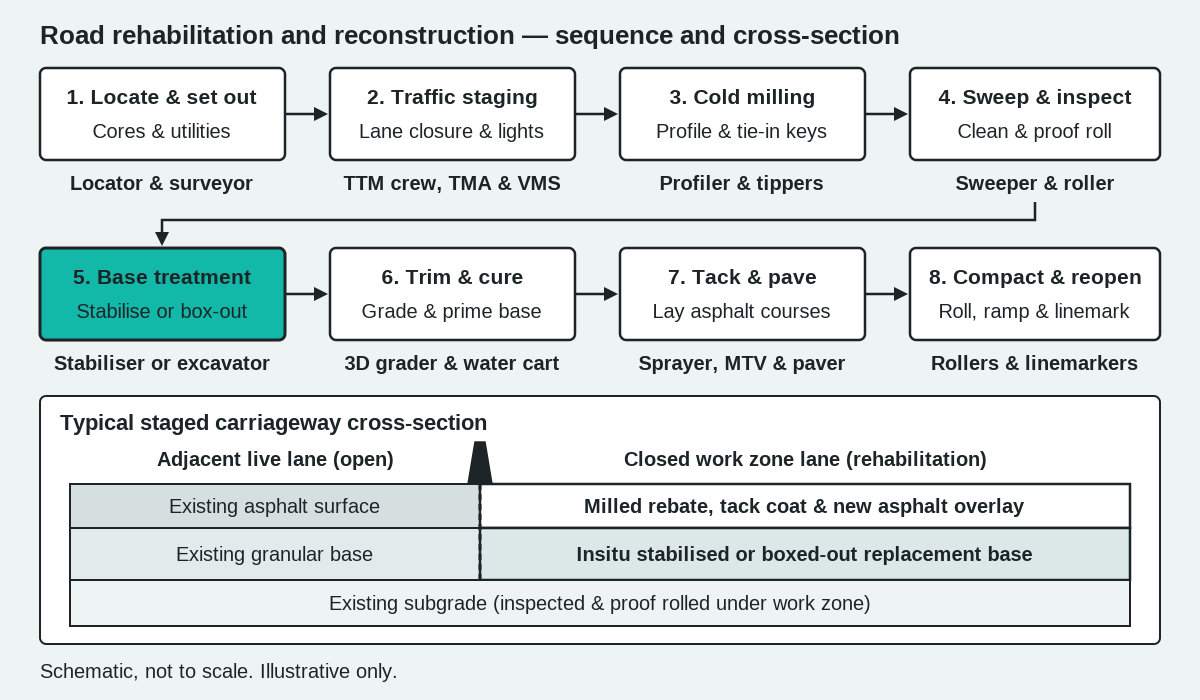
Road rehabilitation and reconstruction renew distressed flexible and bound road pavements to restore ride quality, skid resistance, surface geometry, and structural load-carrying capacity. Across Australian state road authority and local government networks, treatments range from cold milling and asphalt resheeting (mill and fill) to insitu pavement stabilisation, boxed-out granular or heavily bound base replacement, and structural asphalt overlays. Unlike greenfield road construction, rehabilitation works take place within live road corridors constrained by existing surface geometry, underground utilities, subsurface drainage, and active public traffic. Works are frequently delivered under staged traffic management or tight night-shift road occupancy windows. This requires close coordination between profiling crews, stabilisation or granular placement teams, asphalt paving gangs, and traffic control personnel so the carriageway can be safely reopened at the end of each shift. Estimators and planners must account for shift-by-shift traffic staging, tie-in constraints at side roads and bridges, binder curing periods, and night-work gang penalties.
Where the method applies
- Surface and upper-layer asphalt distress (mill and fill): Sealed pavements exhibiting surface oxidation, stripping, top-down cracking, or rutting and shoving confined to the upper or intermediate asphalt layers where the underlying base and subgrade retain adequate structural capacity.
- Level-constrained urban corridors: Carriageways where bridge vertical clearances, kerb and channel heights, overhead structures, or safety barrier profiles prevent raising the finished pavement surface level with a direct overlay.
- Fatigued or moisture-affected granular bases (insitu stabilisation): Existing unbound granular or lightly bound pavement courses that have lost stiffness or suffered moisture ingress, provided the existing aggregate skeleton is suitable for recycling in place with lime, cement, or slow-setting cementitious blends.
- Deep structural and subgrade failures (boxed-out base replacement): Localised heavy patching or full-lane reconstruction where contaminated granular layers, failed heavily bound layers, or severe subgrade deformation require excavation and replacement with new unbound or plant-mixed bound courses.
- Structural strengthening for increased freight loading: Structural asphalt overlays and heavy-duty intermediate courses designed under Austroads mechanistic-empirical procedures to meet increased design traffic loading.
- High-volume arterials and motorways under staged night closures: Live urban corridors and freight routes where daytime lane closures exceed acceptable traffic delay thresholds under road authority Road Occupancy Licences (ROLs) and Traffic Management Plans (TMPs).
This method does not suit pavements with superficial surface defects only—such as minor age-hardening, aggregate loss, or fine surface cracking without loss of shape—where routine crack sealing or a sprayed bituminous reseal (Austroads Guide to Pavement Technology Part 7) is the appropriate treatment. Milling or shallow stabilisation also will not succeed where untreated subsurface moisture or drainage failures remain unaddressed (requiring subsurface drainage works under Austroads Guide to Pavement Technology Part 10), where shallow utilities or oversize rock prevent insitu mixing, or on full-depth rigid concrete slab replacements governed by dedicated rigid pavement specifications.
Sequence of work
- Pre-start investigation, service locating, and survey set-out. Review pavement coring logs, Falling Weight Deflectometer (FWD) or Deflectograph data, and existing layer depths. Complete non-destructive utility locating and potholing to verify cover over underground assets prior to deep milling or mixing, and establish stringline or 3D machine control survey marks for patch limits, lane drops, and tie-in tapers.
- Traffic staging and work zone establishment. Accredited traffic controllers and the Temporary Traffic Management (TTM) implementer deploy advance warning signage, Variable Message Signs (VMS), cones, bollards, mobile lighting towers for night works, temporary safety barriers, and Truck-Mounted Attenuators (TMAs) in accordance with AS 1742.3 and the Austroads Guide to Temporary Traffic Management (AGTTM) before closing the lane.
- Cold milling and profiling of existing pavement. Half-lane or full-lane cold-milling machines (profilers) and compact skid-steer profilers around ironwork remove distressed asphalt or granular layers to the design depth and crossfall (such as under the relevant road authority specification). The crew mills transverse and longitudinal tie-in rebates at the work limits and side streets, loading Reclaimed Asphalt Pavement (RAP) directly into tippers while checking milled depth and pick wear.
- Sweeping, inspection, and substrate assessment. Road sweepers and vacuum trucks clean loose fines and millings from the profiled floor. The supervisor and superintendent inspect the exposed substrate and conduct proof rolling to verify there are no soft spots, pumping subgrades, or delaminated layers before overlying work proceeds.
- Base replacement (box-out) or insitu stabilisation. For boxed-out reconstruction, an excavator removes failed pavement to subgrade level, and the crew trims, compacts (testing to AS 1289), and places new unbound granular (TMR MRTS05 / TfNSW R71) or plant-mixed heavily bound material (TMR MRTS08 / TfNSW R73) in compliant lifts. For insitu stabilisation (TMR MRTS07A / MRTS07B / TfNSW R75), a calibrated spreader applies lime or slow-setting cementitious binder, a road reclaimer/stabiliser mixes the pavement with controlled water injection, and padfoot, smooth-drum, and multi-tyred rollers compact the layer within the binder working time.
- Final trimming, curing, and surface preparation. A grader equipped with 3D machine control or working to stringline trims the stabilised or unbound base course to level and surface deviation tolerances. Water curing, curing membrane, or a bituminous primer/prime-seal is applied, and compaction and surface tolerances are checked before asphalt overlay.
- Tack coating and structural or corrective asphalt laying. After sweeping the prepared base or milled floor dry and clean, an emulsion sprayer applies a uniform bituminous tack coat across the floor and vertical milled edges. A self-propelled asphalt paver—often fed by a Material Transfer Vehicle (MTV) to prevent thermal and material segregation—places the corrective or heavy-duty intermediate asphalt layer (TMR MRTS30 / TfNSW R116) while screed hands verify mat depth and temperature.
- Compaction of asphalt layers. Dual-drum vibratory or oscillatory steel rollers and pneumatic multi-tyred rollers compact the asphalt mat immediately behind the screed through breakdown, intermediate, and finish rolling phases to achieve specified insitu air voids and joint density.
- Tie-ins, ramping, and shift handover (night works). Rake hands and roller operators construct longitudinal joints against adjacent live lanes and step or feather transverse tie-ins. Where full design thickness cannot be completed in one night shift, the crew constructs temporary asphalt ramps at the specified taper gradient, confirms the mat has cooled to trafficable temperature, applies temporary linemarking, and reopens the carriageway before the Road Occupancy Licence cut-off time.
- Wearing course placement, linemarking, and reinstatement. On subsequent shifts, temporary ramps are milled out, the final wearing course asphalt is placed and compacted, utility pits and valve lids are adjusted to finished surface level, detector loops are reinstated, and permanent pavement markings and raised reflective pavement markers (RRPMs) are installed prior to demobilising traffic control.
Typical crew and plant
| Role or machine | What it does | Notes |
|---|---|---|
| Traffic management crew, TMAs, VMS, and mobile lighting towers | Establishes and maintains lane closures, speed reductions, buffer zones, and work-zone illumination for night shifts | Governed by AS 1742.3 and AGTTM; supervised by an accredited TTM Implementer or Traffic Management Supervisor |
| Cold planer / profiler, skid-steer profiler, and road sweeper / vacuum truck | Profiles existing asphalt or bound layers to design depth, cuts transverse/longitudinal rebates and around service pits, and cleans the milled floor | Operated by profiler operator, level hand, skid-steer operator, and sweeper operator; aligned with TfNSW R101 scope |
| Calibrated binder spreader and road reclaimer / insitu stabiliser | Spreads lime or slow-setting cementitious binder at controlled mass per unit area and pulverises/mixes the existing pavement with water injection | Used on insitu stabilisation shifts (TMR MRTS07A / MRTS07B / TfNSW R75) alongside coupled water carts |
| Hydraulic excavator, final-trim grader, and water cart | Excavates boxed-out pavement failures, trims subgrades and unbound/stabilised bases to 3D machine control or stringline tolerances, and conditions moisture | Zero-swing excavators are frequently used where adjacent lanes carry live traffic |
| Tack coat sprayer, Material Transfer Vehicle (MTV), and asphalt paver | Applies bituminous tack coat to floors and vertical edges, remixes delivered asphalt to prevent thermal segregation, and lays asphalt to level and crossfall | Operated by asphalt foreman, paver operator, two screed hands, MTV operator, and rake/lute hands (TMR MRTS30 / TfNSW R116 / AS 2150) |
| Compaction fleet (padfoot, dual-drum steel vibratory/oscillatory, pneumatic multi-tyred rollers) and tipper fleet | Compacts subgrade, granular, stabilised, and hot mix asphalt courses to target density/air voids; bogie tippers or insulated truck-and-dogs haul RAP and new materials | Tipper numbers depend on haul distance, quarry or asphalt plant dispatch rate, and shift working window |
Productivity drivers
- Effective shift working window (night works vs day works). Under urban night-work Road Occupancy Licences, nominal shift duration is reduced by TTM setup at shift start, profiling, sweeping, paving, mat cooling time, temporary ramping, and TTM pack-up before morning curfew. Losing effective paving time directly reduces shift output.
- Milling depth, material hardness, and ironwork density. Profiler advance speed varies with milling depth, asphalt stiffness or cement-treated base strength, frequency of tungsten carbide pick changes, and the density of utility pits, manholes, and bridge expansion joints requiring slow cutting or skid-steer trimming.
- Tipper haul cycle balance. Both cold milling and asphalt paving are continuous operations that stall if truck exchange is interrupted; insufficient tippers leave the profiler or paver idling, while truck bunching risks asphalt cooling and segregation where no MTV is used.
- Binder working time and lift thickness in stabilisation. For insitu stabilisation and plant-mixed heavily bound bases (TMR MRTS07B, MRTS08, TfNSW R73, R75), spreading, mixing, compaction, and final trimming must all finish within the specified binder working window before initial set.
- Mat cooling time and multi-layer lift limits. Deep structural asphalt patches and overlays must be placed in discrete lifts so each course can be compacted to target air voids and cool sufficiently before placing the next lift or reopening the lane to traffic.
- Staging geometry and longitudinal joint frequency. Short patch lengths, narrow lane widths, multiple turn pockets, and frequent side-road tie-ins increase non-productive plant repositioning compared with continuous highway lane runs.
Published references
Only figures that come from a source are listed. Everything else is a driver, not a number.
| Reference | Figure and basis | Status |
|---|---|---|
| No published numerical productivity figures found in opened primary sources | No numerical production rates (such as tonnes per hour or square metres per shift) were verified from opened public specification listings; shift output must be built up from the operational drivers above. | No figure found (negative finding, not a document) |
| Austroads AGPT08: Guide to Pavement Technology Part 8: Pavement Construction (austroads.gov.au) | Defines national construction planning, layer placement, and compaction frameworks for unbound, stabilised, and asphalt pavements (no numerical productivity rates extracted from public index). | Not verified |
| TfNSW QA Specifications R101, R75, and R116 (transport.nsw.gov.au) | Establishes mandatory binder working time limits, milling tolerance controls, and paving temperature/MTV constraints that bound shift output (no numerical productivity figures in public index). | Confirmed |
| TMR Technical Specifications MRTS07B and MRTS30 (tmr.qld.gov.au) & AS 2150 (standards.org.au) | Governs insitu stabilisation mixing/compaction windows and hot mix asphalt transport, layer thickness, and roller train management (no numerical productivity figures in public summaries). | Confirmed |
Quality and hold points
- Mix design registration and material source approval (Hold Point): Submission and Superintendent/Principal release of asphalt mix designs (TMR MRTS30 / TfNSW R116), unbound granular quarry source approvals (TMR MRTS05 / TfNSW R71), and insitu stabilisation laboratory mix designs specifying binder type and spread rate (TMR MRTS07B / TfNSW R75) prior to commencing site works.
- Pre-milling survey and utility clearance verification: Confirmation that underground services have been located and potholed so proposed milling or pulverising depths do not strike shallow conduits, bridge decks, or traffic detector loops.
- Inspection and proof rolling of milled floor or exposed subgrade (Hold Point / Witness Point): Visual inspection and proof rolling of the profiled floor or boxed-out subgrade before placing overlying courses to confirm the absence of delaminated layers, weak lenses, or subgrade pumping.
- Binder spread rate and mixing depth verification (insitu stabilisation): Tray testing or mass-per-unit-area checks during lime or cementitious binder spreading (TMR MRTS07A / MRTS07B / TfNSW R75) together with physical depth checks behind the reclaimer rotor.
- Compaction, moisture, and insitu air voids testing: Insitu density and moisture testing to AS 1289 for earthworks, unbound granular courses, and stabilised layers, and core density / insitu air voids testing for compacted asphalt courses under AS 2150, TMR MRTS30, and TfNSW R116.
- Geometric, surface deviation, and ride quality conformance: Survey verification of finished layer levels, crossfall, layer thickness, straightedge surface deviation across longitudinal and transverse tie-in joints, and International Roughness Index (IRI) ride quality testing.
Risks and controls
- Late reopening of live lanes on night shifts: Overrunning the Road Occupancy Licence curfew causes network congestion, lane rental or liquidated damages penalties, and potential regulator suspension of night permits. Control by enforcing strict "last load milled" and "last truck tipped" cut-off times, keeping standby backup rollers/sweepers on site, and pre-staging temporary ramping materials.
- Latent subgrade or base failure exposed after milling: A profiled floor that fails proof rolling or breaks up under construction tippers during a night shift when quarries are closed can stall reinstatement. Control by conducting pre-construction coring and FWD testing (AGPT05) and stockpiling contingency granular, cold-mix, or rapid-set patching materials for emergency night stabilisation.
- Asphalt cooling and poor compaction (high air voids): Paving in cold or windy conditions leads to high air voids, premature ravelling, moisture ingress, and specification rejection or deductions (TMR MRTS30 / TfNSW R116). Control by enforcing ambient and pavement temperature cut-offs, using insulated tipper bodies and a Material Transfer Vehicle (MTV), and keeping the roller train tight behind the screed.
- Underground utility strike during deep milling or stabilisation: Striking shallow gas, water, telecommunications, or high-voltage assets causes safety hazards, service outages, and immediate work stoppage. Control by completing non-destructive potholing across the full rotor width before deep profiling or mixing and setting physical depth stops and spotters around ironwork.
- Delamination at milled interfaces or tie-in joints: Dust, trapped moisture, or missed tack coat causes slippage cracking, shoving, or potholes along wheelpaths and transverse keys. Control by thoroughly sweeping and vacuuming the milled floor (per the project specification), verifying the surface is dry, and applying uniform tack coat across the floor and all vertical joint edges.
- Worker interaction with live traffic and reversing plant: Constrained single-lane work zones create high collision risk between ground crew, reversing tippers/rollers, and passing traffic. Control by enforcing AGTTM and AS 1742.3 buffer zones, speed reductions, and TMAs, and segregating pedestrians from mobile plant using physical barriers and proximity detection systems.
Programming and weather
- Pre-construction approvals and mix registration lead times: Laboratory mix design testing for insitu stabilisation (TMR MRTS07B / TfNSW R75), heavy-duty asphalt mix registration (TfNSW R116 / TMR MRTS30), and Road Occupancy Licence (ROL) and Traffic Management Plan (AGTTM Part 2) approvals sit on the pre-mobilisation critical path.
- Subsurface and corridor drainage precede pavement renewal: Installation or rehabilitation of subsurface pavement drains, table drains, and cross-drainage (Austroads AGPT10) must be programmed ahead of base stabilisation or asphalt resheeting so trapped moisture does not prematurely fail the new pavement.
- Closed-loop daily shift dependency (mill and fill): On live-traffic resheeting shifts, milling and asphalt paving are bound in a finish-to-finish daily shift relationship—the area profiled in a shift cannot exceed what can be swept, tack-coated, paved, compacted, cooled, and ramped before the traffic curfew expires.
- Curing and trafficking hold periods on stabilised and bound bases: Insitu stabilised and plant-mixed heavily bound courses require curing protection and may be subject to trafficking restrictions, proof rolling, or micro-cracking hold periods before overlying structural asphalt is placed.
- Wearing course sequenced after structural patching and ironwork: Final wearing course asphalt is programmed after all deep patches, intermediate lifts, and utility pit/valve lid adjustments are finished to minimise longitudinal and transverse joints and achieve continuous ride quality.
- Asphalt temperature, wind, and rain cut-offs: Hot mix asphalt placement and tack coating (TMR MRTS30, TfNSW R116, AS 2150) cannot proceed during rainfall or over wet/ponded surfaces, and are restricted by low pavement temperatures and cold winds that accelerate mat cooling on thin lifts and night shifts.
- Wind and rain limits on insitu stabilisation: Spreading dry lime or cementitious powder binders must stop during high winds to prevent fugitive dust and binder loss, and cannot occur during heavy rain which causes uncontrolled moisture spikes and premature hydration (TMR MRTS07A / MRTS07B / TfNSW R75).
- Wet weather exposure of boxed-out excavations: Open boxed-out pavement excavations and unsealed granular bases (TMR MRTS05 / TfNSW R71) are vulnerable to rain inundation, requiring programme float for dewatering, drying back, or re-working softened subgrades prior to priming or sealing.
Estimating considerations
- Traffic management and night shift setup (Shift, Day, or Item): Price traffic control crews, TGS implementation, Truck-Mounted Attenuators (TMAs), VMS boards, and night lighting towers per shift, with separate establishment and disestablishment items for temporary safety barriers.
- Cold milling and profiling take-off (m² by depth bracket or m³): Take off profiling in m² within nominated depth bands (or m³ for bulk excavation), ensuring the rate covers profiler pick wear, water cart suppression, mechanical sweeping/vacuuming, and loading/haulage of RAP.
- Tie-in rebates and transverse keys (m or m²): Measure linear metres (m) or area (m²) of tapered transverse start/finish keys and side-road interface rebates separately where they are not deemed included in the main milling item.
- Insitu pavement stabilisation (m² at specified depth plus t of binder): Measure pulverising, mixing, water addition, compaction, trimming, and curing in m² for each design depth, and take off lime or cementitious binder supply separately in tonnes (t) to isolate binder spread rate variations.
- Box-out excavation and base replacement (m³ compacted or t): Measure excavation to spoil in bank/compacted m³, and measure imported unbound granular (TMR MRTS05 / TfNSW R71) or plant-mixed heavily bound material (TMR MRTS08 / TfNSW R73) in compacted m³ or weighbridge tonnes (t).
- Asphalt courses, density conversion, and shape regulation wastage (t or m²): Take off corrective and intermediate asphalt courses in tonnes (t) and wearing courses in t or m², applying the mix-specific compacted bulk density plus a wastage and shape-regulation allowance for uneven milled substrates and edge slumping; measure tack coat and primer in m² or litres (L) of residual binder.
- Night shift, after-hours plant opening, and minimum call-out loadings: Allow for night and weekend labour penalty rates, asphalt batch plant night opening fees, quarry after-hours surcharges, and minimum hire hours for profilers and tippers on short or weather-interrupted shifts.
- RAP ownership, haulage, and temporary ramping waste: Confirm whether milled Reclaimed Asphalt Pavement (RAP) remains Principal property requiring haulage to a nominated depot (such as under the relevant road authority specification) or transfers to the Contractor, and allow for the non-recoverable material, plant, and milling cost of temporary night-shift asphalt ramps.
- Utility surface pit and detector loop adjustments (No.): Count each manhole frame, drainage grate, water valve lid (No.) requiring plating during milling and raising/lowering to finished surface level, along with traffic signal detector loop reinstatement.
Specifications and standards
Checked 11 November 2026. Each document was looked up in catalogue and regulator listings; many agency PDFs could not be opened in full. Rows marked Confirmed were found to exist as described. Rows marked Not verified were not found or not checked. Clause-level statements, tolerances, temperatures, distances and similar figures in the text are typical values and are unverified unless a row cites the rule. Confirm the current edition of any document before relying on it.
| Document | What it covers for this method | Status |
|---|---|---|
| Austroads AGPT02, AGPT05 (AGPT05-25 Ed 4.2), AGPT07, AGPT08 (AGPT08-19), and AGPT10 | Guide to Pavement Technology series covering pavement structural design (Part 2), evaluation and rehabilitation treatment design (Part 5), maintenance (Part 7), pavement construction (Part 8), and subsurface drainage (Part 10) | Confirmed |
| Austroads Guide to Temporary Traffic Management (AGTTM Parts 1–10) | National framework for temporary traffic management planning (Part 2), static worksites (Part 3), mobile works (Part 4), traffic controllers (Part 6), and sample layouts (Part 9) | Not verified |
| TMR MRTS05, MRTS07A, MRTS07B, MRTS08, and MRTS30 | Queensland TMR technical specifications for unbound pavements (MRTS05), insitu lime subgrade stabilisation (MRTS07A), insitu cementitious pavement stabilisation (MRTS07B), plant-mixed heavily bound pavements (MRTS08), and asphalt pavements (MRTS30) | Confirmed |
| TfNSW R71, R73, R75, R101, R116, and R201 | Transport for NSW QA specifications for unbound/modified courses (R71), plant-mixed heavily bound courses (R73), insitu stabilisation using slow-setting binders (R75), cold milling (R101), heavy-duty dense-graded asphalt (R116), and corridor fencing (R201) | Confirmed |
| AS 1141 (series) and AS 1289 (series) | Australian Standards for sampling and testing aggregates (AS 1141) and testing soils for engineering purposes including compaction, moisture content, and CBR (AS 1289) | Not verified |
| AS 1742.3 and AS 2150 | Australian Standards for traffic control devices for works on roads (AS 1742.3) and good practice in manufacturing, transporting, placing, and compacting hot mix asphalt (AS 2150) | Confirmed |
Only documents confirmed to exist carry the status Confirmed. Check the current edition before relying on any document.
Sources and review
| Source | Used for | Status |
|---|---|---|
| Austroads Guide to Pavement Technology (AGPT02, AGPT05-25 Ed 4.2, AGPT07, AGPT08-19, AGPT10) — austroads.gov.au | Pavement evaluation, deflection and coring diagnosis, rehabilitation treatment selection, subsurface drainage, and pavement construction practices | Confirmed |
| Austroads Guide to Temporary Traffic Management (AGTTM Parts 1–10) — austroads.gov.au | Temporary traffic management planning, static and mobile worksite controls, field staff requirements, and work zone layouts | Not verified |
| Queensland Department of Transport and Main Roads (TMR) Technical Specifications (MRTS05, MRTS07A, MRTS07B, MRTS08, MRTS30) — tmr.qld.gov.au | Specification scopes for unbound granular bases, insitu lime and cementitious stabilisation, plant-mixed bound bases, and asphalt pavements | Confirmed |
| Transport for NSW (TfNSW) QA Specifications (R71, R73, R75, R116) — transport.nsw.gov.au | Specification requirements for cold milling, insitu stabilisation with slow-setting binders, unbound/bound base construction, and heavy-duty dense-graded asphalt | Confirmed |
| Standards Australia (AS 1141, AS 1289, AS 1742.3, AS 2150) — standards.org.au | Standard references for aggregate and soil compaction testing, roadwork traffic control devices, and hot mix asphalt placement practice | Confirmed |
Items marked Not verified have not been checked against a primary source. Research notes.
Library navigation
Plant and method index · Discipline work packages · Survey conformance and lot release