Construction methods / Project controls
Traffic management and staging
Traffic management and staging keeps road users moving safely around an active worksite while giving the contractor a separated, compliant work area. Cost and time are driven by the staging strategy, the shift windows allowed by Road Occupancy Licences, temporary barrier needs, and the hours lost to setup and pack-up. Treat it as a driver of construction productivity, not only a preliminaries allowance.
- Protection vehicleInclude the setup, moves and standby for the active front.
- Traffic taperCheck the implemented layout against the approved staging plan.
- Safety barrierInspect the completed run and terminal before opening the lane.
Overview
Traffic management and staging is the temporary control, separation, redirection and phasing of road users around, through or past an active worksite. Road users include motorists, heavy vehicles, public transport, cyclists and pedestrians. Staging divides the permanent works into spatial and time phases, so the live network keeps operating while the contractor has a separated work area. Depending on corridor volume, road geometry and permit conditions, works may run under full road closures with detours, contraflow, lane shifts behind temporary safety barriers, shuttle flow under traffic controllers or portable signals, or short day and night lane occupations. It is a frontline safety control. It also sets site access, shift windows, staging geometry and plant productivity, so the staging strategy decides how much of the works footprint is available at any one time and how many mobilisation cycles each crew needs.
Where the method applies
- Brownfield road upgrades and widenings: arterial roads, motorways and rural highways where live traffic must be kept moving beside or through the construction corridor.
- Intersection upgrades and signalisation: multi-stage kerb, drainage, utility relocation and pavement tie-in works that need progressive traffic switches.
- Bridge rehabilitation and tie-ins: works on existing decks, approach slabs and abutments that need lane closures, load restrictions or night possessions.
- In-road utility and drainage installation: trenching, launch and receival pits and pit builds inside active road reserves.
- Asphalt resurfacing and pavement rehabilitation: day or night mill-and-fill, spray sealing and structural patching under short-term lane closures or shuttle flow.
- Haul route interfaces: points where heavy civil site traffic crosses or merges with public roads under a Vehicle Movement Plan.
It does not apply to wholly fenced greenfield corridors with no public road interface, where internal haul roads are managed under a site Construction Traffic Management Plan. Track protection inside a rail danger zone is governed by rail safety rules, not road traffic management standards. Permanent signs, linemarking and barriers delivered as the final asset are measured and specified under the permanent roadworks packages.
Sequence of work
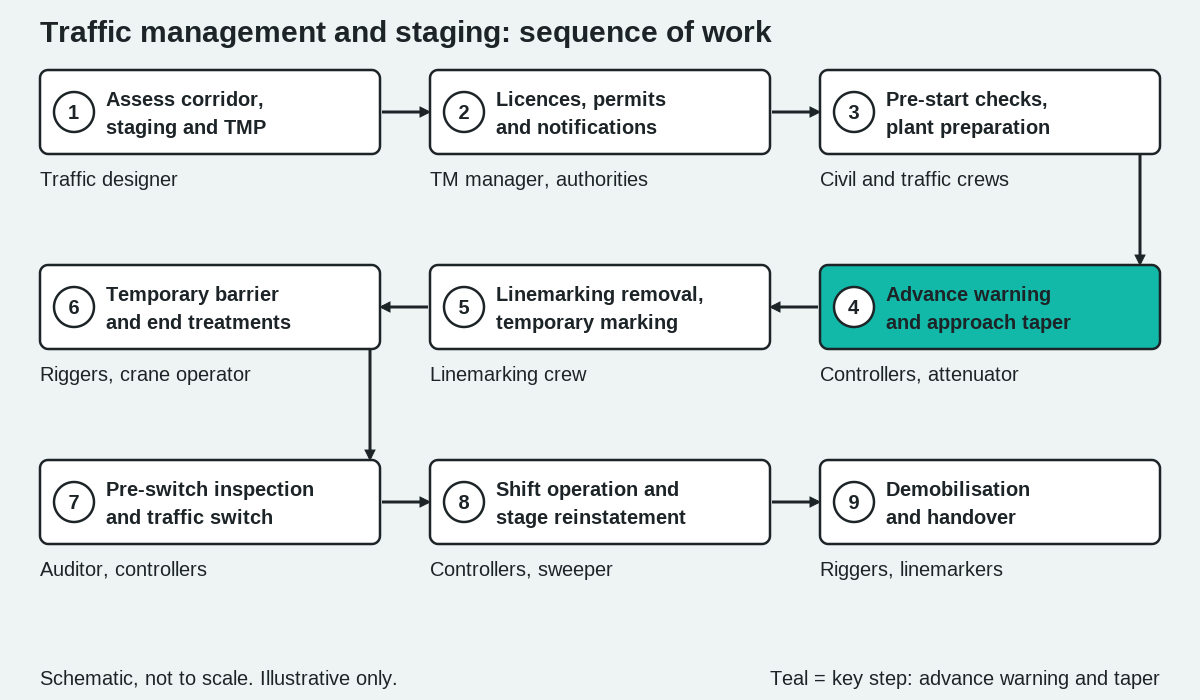
- Corridor assessment, staging strategy and TMP. Review staging drawings, traffic volumes, heavy vehicle and oversize over-mass routes, public transport and property access. Accredited designers prepare the Traffic Management Plan, stage drawings, Speed Management Plans and Traffic Guidance Schemes (formerly Traffic Control Plans).
- Licences, permits and notifications. Submit the TMP, schemes and Road Safety Audit reports to the road authority, council and transport management centre. Obtain Road Occupancy Licences, temporary speed zone authorisations and police or emergency services clearances. Variable message signs and letterbox drops or media notices go out ahead of the works.
- Pre-start verification and plant preparation. Hold a toolbox talk with the civil and traffic control crews on the shift scheme, emergency access and communications. Inspect signs, cones, bollards, arrow boards, truck mounted attenuators and portable signals before leaving the compound.
- Advance warning and approach taper. Install advance warning signs, temporary speed limits and message signs from the furthest upstream point toward the work area. Under shadow vehicle and attenuator protection where required, set tapers to close the lane and establish the buffer zone.
- Linemarking removal and temporary linemarking. For medium and long-term stage switches, remove conflicting permanent lines (waterblasting, grinding or approved masking). Install temporary markings, raised reflective pavement markers and guideposts for the switched lanes.
- Temporary safety barrier and end treatments. Where long-term work areas need positive containment, cranes or telehandlers place precast concrete, steel or water-filled barriers to AS/NZS 3845.1 and the product Technical Conditions for Use. Anchor transitions, keep the dynamic deflection width clear behind the barrier and fit crashworthy end terminals or crash cushions.
- Pre-switch inspection and traffic switch. Carry out a formal pre-opening drive-through and audit, often with the Superintendent or an independent road safety auditor for major switches. Pacing vehicles or traffic controllers move traffic onto the new alignment and gate access points are secured.
- Shift operation, monitoring and maintenance. Manage plant entry and exit at designated gates, run stop/slow control or portable signals, watch queue lengths and log signage inspections each shift. Fix displaced cones, dirty signs and failed lamps straight away.
- Stage reconfiguration or end-of-shift reinstatement. For short-term works, clear plant, sweep the surface, check pavement step levels and temporary ramps, and remove tapers and speed reductions in reverse order so lanes reopen before the licence window ends. For multi-stage works, repeat steps 5 to 7 to move traffic onto the new pavement stage.
- Demobilisation and handover. After permanent works, barriers and final linemarking are complete, remove temporary barriers, markings and signs. Complete a final post-completion Road Safety Audit and close out the Road Occupancy Licence.
Typical crew and plant
| Role or machine | What it does | Notes |
|---|---|---|
| Traffic management designer / Roadworks Traffic Manager | Prepares and certifies the TMP and schemes and reviews high-risk staging changes. | Planning role, ahead of mobilisation. |
| Traffic control supervisor / team leader | Oversees shift deployment, licence compliance, shift logs and coordination with the civil supervisor. | One per shift or work site. |
| Accredited traffic controllers | Deploy signs and tapers, operate stop/slow batons or portable signals and manage work zone gates. | Number depends on the scheme. |
| Attenuator truck operators | Drive shadow and barrier vehicles fitted with truck mounted attenuators. | Needed where the scheme requires shadow protection. |
| Barrier rigging and crane crew | Dogmen, riggers and crane or telehandler operators who install and pin temporary concrete or steel barriers. | Long-term staging only. |
| Linemarking crew | Remove existing lines and apply temporary thermoplastic, paint or tape for traffic switches. | Specialist crew at each stage switch. |
| Traffic control utilities (cone trucks) | Flat-tray utilities with beacons, arrow boards, sign racks, cones and bollards. | Used for setup and pack-up each shift. |
| Truck mounted attenuators | Heavy vehicles with impact attenuators and illuminated arrow boards. | Protects crews on approach. |
| Variable message signs and portable traffic signals | Trailer-mounted message boards and linked portable signal units. | Solar or battery powered. |
| Temporary safety barriers and crash cushions | Precast concrete, steel and water-filled barriers, and attenuating end treatments. | Water-filled barriers suit lower-speed containment or delineation. |
| Lifting and transport plant | Semi-trailers, pick-and-carry cranes, hiabs or telehandlers with certified barrier lifting clutches. | Inferred from typical practice. |
| Lighting towers and street sweeper | Lighting for night works and a broom or vacuum sweeper for lane cleanup before reopening. | Inferred from typical practice. |
Productivity drivers
- Effective shift window. Road Occupancy Licences fix the earliest lane closure and latest reopening. Every minute spent on setup, taper deployment, sweeping and reopening reduces the productive hours left for civil, milling or asphalt crews.
- Staging fragmentation and work area geometry. Narrow longitudinal strips or many micro-stages shorten run lengths for graders, stabilisers and pavers, add plant turnarounds and multiply tie-in joints.
- Barrier working width and lateral clearance. Barriers need a clear dynamic deflection zone behind them. In tight corridors this cuts usable width and can force end-loading or zero-swing machines.
- Gate access and live traffic queuing. Where haul trucks enter and leave through traffic gaps or controlled gates, cycle times become tied to corridor congestion.
- Night work conditions. Night shifts avoid daytime peaks but bring reduced visibility, fatigue controls, batch plant night opening arrangements and noise respite rules on activities such as rock breaking, saw cutting or vibratory rolling.
- Multi-stage switch dependencies. A major switch needs pavement layers, drainage, kerbs, line removal, temporary linemarking, barrier relocation and Road Safety Audits all complete. A delay in one trade can stop the switch within the booked possession.
Published references
Only figures that come from a source are listed. Everything else is a driver, not a number.
| Reference | Figure and basis | Status |
|---|---|---|
| No published productivity figures were found for this method | No crew output rates, such as barrier placed per shift or taper deployment time, were found in the specification listings opened during research. None are given here. | None found |
| Austroads Guide to Temporary Traffic Management (https://www.austroads.gov.au) | Sets qualitative planning and risk parameters, not crew output rates. | No figure |
| Transport for NSW TS 03401 (https://standards.transport.nsw.gov.au/) and Queensland TMR MRTS02 (https://www.tmr.qld.gov.au) | Procedural, audit, licence and measurement requirements. No productivity figures in the listings opened. | No figure |
Quality and hold points
- Hold point: TMP and schemes. Submit the certified TMP, Speed Management Plan and site-specific schemes for review and acceptance before any work that affects road users.
- Hold point: Road Occupancy Licence and speed zone authorisation. No lane closure, shoulder closure or speed reduction without an approved licence and signed temporary speed limit authorisation held on site.
- Hold point: pre-switch Road Safety Audit and joint inspection. Before a major traffic switch or opening a new alignment, an independent audit (day and night where applicable) is done and corrective actions are closed out.
- Verification: temporary barrier installation. Inspection records confirm barriers, connections, anchor pins, flare rates, end terminals and behind-barrier deflection clearances match AS/NZS 3845.1 and the Technical Conditions for Use.
- Shift compliance logs and sign audits. Document inspections at setup, at regular intervals, after any incident or high-wind event and across day and night changeovers, checking sign legibility, credibility and lamp operation. Remove worker-only speed reductions when workers leave site.
Risks and controls
- Errant vehicle entering the work zone. Risk of severe injury to workers, plant damage and regulatory shutdown. Control by full closure and detour where feasible, positive containment with temporary barriers to AS/NZS 3845.1, attenuator shadow vehicles and enforceable speed reductions.
- Breach of the deflection zone behind barriers. A barrier struck by a vehicle can hit workers, excavations or plant. Physically delineate the no-go zone and anchor barriers to the Technical Conditions for Use where width is tight.
- Late lane reopening. Overrunning the licence window causes network congestion and can bring lane rental charges, liquidated damages or loss of future licences. Build conservative buffers into shift programmes and keep standby plant (sweeper, spare roller) on site for night works.
- Driver confusion at stage switches. Old lines left visible can cause head-on, sideswipe or run-off-road crashes in wet night conditions. Remove redundant lines without grooving the pavement, use high-contrast temporary markings and reflective markers, and get night audit sign-off.
- Oversize loads and public transport. Narrowed lanes can strand oversize loads and miss bus stops. Check clear width between barriers for oversize envelopes, coordinate temporary bus stops and notify heavy vehicle regulators ahead of switches.
- Pedestrian and cyclist severance. People may cross live lanes or trenches informally. Provide accessible temporary footpaths, ramps, fencing and protected cyclist detours within the scheme.
Programming and weather
- Lead-time predecessors. TMP preparation, independent Road Safety Audit, council consultation and Road Occupancy Licence approval routinely sit on the critical path before mobilisation. Complex switches and major closures need several weeks of notice.
- Staging predecessors. Before traffic moves to a new stage, the utilities, cross-drainage, subgrade, pavement, kerbing, temporary linemarking and barriers for that stage need quality sign-off.
- Setup and pack-up logic. Within each possession shift, traffic management setup finishes before civil production starts, and civil cleanup finishes before traffic management pack-up starts.
- Duration build-up. Build each shift from the licence window less setup, pack-up and gate delays, then sequence stages so each switch has all its predecessors complete.
- Holiday and event embargoes. Road authorities apply network embargoes over Christmas and New Year, Easter, school holidays and major events, when closures and switches can be prohibited.
- Wet weather. Temporary paint and tape cannot be applied to wet pavement. Traffic cannot be switched onto an unmarked alignment, so one shower can cancel a planned weekend or night switch.
- Wind. Gusts overturn portable signs, cones and unballasted devices, needing extra ballast or a pause in mobile works.
- Fog and heavy rain. Reduced sight distance may prevent short-term lane closures or call for longer advance warning distances.
Estimating considerations
- Repeated short-term setups against long-term barrier hire. Compare the daily labour and attenuator cost of repeated setups with the mobilisation, craneage and hire of long-term temporary barriers.
- Night and weekend loadings. Allow for overtime, night shift loadings and minimum call-out hours for traffic control, civil operators, supervision and subcontractors when licence conditions prohibit daytime closures.
- Production derating. Apply an explicit derating to earthworks, drainage and paving outputs under live traffic staging for lost setup and pack-up time, restricted swing clearance and gate waiting. The notes give no derating figure, so set it from your own records.
- Barrier lifecycle. Barriers are rarely placed once. Allow for freight, offloading, pinning, crash cushions, crane shifts between stages, damage repair and final back-loading.
- Linemarking removal and reinstatement. Allow for several passes of removal and temporary marking across multi-stage projects, plus surface treatment where waterblasting affects wearing course texture.
- Quantities and units. Typical measurement: TMP and scheme preparation as a lump sum; provision of temporary traffic management as a lump sum, time-related (day, week, month) or per shift; temporary barriers per linear metre for install, relocate and time-related hire; temporary linemarking and line removal per linear metre or square metre. Confirm against the contract's own measurement rules.
- Crew and plant hire. Traffic control crews and attenuator trucks are commonly priced per shift or per hour. Crash cushions and end terminals are counted each, and message signs and portable signals per unit per day or week.
- Common omissions. Barrier relocations between stages, repeated linemarking passes, standby plant for night works, and the shift time lost to setup and pack-up.
Specifications and standards
| Document | What it covers for this method | Status |
|---|---|---|
| AS 1742.3:2019 Manual of uniform traffic control devices, Part 3: Traffic control for works on roads (Standards Australia) | Normative requirements for traffic control devices, signs and markings at roadworks. | Confirmed |
| AS/NZS 3845.1 Road safety barrier systems and devices, Part 1: Road safety barrier systems (Standards Australia) | Crashworthiness and physical requirements for temporary and permanent barriers, transitions and terminals. Barriers are assessed under the Austroads Safety Barrier Assessment Panel, with Technical Conditions for Use covering anchoring, dynamic deflection and working width. | Confirmed |
| Austroads Guide to Temporary Traffic Management, Parts 1 to 10 | National framework for planning, static worksites, mobile works, field operations, traffic controllers, training and sample layouts. | Confirmed |
| Queensland TMR MRTS02 Provision for Traffic and MRS02 Provision for Traffic (measurement) | Technical and measurement requirements for temporary traffic management on Queensland state roads, including credible speed zones and removal of worker-only speed reductions when workers are absent. | Confirmed |
| Transport for NSW TS 03401 (Specification G10) Temporary Traffic Management, including TS 03401.1 and TS 03401.2, and TS 05492 Traffic Control at Work Sites Manual | TMPs, schemes, Vehicle Movement Plans, oversize and bus provisions, Road Safety Audits and Road Occupancy Licences on NSW contracts. | Confirmed |
| Main Roads WA Specification 202 Traffic Management, and Traffic Management for Works on Roads Code of Practice | Contract traffic management in Western Australia. | Confirmed |
| Victoria: VicRoads Section 166 Traffic Management, Section 160 Construction – General, and Worksite Safety – Traffic Management Code of Practice | Victorian roadworks traffic management. The notes drew on a council page, not the road authority, so treat as unchecked. | Not verified |
| South Australia, Tasmania, ACT and Northern Territory specifications | Specific specification numbers were not found in the listings opened. | Not verified |
Only documents confirmed to exist carry the status Confirmed. Check the current edition before relying on any document.
Sources and review
| Source | Used for | Status |
|---|---|---|
| Austroads, Guide to Temporary Traffic Management Parts 1 to 10 (https://www.austroads.gov.au) | National framework, AS 1742.3:2019 context | Verified in research notes |
| Standards Australia, AS/NZS 3845.1 (https://www.standards.org.au) | Temporary barrier requirements | Verified in research notes |
| Queensland Department of Transport and Main Roads, MRTS02 and MRS02 (https://www.tmr.qld.gov.au) | Queensland specification and measurement | Verified in research notes |
| Transport for NSW, TS 03401 and TS 05492 (https://standards.transport.nsw.gov.au/) | NSW specification and work site manual | Verified in research notes |
| Main Roads Western Australia, Specification 202 (https://www.mainroads.wa.gov.au) | Western Australian specification | Verified in research notes |
| Victorian Section 166 and Section 160, via a council page (https://www.kingston.vic.gov.au) | Victorian specification references | Not verified |
| Published productivity rates | None found, so none are given | Not verified |
Items marked Not verified have not been checked against a primary source. Research notes.
Library navigation
Plant and method index · Discipline work packages · Survey conformance and lot release