Construction methods / Drainage and services
Utility relocation and protection
Utility relocation and protection covers the desktop investigation, geophysical locating, non-destructive potholing, physical safeguarding, and offline diversion of underground and overhead public utility plant impacted by civil works. Cost and programme duration are driven by subsurface congestion, mandatory Quality Level A exposure before mechanical excavation, specialist accredited trade availability, and statutory utility authority design approvals and network outage windows.
- Existing servicesVerify exposed service positions before working close to them.
- Duct bankRecord alignment, spacing and installed length by section.
- Access pitSurvey connection levels and include the as-built arrangement in handover.
Overview
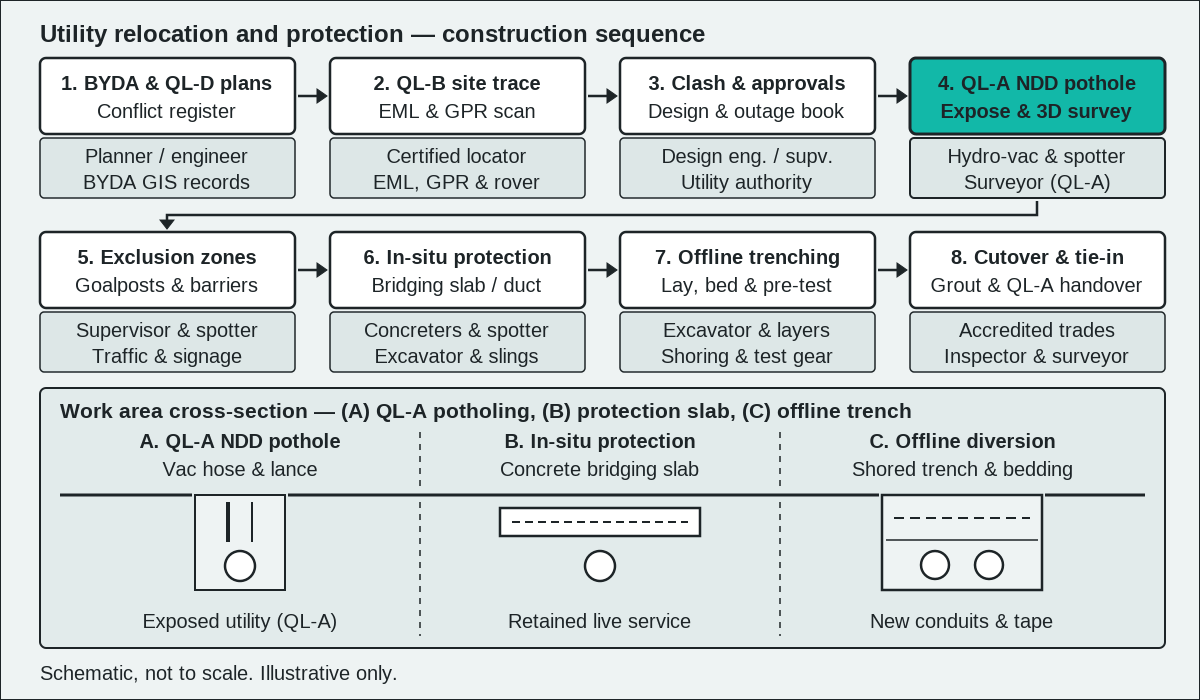
In road, rail, bridge, and bulk earthworks projects, existing Public Utility Plant—including electricity cables, telecommunications conduits, gas mains, water pipes, sewers, and stormwater drainage—frequently conflicts with new alignments, footings, or finished levels. Australian subsurface utility management follows AS 5488.1, which defines four Quality Levels (QL-D to QL-A) of increasing spatial certainty. Contractors progress utility data from Before You Dig Australia (BYDA) desktop plans at QL-D, through surface geophysical tracing using electromagnetic locating and ground penetrating radar at QL-B, to physical exposure via vacuum excavation (non-destructive digging) and 3D survey at QL-A before mechanical excavation starts near live assets. Because utilities are controlled by statutory authorities and network operators, contractors must comply with owner standards, accredited panel schemes, standby supervision, and approved outage windows, placing utility works on or near the critical path of brownfield civil programmes.
Where the method applies
- Brownfield road and intersection upgrades involving corridor widening, vertical grading reductions that reduce cover over buried pipes and cables, new stormwater lines, and retaining wall or signal footings across existing service corridors.
- Bridge, viaduct, and structural foundations where subsurface utilities cross abutment or pier footprints and must either be diverted prior to piling or positively located and protected against ground movement and vibration.
- Trenching for new drainage and services where new gravity stormwater, sewer, or water lines intersect live utilities, requiring positive exposure, temporary support via structural beams and slings across open trenches, and controlled backfill.
- Temporary construction works such as haul road crossings, crane outrigger pads, sheet piling, and shoring over or adjacent to fragile or pressurised pipes (such as asbestos cement water mains, vitrified clay sewers, or high-pressure gas mains) requiring load-spreading protection slabs or bridging structures.
- Rail and metro corridor interface works requiring locating, protecting, or slewing signalling, communications, and traction power feeders within or crossing rail boundaries.
This method does not apply to new utility mains installed in cleared greenfield corridors with no live services, internal building plumbing and electrical services downstream of the consumer meter, or unexploded ordnance and contaminated soil remediation. While utility relocations may incorporate underbores, the mechanical execution of horizontal directional drilling or micro-tunnelling is covered under separate trenchless construction methods.
Sequence of work
- Desktop inquiry and Quality Level D (QL-D) compilation. Submit project polygon inquiries through Before You Dig Australia (BYDA) to all registered asset owners and collate returned asset plans, GIS extracts, and historical as-built drawings into a Utility Conflict Register and composite services drawing at AS 5488.1 QL-D.
- Site reconnaissance and Quality Level C and B (QL-C / QL-B) geophysical survey. Walk the corridor to correlate surface features such as valve lids, hydrants, pits, pillars, and marker posts against QL-D records (QL-C), then engage a certified locator with Electromagnetic Locating (EML) and Ground Penetrating Radar (GPR) to trace and survey alignments on site to achieve QL-B.
- Clash analysis and utility owner engagement. Overlay the 3D civil design (earthworks, drainage strings, pavement boxing, structural footings) against the QL-B utility model to identify spatial clashes and clearance infringements, then submit applications to utility authorities for contestable or non-contestable design, protection assessment, or relocation agreements.
- Permit to Dig and non-destructive digging (potholing to QL-A). Issue an internal Permit to Dig and deploy a hydro-vac or air-vac excavation unit with a spotter to physically expose critical clashes and crossings; survey the top and obvert/invert, record material, diameter, and configuration to achieve AS 5488.1 QL-A, and reinstate or plate the pothole.
- Detailed design approval and network outage booking. Finalise protection designs (such as concrete bridging slabs, encasement, or vibration limits) or relocation designs with the asset owner, obtain formal Design Approval / Authority to Construct, and lodge long-lead applications for network isolations, live-line permits, or cutover windows.
- Surface delineation and overhead protection setup. Establish physical exclusion zones ("No Go Zones"), install high-visibility tiger tails where permitted, erect height-restricting goalposts and signage at overhead powerline haul crossings, and place surface barriers over shallow buried assets before bulk plant mobilisation.
- Installation of in-situ protection measures (for retained assets). Under utility inspector supervision where required, excavate carefully around retained assets to install split ducts, pour reinforced concrete bridging slabs above shallow services to distribute axle and pavement loads, or erect structural support beams and certified slings where a trench cuts beneath a live service.
- Offline trenching and new alignment construction (for relocated assets). Excavate the new utility alignment offline from the live network, place approved bedding (such as thermally stable sand for high-voltage cables or graded sand for water and gas pipes), lay new conduits, pipes, pits, and thrust blocks, and complete pre-commissioning testing (mandrel proving, hydrostatic or pneumatic pressure testing, disinfection, or insulation testing).
- Network isolation, cutover, and live tie-in. Within the utility owner's approved shutdown window, isolate or de-energise the existing section (or perform a live under-pressure tapping or stopple operation), cut and tie in the new offline section to the live network, haul and joint cables where applicable, and re-energise or re-pressurise the relocated asset.
- Decommissioning of redundant plant, as-built survey, and handover. Purge, grout-fill, or remove redundant abandoned pipes and cables as directed to prevent future pavement settlement, complete final QL-A as-built surveys, compile quality assurance dossiers, and obtain asset handover sign-off from the utility authority.
Typical crew and plant
| Role or machine | What it does | Notes |
|---|---|---|
| Certified utility locator (1 person) with EML and GPR | Traces conductive cables and pipes and scans detectable non-conductive conduits to establish AS 5488.1 QL-B alignments | Uses multi-frequency electromagnetic locator, signal transmitter/clamp, sonde, and ground penetrating radar cart |
| Vacuum excavation (NDD) crew (2 persons) and hydro-vac / air-vac truck | Physically exposes buried utilities via non-destructive digging to verify position, depth, and material at QL-A | Comprises 1 Vacuum Truck Operator and 1 Spotter/Lance Operator using high-pressure water or air lance, suction boom, and spoil tank |
| Engineering surveyor (1–2 persons) | Captures 3D coordinates (X, Y, Z) of exposed utilities in open potholes and records final QL-A as-built alignments | Equipped with GNSS rover or total station; must survey exposed services before pothole or trench backfill |
| Supervisor / leading hand (1 person) | Manages internal Permits to Dig, utility authority interfaces, standby inspector coordination, and hold point releases | Oversees exclusion zones and compliance with utility owner construction approvals |
| Plant operators (1–2 persons) with hydraulic excavators, backhoe, or skid-steer | Excavates offline relocation trenches, lifts conduits and pits, and backfills outside live utility exclusion zones | Typically rubber-tracked or wheeled compact-to-medium excavators fitted with rubber pads, tiltrotators, and programmable height/slew limiters |
| Pipelayers, civil concreters, and dedicated safety spotters (2–4 persons) | Lays conduits and pipes, pours thrust blocks, encasements, and bridging slabs, and observes plant clearances | Dedicated safety observer/spotter is mandatory when operating plant near overhead or underground exclusion zones |
| Specialist accredited utility trades and standby inspectors | Executes discipline-specific jointing, welding, live tie-ins, network switching, and compliance inspections | Includes HV cable jointers, electrical linesworkers (e.g. Level 1 ASP in NSW), PE welding technicians, fibre splicers, and utility authority standby officers |
| Support plant and traffic control crew | Cuts pavements, shores trenches, compacts backfill, hauls spoil and bedding, supplies water, and manages live traffic lanes | Road saw, trench shoring boxes, vibratory plate or rammer, tipper trucks, water cart, and accredited traffic controllers with traffic management vehicles |
Productivity drivers
- Subsurface congestion. Potholing and trenching slows significantly in dense urban corridors where multiple duct banks, gas mains, and water services cross at varying depths and require hand-trimming or vacuum excavation around every clash.
- Ground and groundwater conditions. Stiff clay, cobbles, rock, or high water tables impede vacuum excavation and require dewatering, rock sawing, or hydraulic hammering under strict peak particle velocity vibration limits near fragile mains.
- Spoil disposal distance and decanting for NDD. Hydro-excavation trucks fill rapidly with liquid slurry; daily pothole count is heavily governed by haul cycle times to a licensed liquid waste decanting facility and access to clean water refill points on site.
- Pavement cutting and reinstatement. Excavating through trafficked asphalt or reinforced concrete pavements requires road sawing, demolition, controlled low-strength material or stabilised backfill, temporary steel road plates or cold-mix, and permanent hot-mix asphalt patching, often doubling cycle time compared to verge work.
- Traffic management and night-shift windows. Lane occupancy permits on arterial roads frequently restrict potholing, trenching, and cutovers to short night shifts (such as 9:00 pm to 5:00 am), where daily traffic control setup and road plating consume a substantial portion of the shift.
- Utility authority supervision and hold point sign-offs. Working inside electricity easements, rail corridors, or high-pressure gas corridors requires an accredited utility standby inspector on site, constraining daily output to inspector availability and step-by-step hold point releases.
- Joint bay environmental preparation. High-voltage cable jointing and optical fibre splicing require dewatered, clean, and temperature- and dust-controlled joint bays with temporary habitats and dehumidifiers before specialist trades can start work.
Published references
Only figures that come from a source are listed. Everything else is a driver, not a number.
| Reference | Figure and basis | Status |
|---|---|---|
| Austroads ATS 1330 — Management of Utilities on Site (https://austroads.gov.au) | None found in opened primary public specification sources. Defines utility management, AS 5488 quality levels, protection, and adjustment requirements without publishing normative crew production rates. | No figure found (negative finding, not a document) |
| Queensland TMR MRTS170 / MRTS171 / MRS170 — Public Utilities in Road Projects (https://www.tmr.qld.gov.au/business-industry/Technical-standards-publications/Specifications) | None found in opened primary public specification sources. Sets technical, responsibility, and measurement rules for site works; estimators must build first-principles cycle times from pothole volume, slurry haul cycles, and shift windows. | No figure found (negative finding, not a document) |
| Transport for NSW Specification G7 — Utility Adjustment / Services Works (https://www.transport.nsw.gov.au) | None found in opened primary public specification sources. Specifies coordination, protection, testing, and handover rules without publishing crew output figures. | No figure found (negative finding, not a document) |
Quality and hold points
- Hold Point — Utility Management Plan and Permit to Dig: Before any ground disturbance or mechanical excavation, submit the Utility Management / Relocation Plan, verify current BYDA plans on site (typically valid for 28 to 30 days depending on asset owner rules), and complete QL-B / QL-A verification within the specified proximity zone.
- Hold Point — Positive identification (QL-A verification) before mechanical excavation: Mechanical excavation is prohibited within the specified clearance zone of an underground asset until the service has been physically exposed by non-destructive digging (QL-A) and its position, depth, and alignment are verified against the design.
- Hold Point — Utility owner approval of protection or relocation design: No physical protection structure (such as a bridging slab or concrete encasement) or permanent relocation work may start without written design approval and Authority to Construct from the relevant utility owner.
- Witness / Hold Point — Bedding, conduit or pipe placement, and pre-backfill inspection: Prior to backfilling a relocated utility trench or pouring an encasement or bridging slab, the utility owner's representative and Contract Administrator inspect trench depth, separation clearances from other services, bedding thickness, pipe or conduit jointing, marker tape installation, and reinforcement.
- Hold Point — Pre-commissioning testing and cutover readiness: Hydrostatic pressure testing and disinfection/water quality testing (water mains), pneumatic pressure testing (gas), mandrel and draw-wire proving (conduits), or electrical insulation and continuity testing must be signed off before any live network shutdown or tie-in is authorised.
- Hold Point — Decommissioning and final handover: Verify that redundant utilities have been isolated, removed, or grouted in accordance with road authority geotechnical requirements, and that QL-A as-built drawings and quality assurance dossiers have been accepted by the utility authority.
Risks and controls
- Unintended strike on live underground electrical cable or high-pressure gas main: Causes arc flash, electrocution, gas explosion, major network outage, and site shutdown. Control by enforcing a strict Permit to Dig system, keeping current BYDA plans on site, completing EML/GPR sweeps (QL-B) followed by mandatory vacuum excavation potholing (QL-A), using non-conductive hand tools and insulated boots where required, and isolating services where reasonably practicable.
- Plant boom or tipper body contact with overhead powerlines: Causes electrocution, plant fires, and grid trips. Control by erecting physical height-restricting goalposts and warning signage at designated haul crossings, enforcing statutory Approach Distances and No Go Zones, assigning a dedicated trained safety observer (spotter), and fitting programmable height and slew limiters to excavators and cranes.
- Unmapped ("unknown") utilities or confusion between abandoned and live services: Risk of striking a live service mistaken for redundant plant or halting bulk earthworks on discovering an unrecorded asset. Control by treating all exposed pipes and cables as live until positively proven disconnected and certified de-energised by the asset owner, and progressively scanning open trenches with EML/GPR during deep excavation.
- Structural damage to fragile buried pipes from heavy plant loading or vibration: Heavy scrapers, dump trucks, or piling rigs can fracture asbestos cement water mains, cast iron gas pipes, or vitrified clay sewers, causing trench flooding or pavement washout. Control by establishing load-restricted exclusion zones, placing temporary steel bridging plates, timber bog mats, or reinforced concrete protection slabs prior to plant crossings, and monitoring peak particle velocity (PPV) during nearby compaction or piling.
- Asbestos-Containing Material (ACM) in existing pits or conduits: Disturbing older telecommunications pits or asbestos cement water pipes risks worker exposure to airborne asbestos fibres and regulatory stop-work notices. Control by checking BYDA records and inspecting existing pits for ACM warnings prior to disturbance, and engaging licensed asbestos removalists to cut, wrap, and dispose of redundant AC pipes or pits under an Asbestos Management Plan.
Programming and weather
- Predecessor to bulk earthworks, piling, and deep drainage: Schedule QL-B geophysical scanning and QL-A potholing during early site mobilisation; bulk cut operations, bridge piling, soil nailing, and deep stormwater trenching cannot start in a zone until conflicting utilities are verified clear and protected or relocated and decommissioned.
- Utility authority design and commercial approval gates: Securing design certification and commercial execution agreements from statutory authorities takes weeks or months and must be tracked as an external predecessor to physical works.
- Network cutover windows and seasonal embargoes: Electrical distributors restrict planned outages during peak summer cooling and winter heating loads, water authorities limit trunk main shutdowns during high summer demand, and telecommunications carriers impose network freeze embargoes over public holidays and end-of-year retail periods.
- Contestable vs non-contestable trade bottlenecks: Even where the principal contractor completes offline civil trenching and conduit laying, live tie-ins, HV cable jointing, or gas live-tapping must often be performed by the asset owner's internal crews or a limited pool of accredited monopoly subcontractors whose booking lead times govern the cutover date.
- Redesign loops following QL-A potholing: Discovering during vacuum excavation that a duct bank or trunk main sits at a different depth or alignment than shown on QL-D desktop plans frequently triggers a civil drainage or utility redesign and re-approval cycle before trenching can proceed.
- Rainfall sensitivity for potholing and trenching: Moderate to high sensitivity; heavy rain floods open potholes and service trenches, obscuring visual verification for QL-A survey and saturating trench subgrades.
- Moisture and dust sensitivity for jointing and splicing: High-voltage cable jointing and optical fibre splicing in open joint bays require dry, temperature- and dust-controlled conditions inside temporary tents with dehumidifiers; storms or groundwater ingress halt jointing immediately.
- Weather cancellation of booked network outages: Electrical and water authorities routinely cancel pre-booked network shutdowns on the morning of the shift if severe storms, extreme heatwaves, or bushfire weather threaten network reliability, forcing a re-booking cycle that can delay a tie-in by weeks.
Estimating considerations
- Utility locating (QL-B) and management plans: Take off and price as a Lump Sum (LS) or Item, or by linear metre (m) or hectare (ha) of corridor scanned.
- Non-destructive digging / potholing (QL-A) measurement: Measured per pothole (Each / No.) stratified by depth band (e.g. 0–1.5 m, 1.5–3.0 m) and surface type (verge/turf vs asphalt or concrete pavement), by excavated volume (m³), or by hourly wet-hire rate (hr) of the vacuum excavation unit.
- Slurry disposal and water support for hydro-vac: Do not price NDD solely on the vac truck hourly wet-hire rate; allow explicitly for liquid waste / slurry disposal tip fees (per tonne or kilolitre), haul travel time to the decanting facility, and water cart support.
- Physical protection structures: Measure reinforced concrete bridging slabs, encasements, and split ducts per linear metre (m) of utility protected, per cubic metre (m³) of concrete, or Each (No.) per crossing point.
- Relocation trenching, conduits, pipes, and pits: Take off conduits and pipework by linear metre (m) grouped by nominal diameter, material class, trench depth band, and backfill type; count pits, manholes, valves, hydrants, and thrust blocks as Each (No.).
- Cutovers, tie-ins, and decommissioning: Price live cutovers, under-pressure tappings, and cable haul/jointing packages as a Lump Sum (LS) or Each (No.) per event, and measure redundant pipe removal or abandonment grouting by linear metre (m) or cubic metre (m³) of grout injected.
- Utility authority fees and mandatory standby inspectors: Separate physical civil construction costs from statutory authority charges, allowing for design review fees, network switching/isolation fees, compliance audit fees, and daily or nightly charge-out rates for utility standby officers.
- Temporary support across deep drainage trenches: Where new deep stormwater or sewer trenches cross existing live services, allow for temporary structural support beams, certified slings, slow hand-trimming around the exposed pipe, and lean-mix or stabilised sand backfill beneath the suspended utility.
- Specialised thermal and stabilised backfill: High-voltage cable relocations often specify imported Fluidised Thermal Backfill (FTB) or certified thermally stable bedding sand with laboratory thermal resistivity testing, which carries a substantial supply and testing premium over standard quarry sand.
- Contract risk allocation for unidentified services: Check the contract annexures (such as TMR MRTS171 or TfNSW G2/G7) to confirm whether unidentified utilities not shown on tender drawings and utility authority delays are covered under a Provisional Sum / latent condition clause or sit at the Principal Contractor's risk.
Specifications and standards
Checked 11 November 2026. Each document was looked up in catalogue and regulator listings; many agency PDFs could not be opened in full. Rows marked Confirmed were found to exist as described. Rows marked Not verified were not found or not checked. Clause-level statements, tolerances, temperatures, distances and similar figures in the text are typical values and are unverified unless a row cites the rule. Confirm the current edition of any document before relying on it.
| Document | What it covers for this method | Status |
|---|---|---|
| AS 5488.1:2022 — Classification of Subsurface Utility Information, Part 1: Subsurface Utility Information (SUI) | Defines the four Quality Levels (QL-D through QL-A) for classifying the spatial accuracy and collection method of subsurface utility data | Confirmed |
| AS 2885 (Series) — Pipelines — Gas and liquid petroleum | Governs engineering, construction, protection, and safety management near high-pressure gas and liquid petroleum transmission pipelines | Confirmed |
| AS/NZS 4645 (Series) — Gas distribution networks | Requirements for design, construction, protection, and operation of gas distribution mains and services | Confirmed |
| AS 4799 — Installation of underground utility services and pipelines within railway boundaries | Requirements for locating, protecting, and installing underground utility services and pipelines crossing or running within rail corridors | Confirmed |
| Austroads Technical Specification ATS 1330 — Management of Utilities on Site | National specification covering utility liaison, locating to AS 5488, positive verification, protection works, and construction of utility adjustments | Confirmed |
| Queensland TMR MRTS170, MRTS171 and MRS170 — Public Utilities in Road Projects | State road authority technical, principal contractor responsibility, and measurement/billing specifications for utility site works and relocations | Confirmed |
| Transport for NSW Specifications G2 (General Requirements) and G7 (Utility Adjustment / Services Works) | NSW requirements for locating and protecting existing underground utilities and coordinating, testing, and handing over utility adjustments | Confirmed |
| Safe Work Australia — Model Code of Practice: Excavation Work | Statutory WHS guidance on obtaining current underground essential service plans (BYDA), positive identification (potholing), and safe excavation controls | Confirmed |
| Safe Work Australia — General Guide for Working in the Vicinity of Overhead and Underground Electric Lines | WHS guidance on approach distances, exclusion zones, goalposts, spotters, and control measures near live overhead and underground powerlines | Confirmed |
| Other state road authority utility specifications (VicRoads / DTP Victoria, Main Roads WA, DIT SA) | State-specific road authority specifications for utility protection and relocation not opened in primary listings during research | Not verified |
Only documents confirmed to exist carry the status Confirmed. Check the current edition before relying on any document.
Sources and review
| Source | Used for | Status |
|---|---|---|
| Standards Australia — AS 5488.1:2022 Classification of Subsurface Utility Information (https://www.standards.org.au) | Quality Level D to Quality Level A classification framework, geophysical locating, and potholing survey definitions | Confirmed |
| Austroads — Technical Specification ATS 1330 Management of Utilities on Site (https://austroads.gov.au) | National workflow for utility management plans, locating, hold points, protection works, and handover | Confirmed |
| Department of Transport and Main Roads (QLD) — MRTS170, MRTS171, and MRS170 (https://www.tmr.qld.gov.au/business-industry/Technical-standards-publications/Specifications) | Site work requirements, principal contractor responsibilities, hold points, Australian Standard references, and measurement units | Confirmed |
| Transport for NSW — Specifications G2 and G7 (https://www.transport.nsw.gov.au) | Utility protection, accredited service provider interfaces, pre-commissioning testing, and handover requirements | Confirmed |
| Safe Work Australia — Model Code of Practice: Excavation Work (https://www.safeworkaustralia.gov.au/doc/model-code-practice-excavation-work) | Statutory obligations for underground essential services, Permit to Dig controls, and non-destructive digging | Confirmed |
| Safe Work Australia — General Guide for Working in the Vicinity of Overhead and Underground Electric Lines (https://www.safeworkaustralia.gov.au/doc/general-guide-working-vicinity-overhead-and-underground-electric-lines) | Overhead powerline exclusion zones, goalposts, tiger tails, and dedicated safety observer (spotter) requirements | Confirmed |
| Before You Dig Australia (BYDA) National Portal (https://www.byda.com.au) | Desktop utility inquiry workflow and QL-D asset plan compilation | Confirmed |
Items marked Not verified have not been checked against a primary source. Research notes.
Library navigation
Plant and method index · Discipline work packages · Survey conformance and lot release