Plant / 25 t pick-and-carry mobile crane
25-Tonne Pick-and-Carry Crane (Franna)
The quintessential Australian articulated mobile crane for pipeline installation, precast placement, yard logistics, and plant maintenance without outriggers.
- Boom and hookMatch load and radius to the project lift configuration.
- Articulated chassisTravel route and turning space govern pick-and-carry access.
- Carrier wheelsAllow for loaded travel and return movements.
- Max capacity
- 25,000kg
- Max hook height
- 18.0m
AUD ex GST. *Unquoted placeholder. In accordance with Vaultix estimating principles, hire rates are never invented or extrapolated. Obtain current supplier quotations.
Choosing this class of pick-and-carry crane
A 25 t class pick-and-carry articulated crane (such as the Terex Franna MAC 25-4) is the ubiquitous workhorse across Australian civil infrastructure, pipeline, mining, and industrial construction. Designed and built in Brisbane, Queensland, it combines highway mobility up to 80 km/h with heavy-duty rough-terrain pick-and-carry capability without outriggers. Equipped with an 18.4 m full-power boom, 25 t maximum capacity at 1.4 m radius, ±40° chassis articulation, and dynamic LMI monitoring, it delivers rapid crane support. Productivity is modeled by pick cycles per hour and tonnes placed per hour, governed by placement radius, chassis articulation angle deration, and site travel duration.
The quintessential Australian articulated mobile crane for pipeline installation, precast placement, yard logistics, and plant maintenance without outriggers.
25 t class / 18.4 m full-power boom / Pick-and-carry crane / SafeWork CN / DG
- Precast drainage and bridge unit installation (box culverts, pipes, wingwalls, pits, headwalls)
- Pick-and-carry pipe handling and stringing along pipeline trenches
- Structural steel erection, portal frames, gantry components, and heavy formwork placement
- Site compound setup, relocatable building handling, and 20 ft shipping container relocation
- Workshop and yard heavy plant maintenance (engine swaps, transmission pulls, bucket changes)
- Heavy civil construction yard logistics, loading/unloading flatbed transport trailers
- Temporary traffic barrier placement (precast concrete jersey barriers and steel crash barriers)
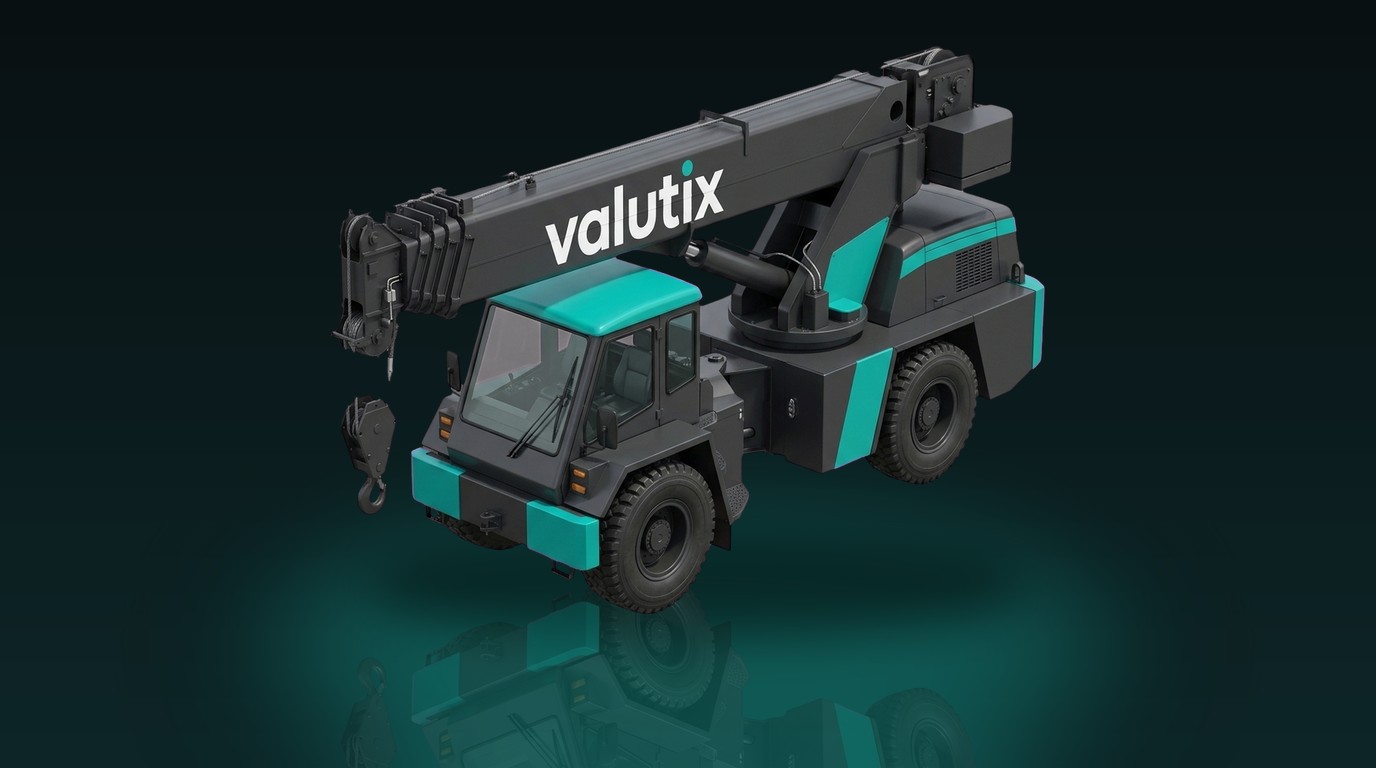
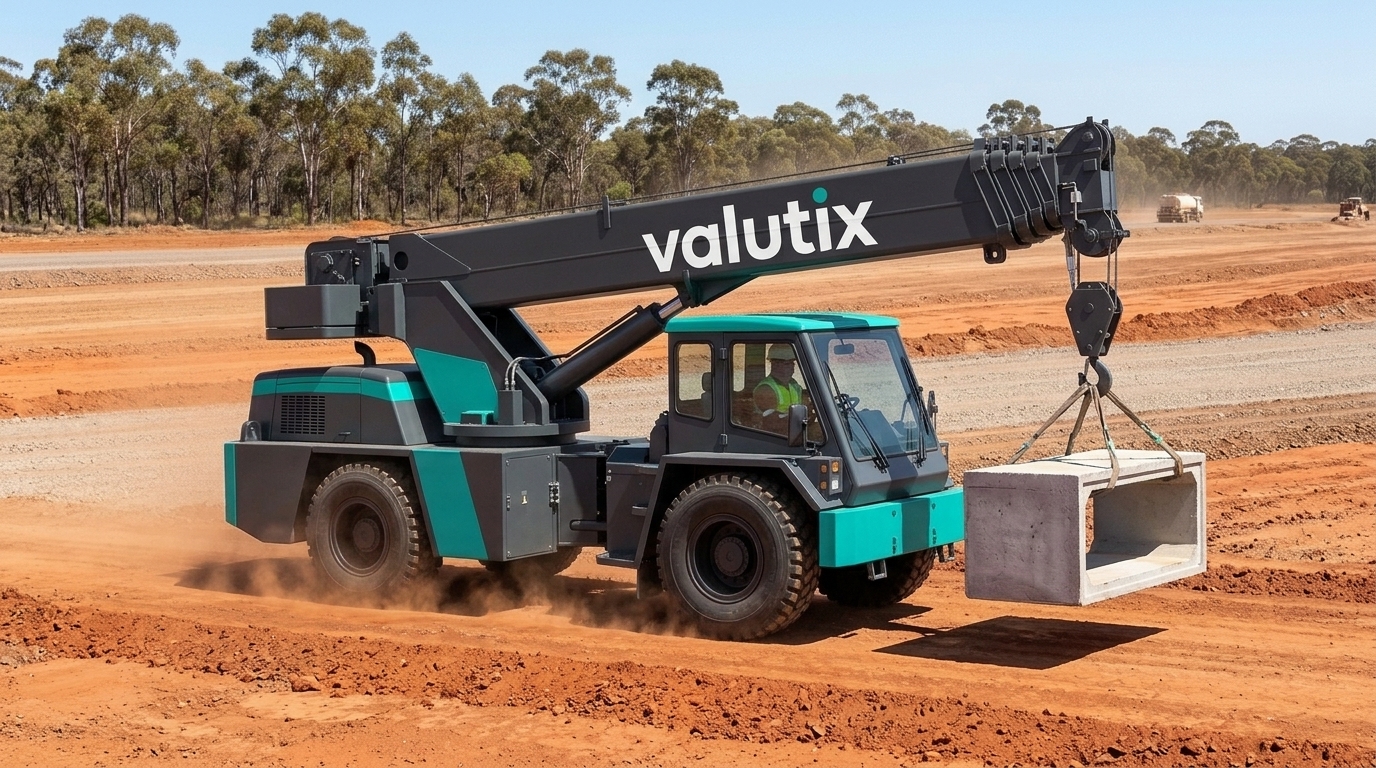
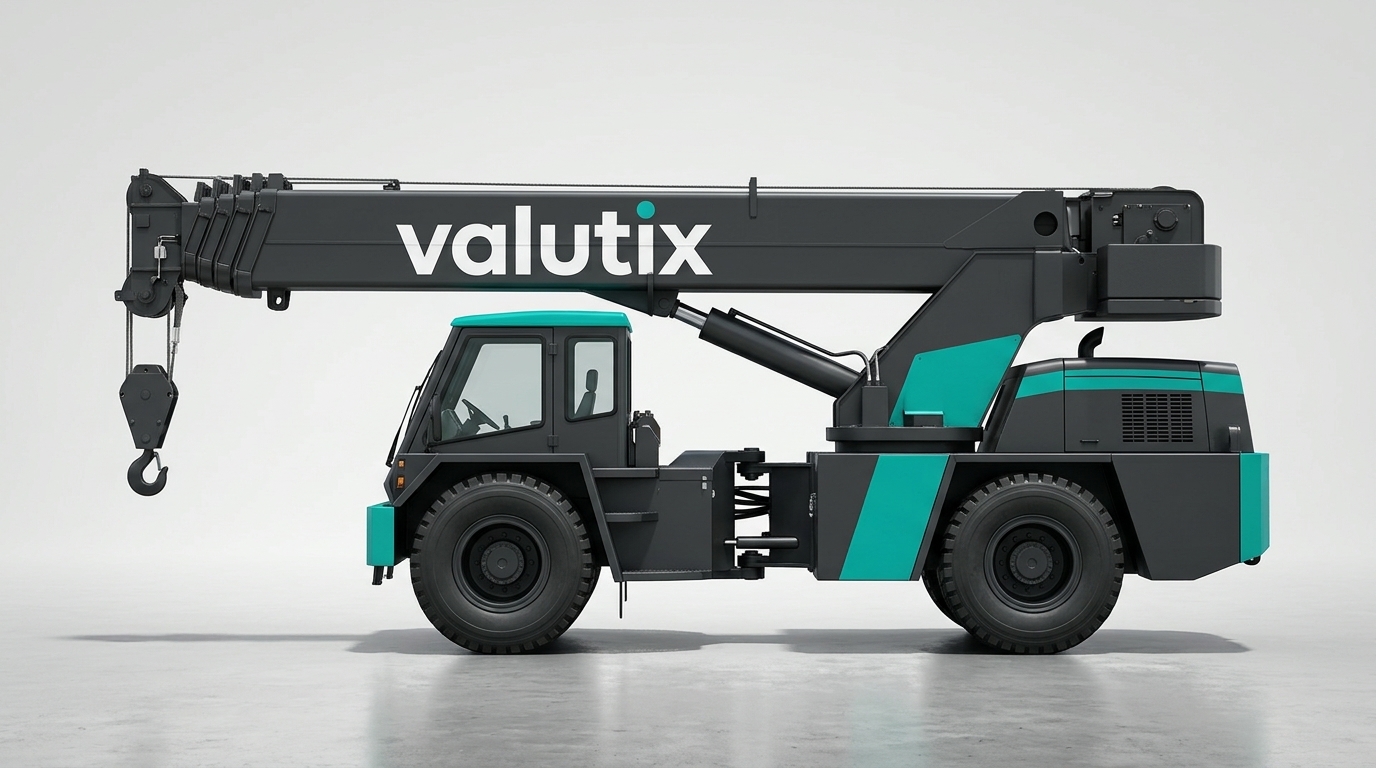
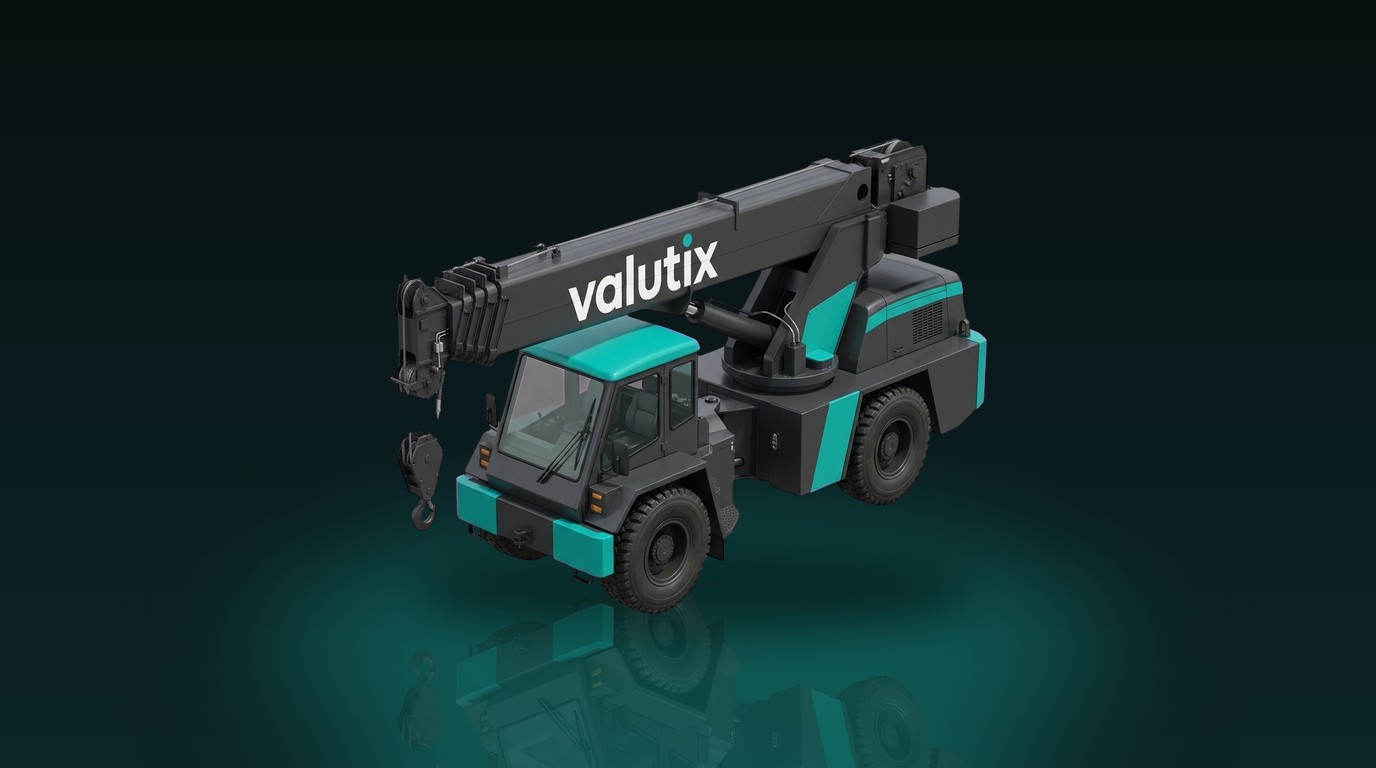
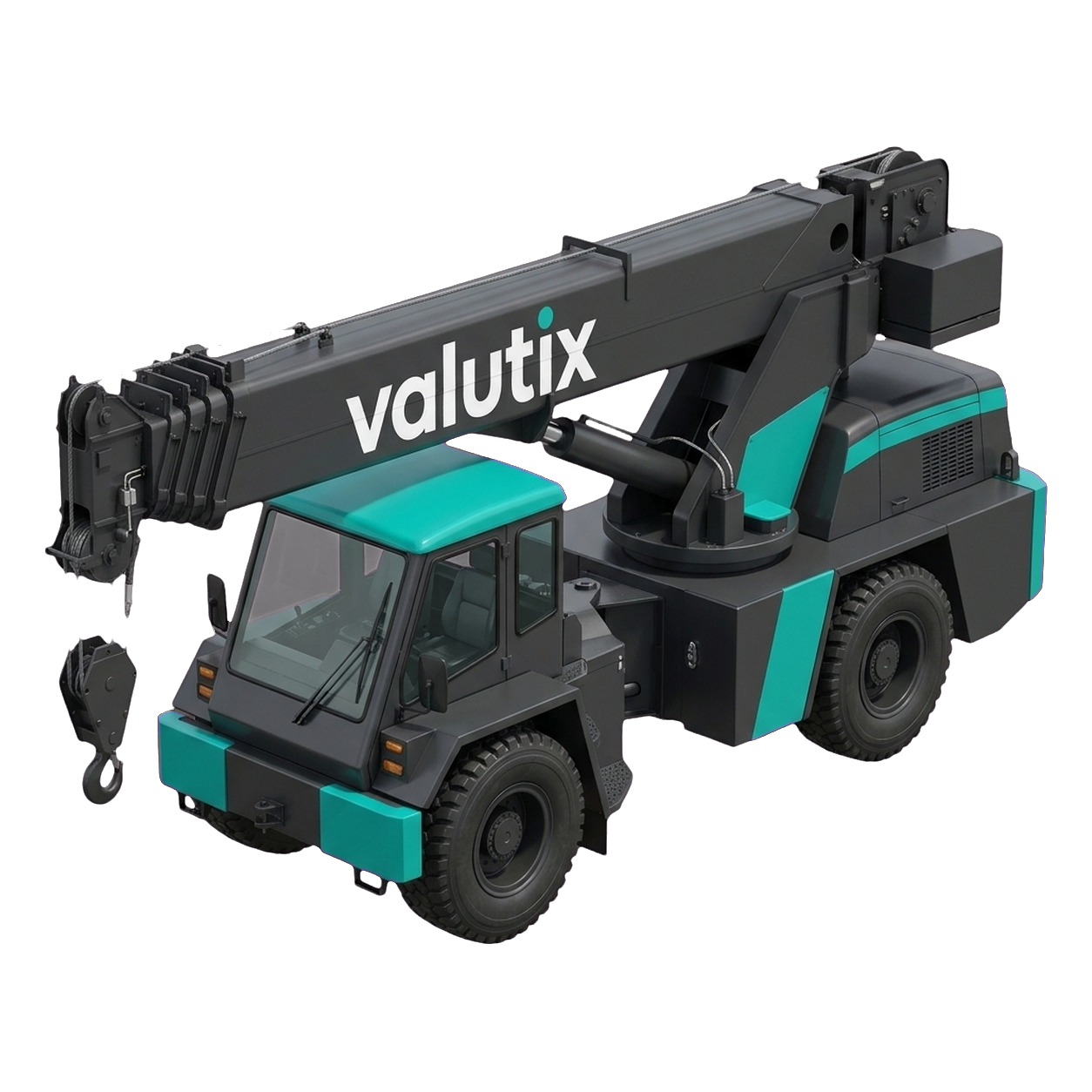
Illustrations featuring the Vaultix civil livery. Machine geometry, articulation, and attachments represent typical Australian civil specifications.
Class planning guide
Published manufacturer specifications for the Terex Franna MAC 25-4 / 25 t class pick-and-carry mobile crane. Use supplier specifications for exact procurement.
| Ref | Item | Value | Planning note |
|---|---|---|---|
| 01.01 | Max lifting capacity | 25,000 kg @ 1.4 m radius | Rated on 6-part line fall block, boom retracted to 6.12 m at 49° elevation, firm level ground at 0° articulation. |
| 01.02 | Maximum hook height | 18.0 m (20.5 m with fly jib) | Main boom reaches 18.0 m at 65° elevation; optional 3.0 m fly jib extends hook height to 20.5 m. |
| 01.03 | Maximum boom length | 18.4 m (retracted 6.06 m) | 4-section full-power boom comprising 1 base section and 3 powered telescoping extensions. |
| 01.04 | Engine net power | 205 kW (275 hp) / 1,100 Nm | Mercedes-Benz OM 906 LA 6-cylinder turbo diesel coupled to Allison 6-speed automatic transmission. |
| 01.05 | Gross vehicle mass (road tare) | 23,900 kg (11.9 t front / 12.0 t rear) | Standard road transit tare with 1,280 kg counterweight pinned on front bumper; 80 km/h highway speed. |
| 01.06 | Pick-and-carry speed limit | 1.44 km/h (0.4 m/s) | Statutory maximum travel speed with suspended load under AS 2550.5 to prevent pendulum load swing. |
| 01.07 | Fuel burn allowance | About 9 to 21 L/hr (14.0 L/hr civil) | Derived from Mercedes OM906 duty load factor; 14.0 L/hr adopted for medium-duty civil pick-and-carry. |
| 01.08 | Derived shipping payload | 23,500 kg (derived) | Derived: 23,900 kg tare less ~400 kg diesel fuel allowance = ~23,500 kg net trailer payload for long-haul float transit. |
| Ref | Item | Value | Planning note |
|---|---|---|---|
| 02.01 | Precast & culvert placement | Pick-and-carry mobility | Eliminates crane setup time and outrigger pads; transports pipes and culverts directly from yard to trench. |
| 02.02 | Articulation steering | ±40° Articulation arc (80° sweep) | Twin hydraulic steering cylinders slew the load by articulating chassis, allowing precision landing in tight corridors. |
| 02.03 | Site logistics & yard handling | Rhino hook & machinery lifting | Auxiliary 15 t nose hook allows lifting inside low-clearance workshop bays and under overhead obstructions. |
| 02.04 | Highway self-deployment | 80 km/h Cruising speed | Self-travels under NHVR Class 1 SPV notice without float for regional sites within ~200 km, saving mobilisation costs. |
| 02.05 | Rough terrain capability | 4WD low range & 45% gradeability | ZF 2:1 transfer case and 14.00 x 20 earthmover tyres handle unpaved subgrades, gravel access roads, and laydown yards. |
Dimensions and transport planning
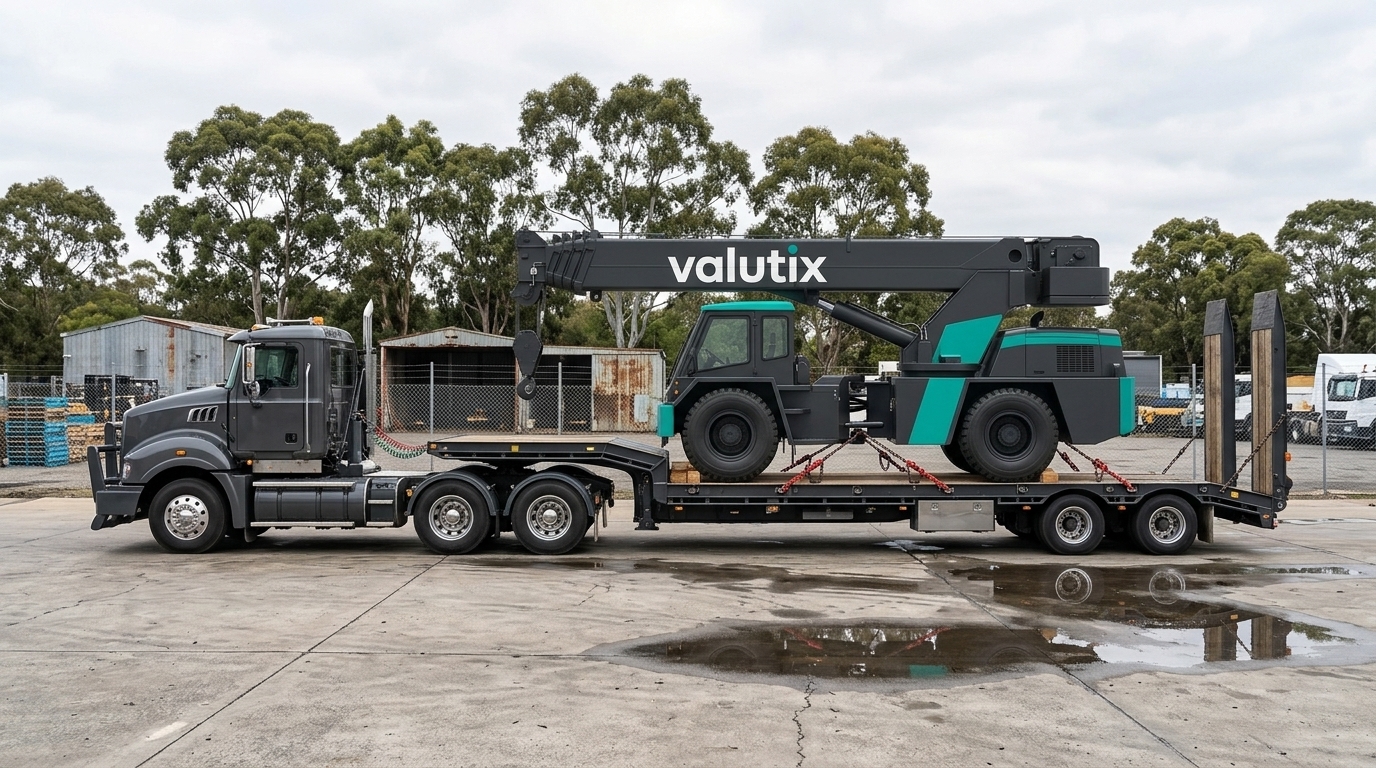
Machine dimensions exclude the transport float trailer. Obtain verified deck height, loaded envelope, axle group weights, route clearance and restraint plans from haulier before mobilisation.
| Code | Dimension | Published value | Planning note |
|---|---|---|---|
| L | Overall length (boom head to rear bumper) | 9,985 mm | Front of boom head to rear chassis bumper with boom retracted in travel rest. |
| W | Overall width across 14.00 x 20 tyres | 2,720 mm | Maximum width across outer tyre sidewalls (exceeds 2.50 m; travels under NHVR SPV notice). |
| H | Overall height to top of cabin structure | 3,075 mm | Ground line to highest point of cabin roof structure. Excludes float deck. |
| WB | Wheelbase (front drive/steer to rear drive axle) | 4,750 mm | Centerline front drive/steer axle to centerline rear drive axle. |
| TW | Track width (center-to-center tyres) | 2,205 mm | Center-to-center track width between tyre contact footprints. |
| OH_F | Front overhang (front axle to foremost bumper) | 2,375 mm | Centerline front axle to foremost point of front bumper / counterweight mount. |
| OH_R | Rear overhang (rear axle to counterweight frame) | 3,410 mm | Centerline rear axle to rearmost chassis edge / counterweight frame (2,860 mm to body corner). |
| GC | Ground clearance under central articulation pivot | 335 mm | Lowest chassis clearance under central articulation pivot / transfer case (375 mm under front axle). |
| R_turn | Turning circle radius across outside wheels | 7,900 mm | Measured across outside wheels at maximum 40° steering articulation. |
| Boom_L | Boom length range (retracted to extended) | 18,420 mm | Fully extended 4-section boom length (retracted 6.06 m, powered extension stroke 12,360 mm). |
Working range & kinematics
Rated lifting capacities, reach envelopes, and articulation derations for the Terex Franna MAC 25-4 mobile crane. Capacities are strictly governed by working radius and chassis articulation angle under AS 1418.5 / AS 2550.5.
| Code | Kinematic range item | Published value |
|---|---|---|
| 1 | Max lifting capacity (1.4 m radius, 0° articulation) | 25,000 kg (6-part line fall block, boom retracted to 6.12 m at 49° elevation) |
| 2 | Rated capacity at 3.0 m radius (0° articulation) | 14,800 kg (Straight-ahead pick-and-carry rating with rear counterweight) |
| 3 | Rated capacity at 3.0 m radius (40° articulation) | 13,200 kg (Full chassis articulation; 10.8% lateral deration) |
| 4 | Rated capacity at 5.0 m radius (0° articulation) | 8,250 kg (Standard 5.0 m operating radius rating) |
| 5 | Rated capacity at 5.0 m radius (40° articulation) | 5,400 kg (35.7% deration due to lateral overturning moment) |
| 6 | Rated capacity at 8.0 m radius (0° articulation) | 4,800 kg (Intermediate radius pick-and-carry rating) |
| 7 | Rated capacity at 8.0 m radius (40° articulation) | 3,350 kg (30.2% deration at 40° articulation) |
| 8 | Rated capacity at 10.0 m radius (0° articulation) | Not verified (chart text unclear) |
| 9 | Rated capacity at 10.0 m radius (40° articulation) | Not verified (chart text unclear) |
| 10 | Rated capacity at maximum radius (15.71 m, 0° articulation) | 1,800 kg (Fully extended 18.42 m boom at 17° elevation) |
| 11 | Rated capacity at maximum radius (15.71 m, 40° articulation) | 1,450 kg (19.4% deration at 40° articulation) |
| 12 | Maximum hook height (main boom) | 18.0 m (At 65° boom elevation with fully extended 18.42 m boom) |
| 13 | Maximum hook height with 3.0 m fly jib | 20.5 m (Fitted to boom head at 65° elevation; range diagram shows up to 21.4 m) |
| 14 | Auxiliary machinery / rhino hook capacity | 15,000 kg (Low-profile nose hook mounted directly to boom tip head) |
| 15 | Maximum pick-and-carry speed with load | 1.44 km/h (0.4 m/s; statutory limit under AS 2550.5 to prevent pendulum sway) |
Direct cost and market hire prices
Never invent hire rates. In strict accordance with Vaultix estimating governance, all hire rate figures for this 25 t pick-and-carry crane class are recorded as not-yet-quoted placeholders. Enter verified project supplier quotes in the calculator below.
Metro and Remote direct costs
| Basis / AUD ex GST | Metro | Remote |
|---|---|---|
| Direct dry / hr | Not yet quoted (placeholder) | Not yet quoted (placeholder) |
| Direct wet / hr | Not yet quoted (placeholder) | Not yet quoted (placeholder) |
| Crane operator & dogman / paid site hr | Not yet quoted (placeholder) | Not yet quoted (placeholder) |
| Delivered diesel / L | 1.94 (reference proxy) | 2.23 (reference proxy) |
| Maintenance, parts and freight | Base allowance | Base plus 25% |
| Roster and camp | Metro working-week roster | 14/7 FIFO, 12-hour days, camp and flights |
Standing decision: Rates for this class have not yet been quoted or audited for vaultix.com.au. To ensure estimating integrity, rates are never estimated from other classes without supplier evidence. Estimators can input their project quotes directly in the instrument below.
Mobilisation, separate one-off cost
| Purchased transport / AUD ex GST | Metro | Remote |
|---|---|---|
| One delivery event | To be quoted by haulier | To be quoted by haulier |
Mobilisation depends on transit distance, route permits, and transport method (regional self-deployment up to 80 km/h under NHVR Class 1 SPV notice vs heavy low-loader float). Allow separate return demobilisation event.
| Source / date | Hire basis | Per hour | Per day | Per week | Conditions |
|---|---|---|---|---|---|
| Awaiting supplier tender verification Status: Unquoted placeholder |
Dry / Wet pending quotes | Not yet quoted | Not yet quoted | Not yet quoted | All hire rate values are unquoted placeholders. Obtain 3 dated project rate cards including Superlift counterweight fitment, fly jib / rhino hook options, fuel inclusion, rigging gear, and mobilisation terms. |
First-principles direct hourly cost
| Component | Direct dry AUD/hr | Direct wet AUD/hr |
|---|---|---|
| Ownership: depreciation and interest | Not yet quoted | Not yet quoted |
| Insurance and registration | Not yet quoted | Not yet quoted |
| Maintenance, servicing, tyres and rigging gear | Not yet quoted | Not yet quoted |
| Fuel and operating lubricants (14.0 L/hr proxy) | 0.00 | Not yet quoted |
| Crane operator and dogman cost per paid site hour | 0.00 | Not yet quoted |
| Direct cost per operating hour | Not yet quoted | Not yet quoted |
Placeholder. Replace with a current supplier quote; no hire rates are invented or assumed.
Productivity and calculator
Picks per Hour = 3,600 / (Hook Time s + Travel & Articulation Time s + Set & Release Time s) x Efficiency. Hourly Output Rate (t/hr) = Picks per Hour x Typical Unit Load (t). Pick-and-carry travel speed is legally capped at ≤1.44 km/h (0.4 m/s) under AS 2550.5. Rated lifting capacity is governed by radius and articulation angle (load chart derates up to 36% at 40° articulation). All factors are Vaultix estimating assumptions.
Activity estimating guides
Vaultix crane estimating standards, 9 November 2026. Joint pick-and-carry planning scenarios, not statistical confidence limits.
Cycle times based on 3-part cycle: hook/rigging (30–180 s), travel/articulate at ≤1.44 km/h (45–360 s), and set/release (45–600 s). Efficiency: 0.55 to 0.80. Output: 3.1 to 9.6 picks/hr (7.8 to 26.7 t/hr).
Low scenario: +30% cycle duration, 15% lower efficiency (congested site, tag-line holds, precision dipping). High scenario: -25% cycle duration, 15% higher efficiency (clear access, repetitive cycles, rapid slinging). Capacity strictly governed by radius and articulation angle.
01Precast unit placement
Hooking, slinging, pick-and-carry transfer from laydown stockpile to trench or rebate, and precision setting of precast culvert units, bridge planks, or drainage pits.
Vaultix assumptions: Hook time 90 s; travel & articulation time 150 s; set & release time 150 s; total cycle time 390 s; efficiency 75%; typical unit load 3.5 t at 5.0 m operating radius.
Worked example: 3,600 / 390 s x 0.75 efficiency = 6.9 picks/hr; 6.9 picks/hr x 3.5 t = 24.2 t/hr output. Shift total: ~55 picks or 194 t in an 8-hour shift.
Allow for: 4-leg chains or swift-lift clutches, tag lines, test lift tensioning, 20–50 m travel with front suspension locked, precision dipping by surveyor, shimming, and unhooking.
Pitfalls: Pick-and-carry travel speed strictly limited to 1.44 km/h (0.4 m/s) under AS 2550.5; chassis articulation derates capacity by up to 36% at 5 m radius (from 8.4 t to 5.4 t).
02Pipe and culvert handling
Offloading, stringing, and placing concrete drainage pipes, stormwater culverts, or pressure sewer pipes along trench lines.
Vaultix assumptions: Hook time 75 s; travel & slew time 120 s; set & release time 105 s; total cycle time 300 s; efficiency 80%; typical unit load 2.2 t at 4.5 m operating radius.
Worked example: 3,600 / 300 s x 0.80 efficiency = 9.6 picks/hr; 9.6 picks/hr x 2.2 t = 21.1 t/hr output. Shift total: ~77 pipes or 169 t in an 8-hour shift.
Allow for: Pipe lifting beam, scissor clamp or synthetic round slings, pipe bedding guidance, spigot-into-socket jointing with rubber ring, and laser grade checks.
Pitfalls: Keep drive tandems off soft trench edges; never travel with boom elevated or unhooked tag lines; ensure front spring lockouts are fully engaged.
03Steel and formwork lifts
Transferring structural steel columns, beams, portal rafters, and heavy formwork shutters from transport trailers to foundations or slab edges.
Vaultix assumptions: Hook time 105 s; travel & slew time 110 s; set & release time 165 s; total cycle time 380 s; efficiency 70%; typical unit load 1.8 t at 6.0 m operating radius.
Worked example: 3,600 / 380 s x 0.70 efficiency = 6.6 picks/hr; 6.6 picks/hr x 1.8 t = 11.9 t/hr output. Shift total: ~53 lifts or 95 t in an 8-hour shift.
Allow for: Certified wire rope or webbing slings, dual tag lines, chassis articulation around scaffolding/access ramps, bolt torqueing, temporary prop pinning, and de-rigging.
Pitfalls: Wind loading on large formwork shutters induces severe dynamic side-pull; beware overhead powerlines and scaffolding proximity; avoid sudden braking while carrying steel.
04Plant and material pick-and-carry
Site-wide pick-and-carry transport of skid-mounted generators, pumps, trench plates, tool containers, and bundled materials across work areas.
Vaultix assumptions: Hook time 60 s; travel & slew time 180 s; set & release time 75 s; total cycle time 315 s; efficiency 78%; typical unit load 3.0 t at 3.5 m operating radius.
Worked example: 3,600 / 315 s x 0.78 efficiency = 8.9 picks/hr; 8.9 picks/hr x 3.0 t = 26.7 t/hr output. Shift total: ~71 loads or 214 t in an 8-hour shift.
Allow for: 2-leg or 4-leg slings, shackle attachments to lifting lugs, 50–150 m travel across prepared site haul routes at ≤1.44 km/h, and landing onto timber cribbing.
Pitfalls: Uneven ground or potholes cause pendulum swing and lateral overturning moments; speed must not exceed 0.4 m/s (1.44 km/h); maintain load close to ground.
05Crane-supported maintenance
Lifting, holding, and positioning heavy machinery assemblies (engines, transmissions, final drives, hydraulic cylinders, excavator buckets) during workshop or field fitout.
Vaultix assumptions: Hook time 180 s; travel & slew time 90 s; set & release time 360 s; total cycle time 630 s; efficiency 55%; typical component load 2.5 t at 4.0 m operating radius.
Worked example: 3,600 / 630 s x 0.55 efficiency = 3.1 picks/hr; 3.1 picks/hr x 2.5 t = 7.8 t/hr output. Shift total: ~25 lifts or 62 t in an 8-hour shift.
Allow for: Auxiliary 15 t machinery/rhino hook for low headroom, spreader beams, delicate inching control, extended load holding during dowel pin/bolt alignment, and fitter safety.
Pitfalls: Extended suspended load hold times require clear exclusion zones; never work under suspended components without positive mechanical blocking or stands.
06Site setup and demobilisation lifts
Loading, unloading, and positioning 20 ft site containers, relocatable office skids, precast jersey safety barriers, and temporary fence blocks during site compound establishment.
Vaultix assumptions: Hook time 90 s; travel & slew time 140 s; set & release time 120 s; total cycle time 350 s; efficiency 72%; typical unit load 3.2 t at 4.5 m operating radius.
Worked example: 3,600 / 350 s x 0.72 efficiency = 7.4 picks/hr; 7.4 picks/hr x 3.2 t = 23.7 t/hr output. Shift total: ~59 lifts or 190 t in an 8-hour shift.
Allow for: Container lifting lugs (twist locks), 4-leg container chains, concrete barrier lifters/grabs, maneuvering through compound gates, and landing on footings.
Pitfalls: Overhead service connections, compound power cables, and crowded parking areas require dedicated electrical spotter and dogman traffic guidance.
Estimator checks
- Mandatory HRWL classes: SafeWork High Risk Work Licence class CN (Non-slewing mobile crane >3 tonnes capacity) required for operator; qualified dogman / rigger (class DG or RB/RI/RA) required for all slinging and load control.
- Dynamic articulation deration: Symmetrical steering articulation up to ±40° reduces lateral tipping stability and load capacity by up to 36% at intermediate radii (e.g. at 5.0 m radius, SWL drops from 8,250 kg at 0° to 5,400 kg at 40°). Verify operating radius and articulation angle before lifting.
- Pick-and-carry speed limit: Travel speed with a suspended load is strictly limited to 0.4 m/s (1.44 km/h) under AS 2550.5. Never allow road-speed travel with load.
- Front suspension lockout: Front axle hydraulic leaf spring lockouts must be fully engaged before any crane lifting or pick-and-carry movement.
- Counterweight position: Standard 1,280 kg counterweight is pinned to the front bumper for road transit (balancing axle loads to 11.9 t / 12.0 t) and must be transferred to the rear chassis mount for lifting duties.
- Road travel under NHVR: Machine width is 2.72 m and operating tare is 23,900 kg. Travels on public roads under NHVR Class 1 SPV Notice with OVERSIZE signs and amber beacons at up to 80 km/h cruising speed.
- Tyre pressure compliance: Rated capacity fundamentally relies on tyre stiffness. Maintain front tyres at 830 kPa (120 psi) and rear tyres at 620 kPa (90 psi).
- All hire rate schedules are unquoted placeholders. In accordance with Vaultix estimating principles, never invent hire rates without formal supplier tenders.
- Output is pick-governed (picks/hr) and load-governed (t/hr), not bucket payload. Balance crane placement rate with delivery transport and installation crew pacing.
- SafeWork HRWL Class CN required for crane operator; Class DG required for dogman/rigger.
Data basis. Corrected 10 November 2026 against the Terex MAC 25-4 datasheet (March 2021): capacity at 5.0 m radius is 8,250 kg; the 10.0 m radius capacities could not be read reliably and are Not verified. Not on the Terex sheet and unverified: tyre size 14.00 x 20, the 1,280 kg counterweight and the wire rope detail. The MAC 25-4 is the previous generation; Terex now sells the MAC 25 Series 5 (MAC 25-5). Reference model: Terex Franna MAC 25-4 Mobile Articulated Pick and Carry Crane. Technical specifications sourced from Terex Australia MAC 25-4 Technical Datasheet (web.pdf) and Rated Capacity Manual T138758F. Sourced 9 November 2026. Fuel burn derived from Mercedes-Benz OM906 telematics duty load factor benchmark (14.0 L/hr medium duty). Productivity uses Vaultix pick-and-carry cycle formulas. Hire rates remain unquoted placeholders pending verified tenders. Sources and assumptions.
Entry / franna-25t Issue / 2026-11-09
Library navigation
Plant and method index · Discipline work packages · Survey conformance and lot release