Plant / 14 to 16 t road-construction grader
16-Tonne Motor Grader
The primary grading workhorse for highway construction, civil subdivisions, rail corridors, and mine haul roads throughout Queensland and Australia.
- MouldboardCut width and pass count determine grading effort.
- Front axleTurning space and manoeuvres affect productive time.
- Rear tandemGround and haul traffic affect traction and finish.
- Standard blade
- 3.66m
- Net power
- ≈174kW Approximate
AUD ex GST. *Unquoted placeholder. In accordance with Vaultix estimating principles, hire rates are never invented or extrapolated. Obtain current supplier quotations.
Choosing this class of motor grader
A 14 to 16 t class motor grader (such as the Cat 140 / 140M3 series) is the benchmark production and finishing machine across Australian civil infrastructure. Combining a 3.66 m (12 ft) moldboard, powertrain of up to 174 kW (tandem), frame articulation and front wheel lean, it excels across bulk fill spreading, pavement layer shaping, drainage cut and millimeter-tolerance final subgrade trim with 3D UTS/GPS machine control.
The primary grading workhorse for highway construction, civil subdivisions, rail corridors, and mine haul roads throughout Queensland and Australia.
14-16 t class / 3.66 m moldboard / Direct-drive powershift / Civil estimating guide
- Final trim of subgrade and crushed rock pavement layers to tight design levels (±10 mm)
- Spreading, mixing, moisture-conditioning, and shaping unbound granular pavements
- Gravel re-sheeting, crown formation, and shoulder reconditioning on unsealed roads
- Bulk blading and uniform layer distribution of dumped earthworks windrows
- Formation of table drains, V-drains, and catch drains with articulated bank-cut positioning
- Batter trimming, slope dressing, and high-speed haul-road maintenance
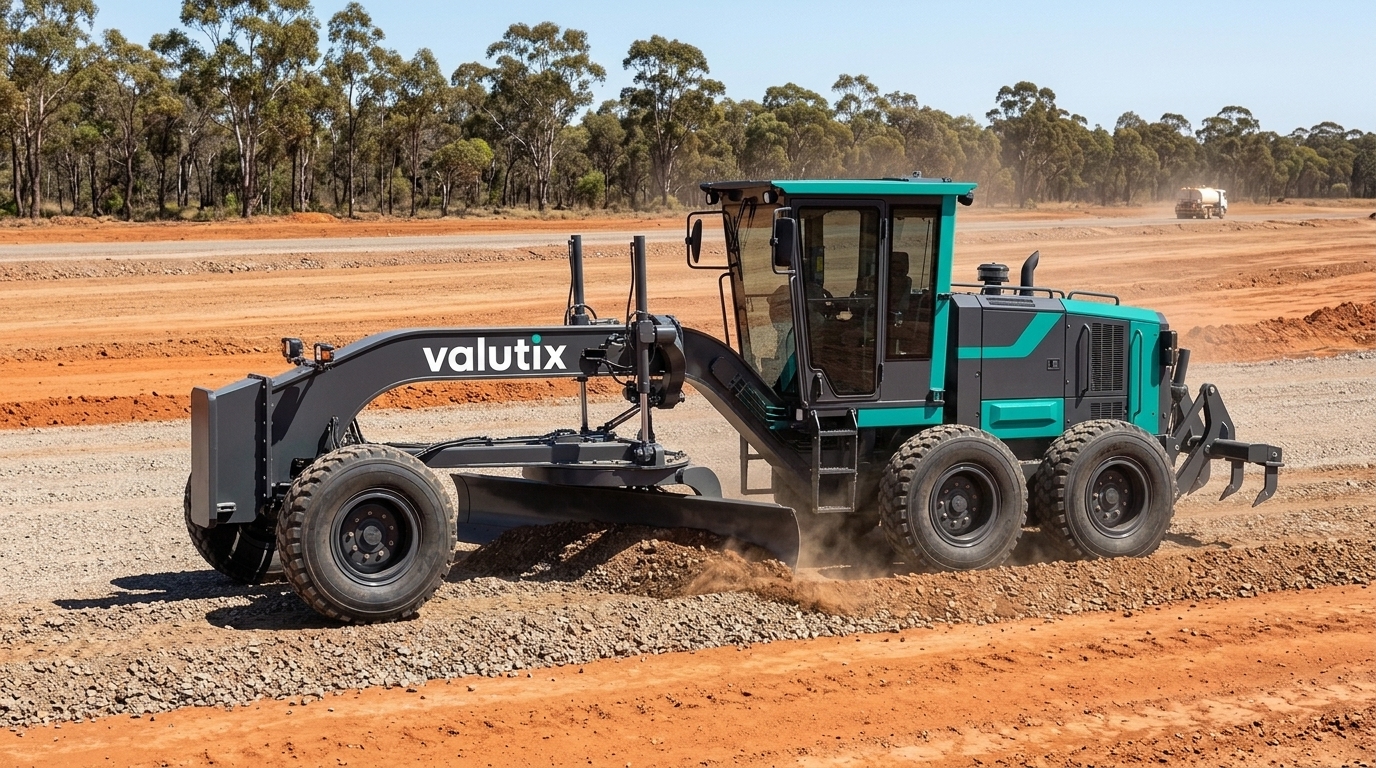
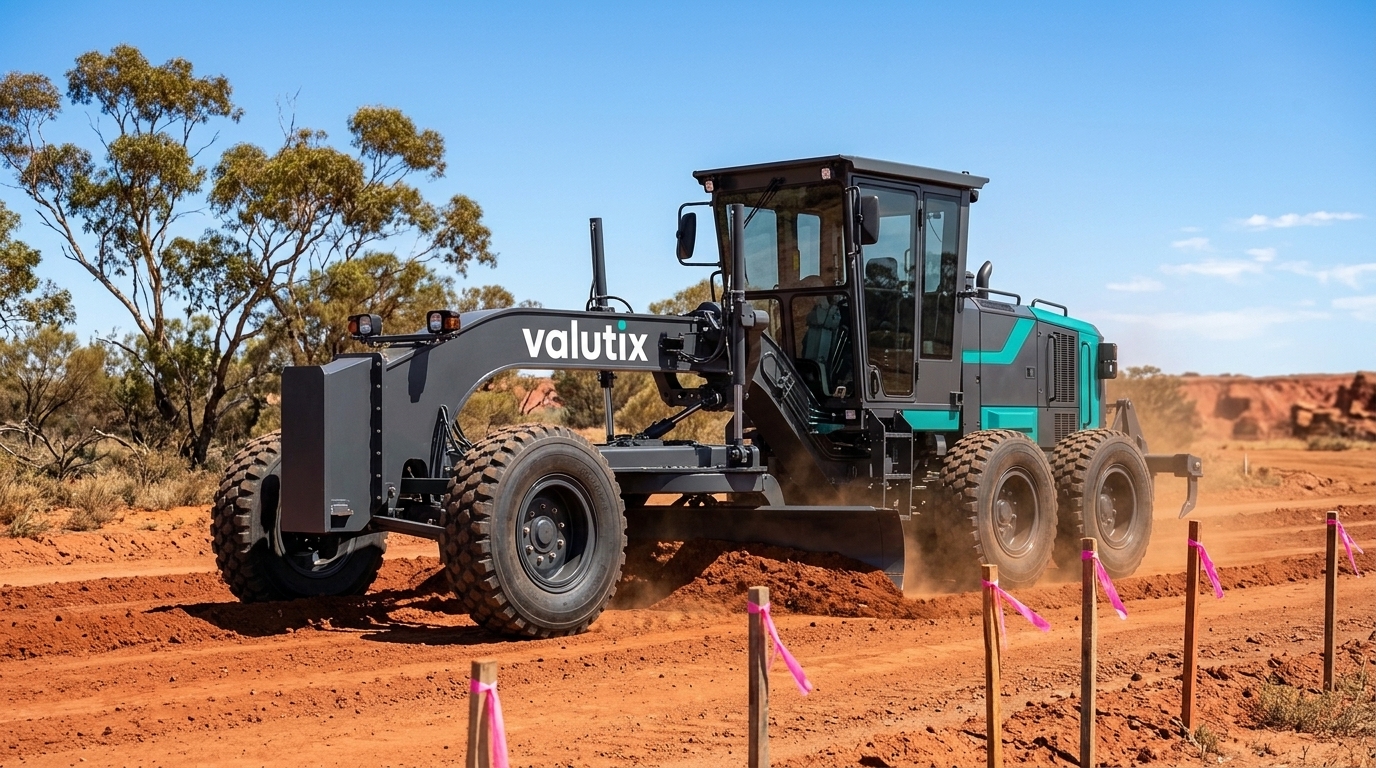
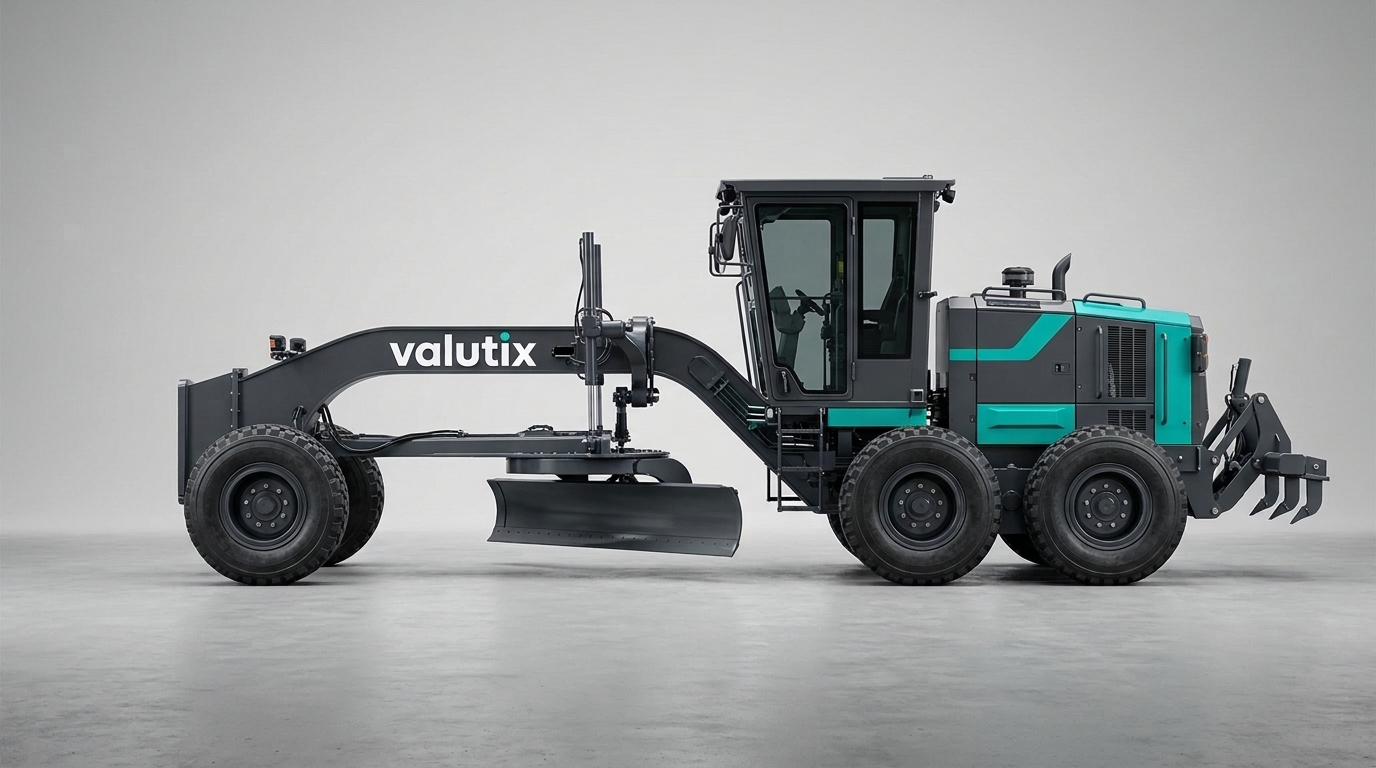
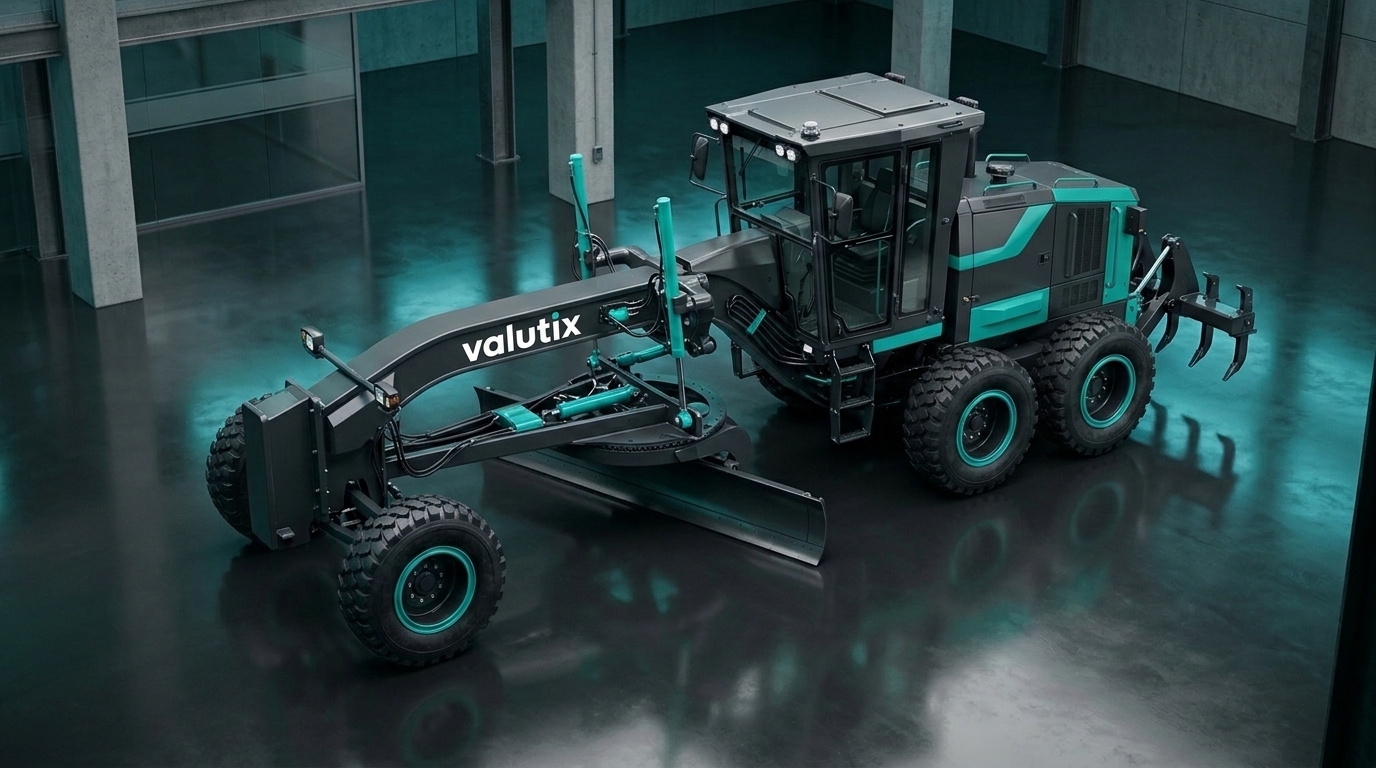
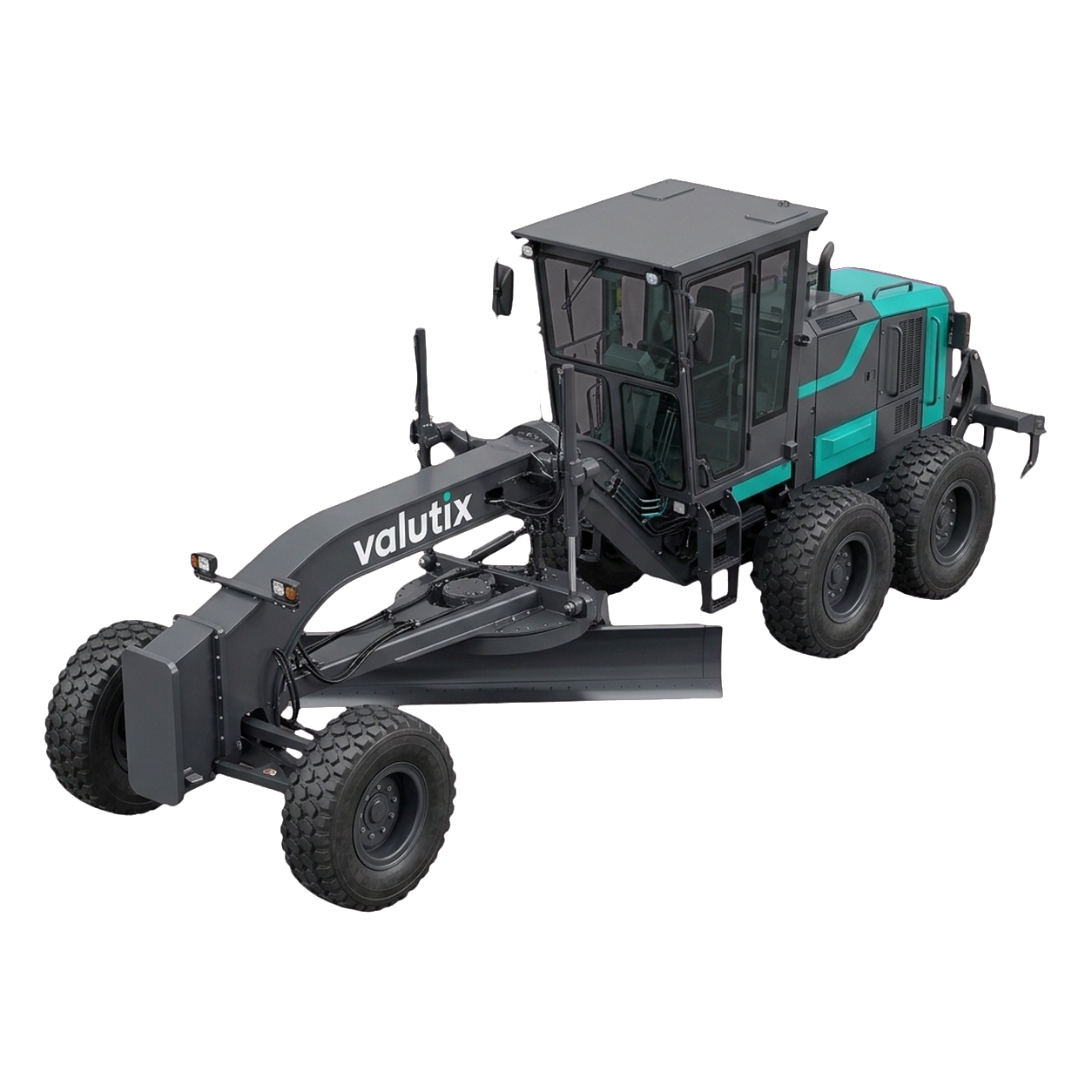
Illustrations featuring the Vaultix civil livery. Machine geometry, articulation, and attachments represent typical Australian civil specifications.
Class planning guide
Published manufacturer specifications for the Cat 140 / 14-16 t class motor grader. Use supplier specifications for exact procurement.
| Ref | Item | Value | Planning note |
|---|---|---|---|
| 01.01 | Operating mass (equipped) | 19,127 kg | Includes cab, full fluids, operator, push block, 14.0R24 tyres and 5-shank rear ripper. |
| 01.02 | Base operating mass | Not verified | Not on the Cat AEXQ4475-00 sheet. The earlier 16,627 kg value was removed. |
| 01.03 | Engine net power (ISO 9249) | 94 to 174 kW (126 to 233 hp) | Cat C7.1 at 2,000 rpm, tandem (non-AWD). AWD range is 98 to 194 kW (131 to 260 hp). Cat tech spec AEXQ4475-00, p2. |
| 01.04 | Standard moldboard width | 3,658 mm (12 ft) | Blade height 610 mm, thickness 22 mm, arc radius 413 mm. Optional 4.27 m (14 ft) blade. |
| 01.05 | Maximum travel speed | 48.3 km/h | 8th gear forward; 9 forward (including finish gear) and 6 reverse. Reverse tops out at 38.1 km/h. Working gears typically 3.0 to 12.0 km/h. |
| 01.06 | Rear ripper / scarifier | 5 shanks / 9 teeth | Max ripping depth 424 mm, penetration force 84.6 kN, pryout force 104.0 kN. |
| 01.07 | Fuel tank / DEF tank | 371 L / 17 L | 371 L diesel; 17 L DEF. Allow DEF separately where Tier 4 Final / Stage V fitted. |
| 01.08 | Fuel burn allowance | About 11 to 24 L/hr | 16.1 L/hr used in rate planning proxy; duty cycle, road gradient and idle time matter. |
| 01.09 | Derived shipping mass | About 18.8 t | Equipped operating mass less fuel and operator; stripped shipping mass not verified. Excludes trailer. Confirm with haulier. |
| Ref | Item | Value | Planning note |
|---|---|---|---|
| 02.01 | Final trim & pavement | 3D UTS / GPS Machine Control | Cat Grade with Cross Slope, Trimble or Topcon systems reduce passes and achieve ±10 mm. |
| 02.02 | Gravel re-sheeting | Ripper, scarifier & water cart | Ripping breaks up compacted corrugations; scarifier and blade blend fresh aggregate. |
| 02.03 | Drainage & batter trim | 90° Bank cut & frame articulation | Offsets machine body onto roadway while blade works steep slope or drain channel. |
| 02.04 | Bulk blading | Blade roll & wheel lean | 18° wheel lean counteracts side-draft when cutting heavy cohesive windrows. |
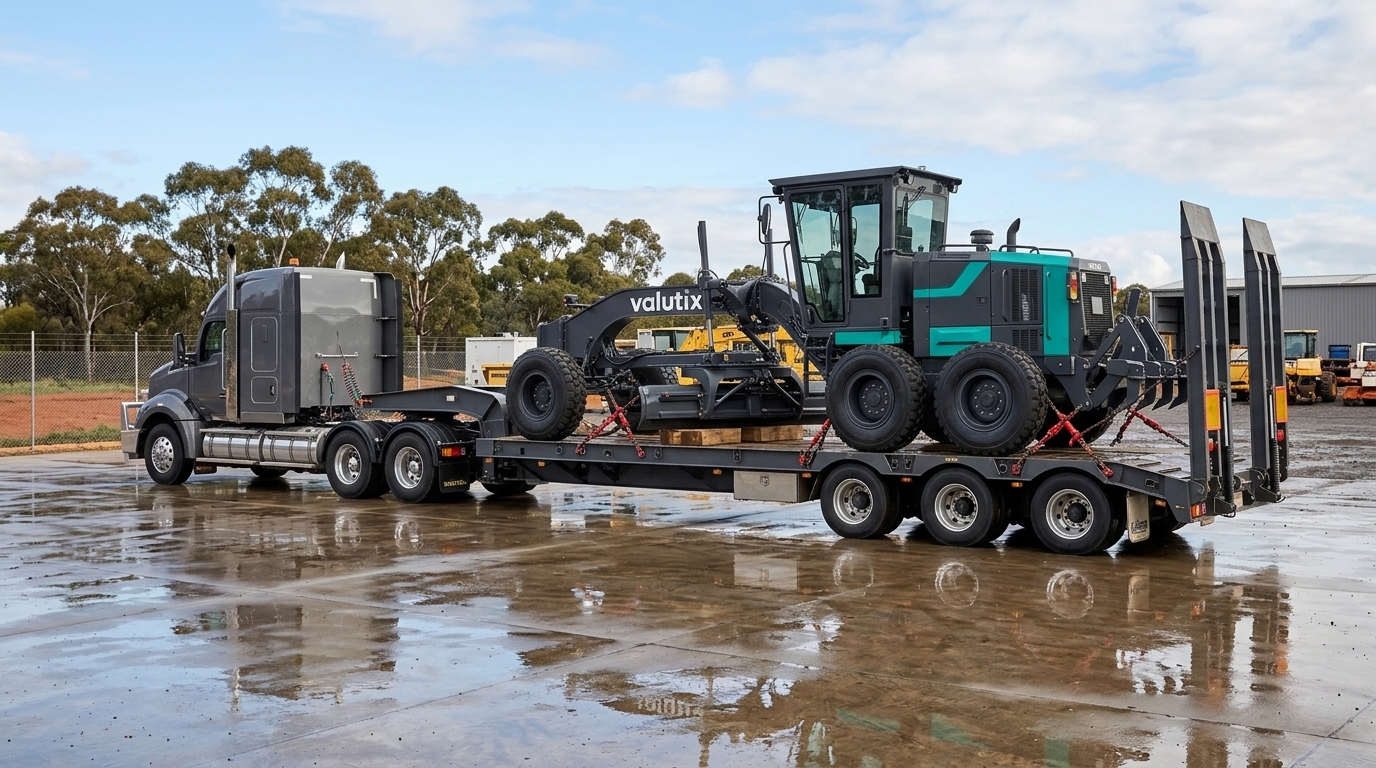
| 02.05 | Float transport | Drop-deck low-loader float | Blade angled along deck; check 2.51 m tyre width, 4.2 m combined height and axle limits. |
Dimensions and transport planning
Machine dimensions exclude the transport float trailer. Obtain verified deck height, loaded envelope, axle group weights, route clearance and restraint plans from haulier before mobilisation.
| Code | Dimension | Published value | Planning note |
|---|---|---|---|
| A | Overall length (push plate to ripper) | 10,297 mm | Push plate to ripper (Cat sheet p7). |
| B | Height to top of cab (ROPS) | 3,454 mm | Measured with standard 14.00R24 tyres. Excludes float deck. |
| C | Height to top of exhaust stack | 3,313 mm | Exhaust stack clearance from ground line. |
| D | Wheelbase (front axle to tandem center) | 6,136 mm | Primary stability and levelling base. |
| E | Length, front axle to moldboard | 2,552 mm | Drawbar geometry governing blade positioning. |
| F | Tandem axle spacing | 1,523 mm | Drive bogie axle spacing. |
| G | Width outside front tyres | 2,521 mm | Lever tandem, 14.00R24 tyres. Joystick tandem 2,583 mm; AWD 2,667 mm. |
| H | Width outside rear tyres | 2,506 mm | Drive tandem width. |
| I | Ground clearance at rear axle | 339 mm | Clearance under rear differential. |
| J | Ground clearance at front axle | 596 mm | Front leaning axle ground clearance. |
| K | Overall width across standard blade | 3,658 mm | Blade is angled along deck for float transport. |
| L | Turning radius (outside front tyres) | 7,500 mm | Using front steering, wheel lean, and full frame articulation. |
Working range & kinematics
Kinematic capabilities for blade sideshift, circle rotation, frame articulation and bank cutting angles. Allow for soil friction, slope stability, and operator visibility.
| Code | Kinematic range item | Published value |
|---|---|---|
| 1 | Circle centershift right | 740 mm |
| 2 | Circle centershift left | 724 mm |
| 3 | Moldboard sideshift right | 947 mm |
| 4 | Moldboard sideshift left | 821 mm |
| 5 | Maximum blade position angle | 90 degrees (both sides) |
| 6 | Blade tip range forward | 50 degrees |
| 7 | Blade tip range rear | 5 degrees |
| 8 | Max shoulder reach outside tyres right | 1,948 mm |
| 9 | Max shoulder reach outside tyres left | 1,830 mm |
| 10 | Maximum blade lift above ground | 447 mm |
| 11 | Maximum depth of cut | 640 mm |
| 12 | Front wheel lean angle | 18 degrees (left & right) |
| 13 | Frame articulation angle | 20 degrees (left & right) |
Direct cost and market hire prices
Never invent hire rates. In strict accordance with Vaultix estimating governance, all hire rate figures for this 14-16 t grader class are recorded as not-yet-quoted placeholders. Enter verified project supplier quotes in the calculator below.
Metro and Remote direct costs
| Basis / AUD ex GST | Metro | Remote |
|---|---|---|
| Direct dry / hr | Not yet quoted (placeholder) | Not yet quoted (placeholder) |
| Direct wet / hr | Not yet quoted (placeholder) | Not yet quoted (placeholder) |
| Grader operator / paid site hr | Not yet quoted (placeholder) | Not yet quoted (placeholder) |
| Delivered diesel / L | 1.94 (reference proxy) | 2.23 (reference proxy) |
| Maintenance, parts and freight | Base allowance | Base plus 25% |
| Roster and camp | Metro working-week roster | 14/7 FIFO, 12-hour days, camp and flights |
Standing decision: Rates for this class have not yet been quoted or audited for vaultix.com.au. To ensure estimating integrity, rates are never estimated from other classes without supplier evidence. Estimators can input their project quotes directly in the instrument below.
Mobilisation, separate one-off cost
| Purchased transport / AUD ex GST | Metro | Remote |
|---|---|---|
| One delivery event | To be quoted by haulier | To be quoted by haulier |
Float mobilisation depends on transport distance, route permits, pilot escorts (for 3.66 m blade width if carried straight) and float deck availability. Allow separate return demobilisation event.
| Source / date | Hire basis | Per hour | Per day | Per week | Conditions |
|---|---|---|---|---|---|
| Awaiting supplier tender verification Status: Unquoted placeholder |
Dry / Wet pending quotes | Not yet quoted | Not yet quoted | Not yet quoted | All hire rate values are unquoted placeholders. Obtain 3 dated project rate cards including GPS/UTS machine control options, fuel inclusion, wear terms and float costs. |
First-principles direct hourly cost
| Component | Direct dry AUD/hr | Direct wet AUD/hr |
|---|---|---|
| Ownership: depreciation and interest | Not yet quoted | Not yet quoted |
| Insurance and registration | Not yet quoted | Not yet quoted |
| Maintenance, servicing, tyres and GET | Not yet quoted | Not yet quoted |
| Fuel and operating lubricants (16.1 L/hr proxy) | 0.00 | Not yet quoted |
| Grader operator cost per paid site hour | 0.00 | Not yet quoted |
| Direct cost per operating hour | Not yet quoted | Not yet quoted |
Placeholder. Replace with a current supplier quote; no hire rates are invented or assumed.
Productivity and calculator
Finished area m2/hr = speed km/h x 1,000 x effective blade width m x efficiency / passes. Linear advance km/hr = speed km/h x efficiency / passes. Single-pass rate m2/hr = speed km/h x 1,000 x effective blade width m x efficiency. All speed, width, pass count and efficiency factors are Vaultix estimating assumptions.
Activity estimating guides
Vaultix estimating standards, 9 November 2026. Joint planning scenarios, not statistical confidence limits.
Low: speed x 0.85, width x 0.90, efficiency x 0.80, passes x 1.20. High: speed x 1.15, width x 1.05 (cap 4.3 m), efficiency x 1.10 (cap 1.00), passes x 0.85 (min 1).
01Final trim of subgrade
Precision skim trimming of prepared subgrade to tight vertical tolerances (±10 mm to ±15 mm) prior to placing subbase. Commonly executed using 3D UTS (Universal Total Station) or mmGPS machine guidance.
Vaultix assumptions: Speed 3.5 km/h (Gear 1-2); effective width 2.8 m; 3 passes (cut to windrow, blade out, skim trim); efficiency 70%.
Worked example: (3.5 x 1000 x 2.8 x 0.70) / 3 = 2,287 m²/hr, or 18,293 m² in an 8-hour shift. Net advance: 0.82 linear km/hr.
Allow for: Survey control points, UTS prism tracking, smooth drum roller coordination, moisture misting, and spot checks by grade checker.
Pitfalls: Machine speed must be restrained for 3D guidance hydraulic response; attempting excessive travel speed induces washboarding and level failure.
02Pavement shaping
Spreading, crossfall profiling (e.g. 3% standard crown, superelevations), and level shaping of unbound crushed rock road base and subbase courses.
Vaultix assumptions: Speed 4.5 km/h (Gear 2); effective width 2.8 m; 4 passes (spread, shape, roll-correct, final crown dress); efficiency 70%.
Worked example: (4.5 x 1000 x 2.8 x 0.70) / 4 = 2,205 m²/hr, or 17,640 m² in an 8-hour shift. Net advance: 0.79 linear km/hr.
Allow for: Water cart for OMC (optimum moisture content) blending, multi-tyre and padfoot/smooth drum rollers, and crossfall template checks.
Pitfalls: Aggregate segregation occurs if material is bladed dry or worked excessively. Ensure water cart operates directly with grader.
03Gravel re-sheeting
Reconditioning unsealed roads: scarifying worn surface, spreading dumped gravel aggregate to 100-150 mm uncompacted thickness, crowning and boxing edges.
Vaultix assumptions: Speed 5.0 km/h (Gear 2-3); effective width 2.7 m; 5 passes (initial scarify, knockdown, blade mix, shape crown, tidy edge); efficiency 70%.
Worked example: (5.0 x 1000 x 2.7 x 0.70) / 5 = 1,890 m²/hr, or 15,120 m² in an 8-hour shift. Net advance: 0.70 linear km/hr.
Allow for: Rear scarifier shank tooth wear, heavy water cart allocation, traffic control on live rural corridors, and road roller compaction.
Pitfalls: Failure to scarify the hard underlying crust produces a plane of weakness that leads to premature pavement corrugation and delamination.
04Windrow spreading and blading
High-volume spreading of dumped fill or stockpile material across bulk earthwork embankments or roadbeds into uniform layer thicknesses (150-250 mm).
Vaultix assumptions: Speed 6.0 km/h (Gear 3); effective width 2.6 m (steep blade angle to discharge heavy windrow); 2 passes; efficiency 75%.
Worked example: (6.0 x 1000 x 2.6 x 0.75) / 2 = 5,850 m²/hr, or 46,800 m² in an 8-hour shift. Net advance: 2.25 linear km/hr.
Allow for: Haul truck tipping coordination, dozer assistance on oversized boulders, wheel lean to counteract blade draft, and high fuel burn.
Pitfalls: Spreading lifts thicker than compaction equipment specification causes hidden density failures in subgrade layers.
05Table drain and V-drain formation
Excavating and shaping longitudinal roadside drainage swales, V-drains, and table drains. Uses blade heel pitched in invert with front wheels leaned.
Vaultix assumptions: Speed 3.0 km/h (Gear 1); effective width 1.8 m (angled ditch cut); 4 passes (initial cut, windrow throw, backslope trim, invert clean); efficiency 55%.
Worked example: (3.0 x 1000 x 1.8 x 0.55) / 4 = 743 m²/hr, or ~412 linear metres of table drain formed per hour.
Allow for: High draft loads, blade wear strips, articulated frame steering to keep drive tandems on firm shoulder, and culvert headwall cleanouts.
Pitfalls: Wet ditch inverts can trap front wheels. Ensure articulation keeps tandems on firm roadway rather than driving into soft swale bottom.
06Haul-road maintenance
Rapid routine maintenance of active heavy civil and quarry haul roads: skimming washboards, clearing rock spillage, and restoring crossfall for runoff.
Vaultix assumptions: Speed 8.0 km/h (Gear 4); effective width 3.0 m (flat blade angle for light skim); 2 passes (up and down corridor); efficiency 80%.
Worked example: (8.0 x 1000 x 3.0 x 0.80) / 2 = 9,600 m²/hr, or 3.2 linear km of haul road maintained per hour.
Allow for: Active traffic integration with dump trucks, safety communications on mine radio channel, dust suppression water cart, and tyre wear.
Pitfalls: Avoid leaving loose windrows on active haul roads where haul truck tyres can sustain impact cuts or loose rock throwing.
07Batter dressing
Trimming and dressing cut/fill batters (slopes typically 1:2 to 1:4). Machine runs on roadway or bench while moldboard extends up or down the slope.
Vaultix assumptions: Speed 3.0 km/h (Gear 1); effective width 2.2 m (angled on batter slope); 3 passes; efficiency 50%.
Worked example: (3.0 x 1000 x 2.2 x 0.50) / 3 = 1,100 m²/hr, or 8,800 m² in an 8-hour shift.
Allow for: Frequent repositioning, circle sideshift adjustment, spotter for slope safety, drainage check dams, and cleanout of fallen spoil.
Pitfalls: Machine rollover hazard if driven too close to soft crest. Use full circle side-shift (947 mm right) and shoulder reach (1,948 mm right) from safe hardstand.
Estimator checks
- Specify moldboard length with supplier: standard 3.66 m (12 ft) vs optional 4.27 m (14 ft); wider blades increase pass area by approximately 15%.
- Confirm machine control receivers and mast mounts: 3D UTS (total station) or mmGPS is essential for final trim subgrade and pavement tolerances.
- Check rear attachment: 5-shank ripper is standard for Australian civil machines; verify whether scarifier shanks are installed for re-sheeting.
- Price transport loaded: 3.31 m bare machine height on a 900 mm drop-deck float yields ≈4.21 m overall travel height. Confirm bridge clearances and route permits.
- Shipping weight is derived at ≈18.8 t equipped; the stripped weight is not verified. Confirm haulier axle loading and oversize signage for 3.66 m blade width.
- All hire rate schedules are unquoted placeholders. In accordance with Vaultix estimating principles, never invent hire rates without formal supplier tenders.
- Output is area-governed (m²/hr) and linear-governed (km/hr), not bucket volume. Balance grader output with compaction rollers and water cart delivery.
- No HRWL class required; operator competency confirmed by VOC and RIIMPO310E.
Data basis. Reference model: Cat 140 Motor Grader, OEM sheet AEXQ4475-00, standard direct-drive powershift configuration. Sourced 9 November 2026 and corrected against the Cat 140 tech spec (Oct 2025) after an independent check; items marked Not verified are not on that sheet. Fuel uses OEM Performance Handbook telematics proxy (16.1 L/hr medium duty). Productivity uses Vaultix estimating formulas. Hire rates remain unquoted placeholders pending verified tenders. Sources and assumptions.
Entry / grader-16t Issue / 2026-11-09
Library navigation
Plant and method index · Discipline work packages · Survey conformance and lot release