Plant / 15 to 25 t pneumatic multi-tyre roller
20-Tonne Multi-Tyre Roller
The benchmark pneumatic multi-tyre compactor for asphalt intermediate and finish sealing, sprayed seal chip embedment, and granular base kneading.
- Pneumatic tyresPressure and ballast govern contact conditions.
- Ballast bodyConfirm the agreed working configuration.
- Operator stationAllow for turning and overlap in the rolling pattern.
- Rolling width
- 2.04m
- Operating weight
- 20,000kg Not verified
AUD ex GST. *Unquoted placeholder. In accordance with Vaultix estimating principles, hire rates are never invented or extrapolated. Obtain current supplier quotations.
Choosing this class of multi-tyre roller
A 15-25 t ballasted class pneumatic multi-tyre roller (such as the BOMAG BW 27 RH) is the benchmark compaction and kneading machine across Australian road construction and asphalt surfacing. Equipped with 8 smooth compaction tyres (4 front oscillating, 4 rear driven with 42 mm track overlap), hydrostatic dual hydraulic motor rear axle drive, a 100 kW Deutz engine, a 3.5 m³ ballast compartment, and a 400 L pressurised water sprinkler, it delivers tailored ground contact pressure (2.0 to 8.1 bar) for asphalt sealing, chip embedment, and granular base interlock. Compaction productivity is modeled by compacted surface area (m²/hr) or compacted volume (m³/hr) governed by rolling speed, compaction width (2.042 m), required pass count, lift thickness, and site efficiency.
The benchmark pneumatic multi-tyre compactor for asphalt intermediate and finish sealing, sprayed seal chip embedment, and granular base kneading.
15 to 25 t class / 2,042 mm rolling width / Multi-tyre roller / Civil estimating guide
- Intermediate and finish rolling of dense-graded asphalt courses (AC10, AC14, AC20) to seal surface voids and eliminate microcracks
- Sprayed chip seal rolling behind aggregate spreader to re-orient aggregate onto its flat face without crushing stone
- Granular road base kneading (e.g. 150 mm crushed rock / DGB20 / Type 2.1) to interlock flaky aggregates and tighten matrix
- In-situ cement, lime, or slag stabilized pavement finish rolling to close surface shearing tears before initial set
- Cold-mix and foamed bitumen stabilized base (FBSB) layer compaction to expel moisture and orient bitumen mastic
- Subgrade proof rolling and deflection testing to expose soft spots under high concentrated wheel loads
- Industrial pavement and airport runway asphalt surfacing requiring tight void closure
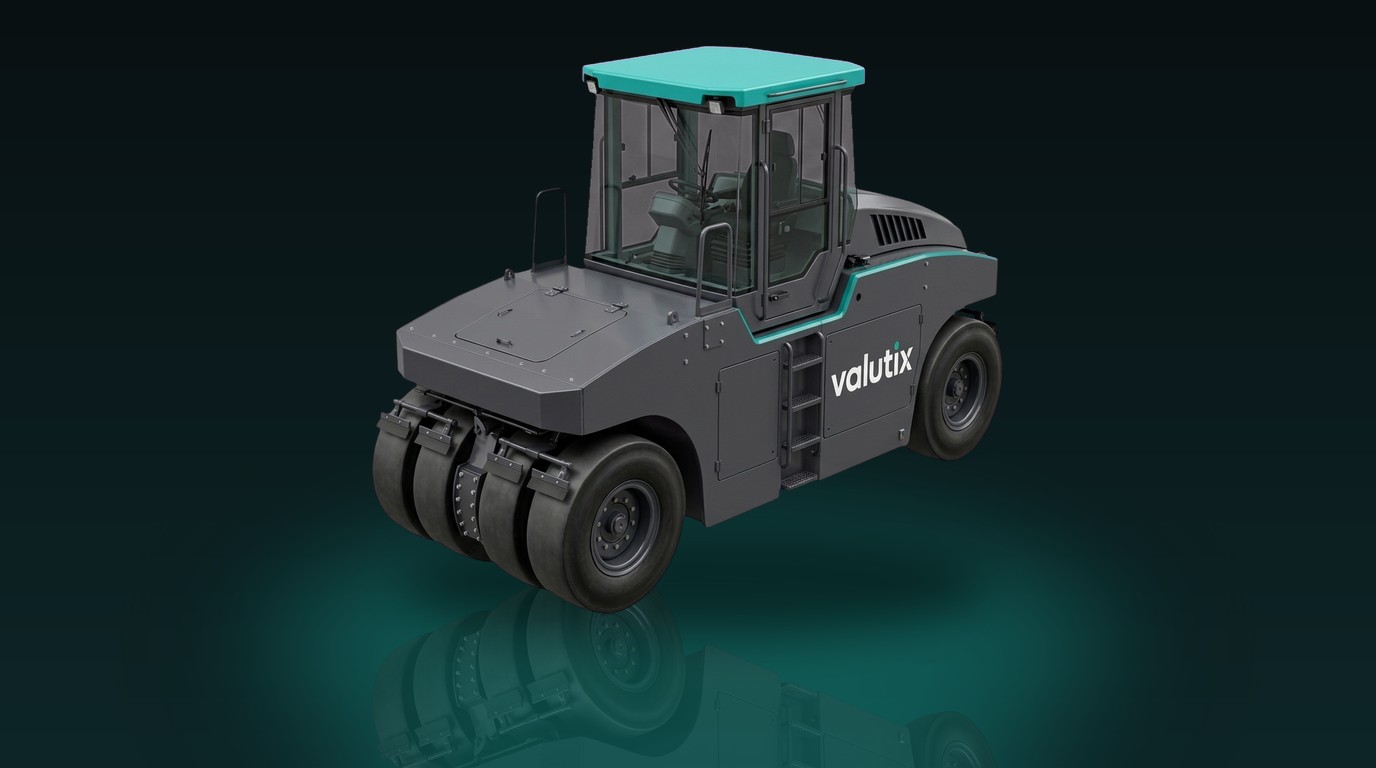
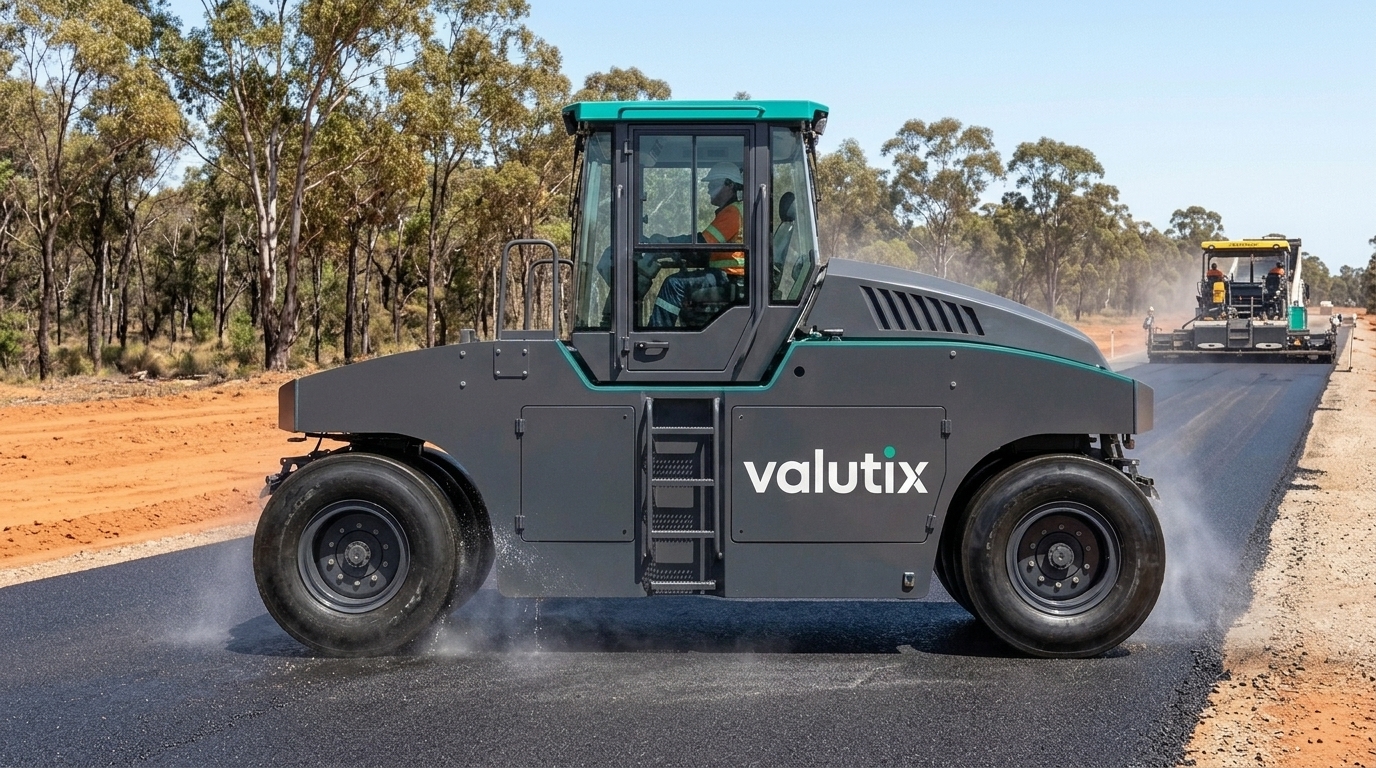
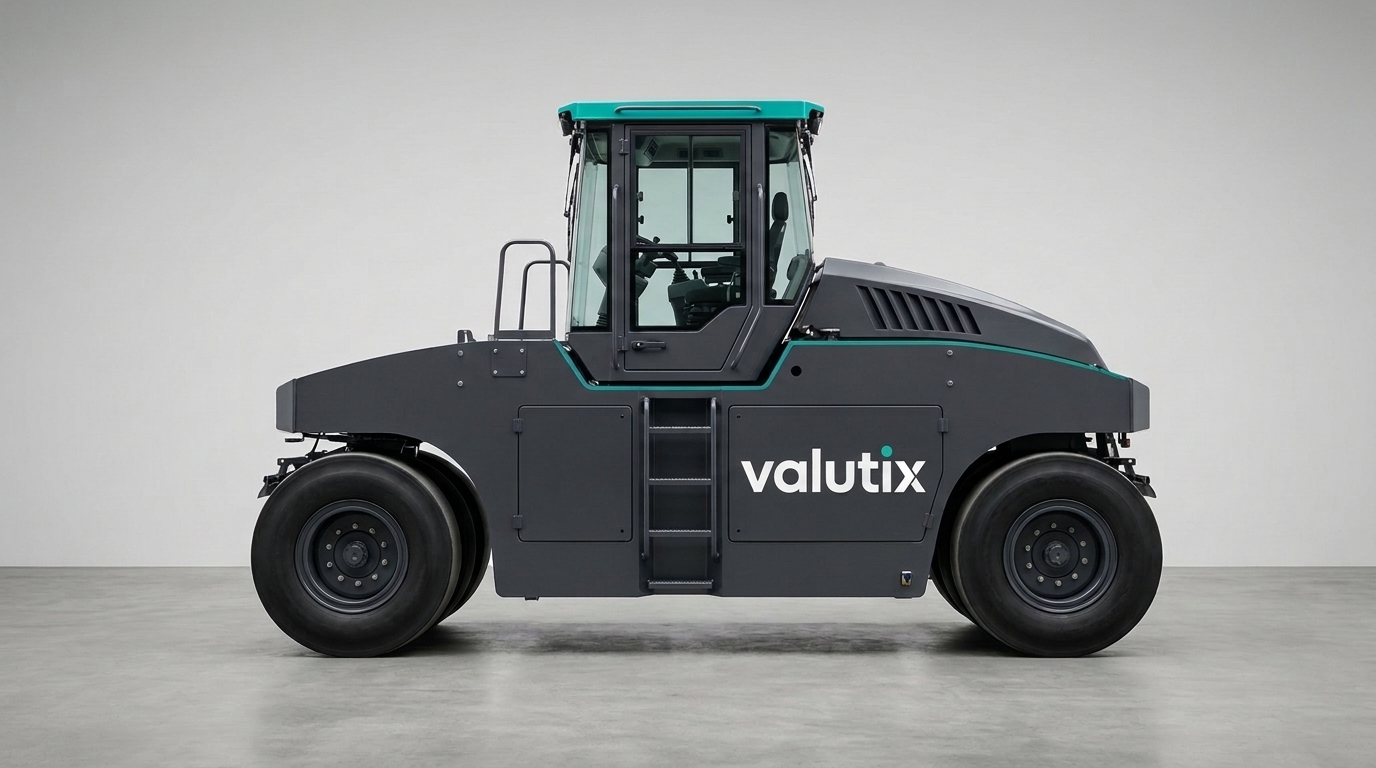
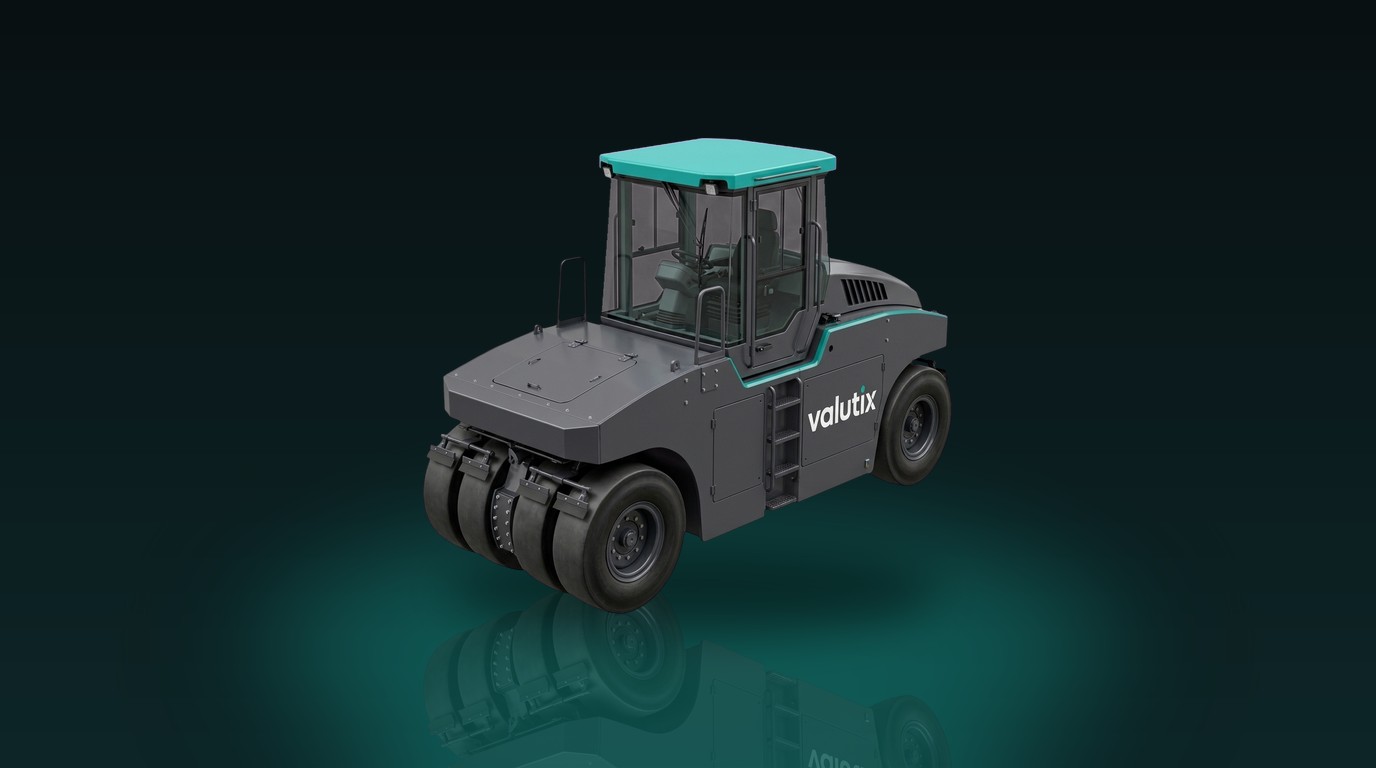
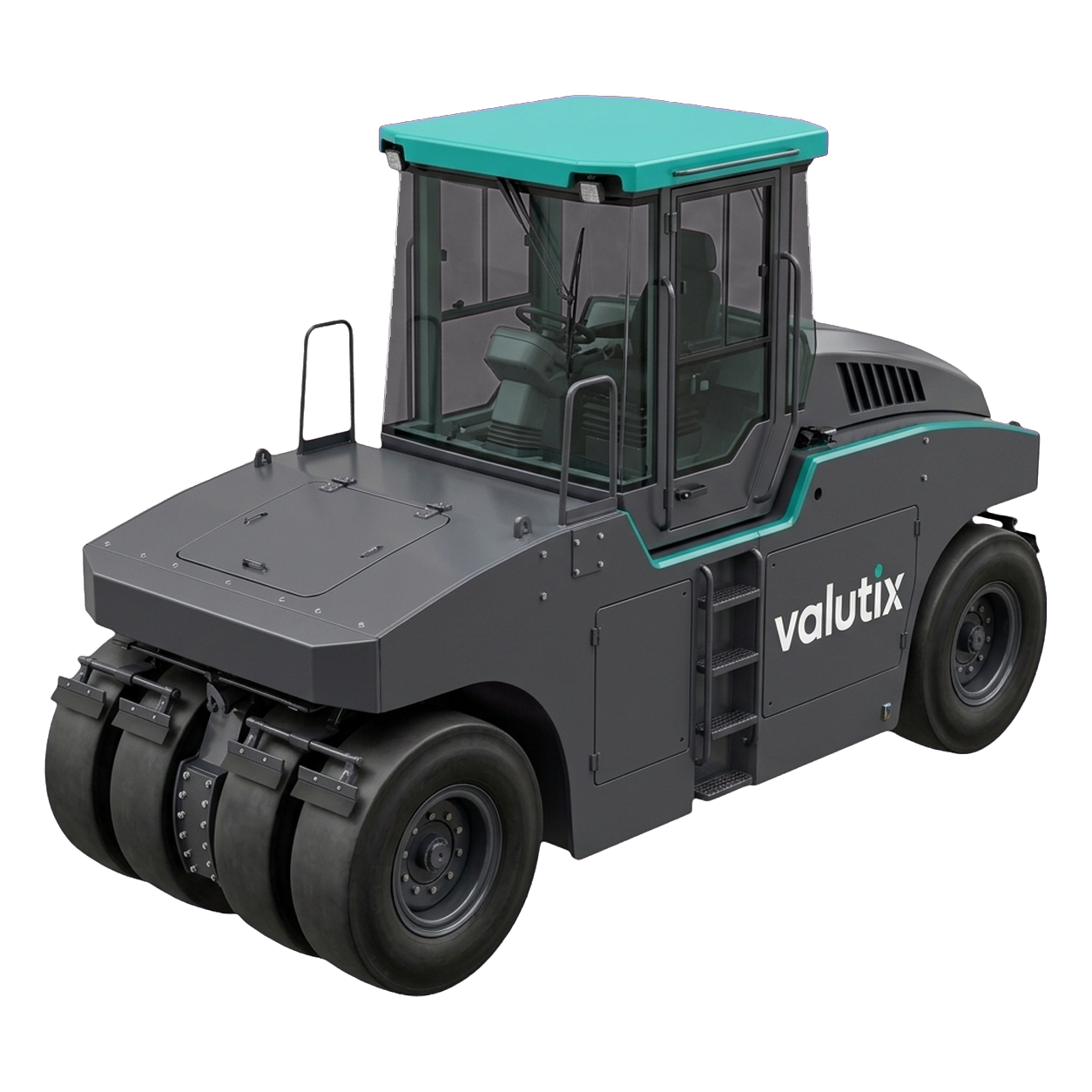
Illustrations featuring the Vaultix civil livery. Machine geometry, articulation, and attachments represent typical Australian civil specifications.
Class planning guide
Published manufacturer specifications for the BOMAG BW 27 RH / 15-25 t class pneumatic multi-tyre roller. Use supplier specifications for exact procurement.
| Ref | Item | Value | Planning note |
|---|---|---|---|
| 01.01 | Operating mass | 20,000 kg (typical ballasted) / 13,600 kg (unballasted) | Derived: 13,600 kg unballasted + 6,400 kg ballast (3.5 m³ sand) = 20,000 kg nominal civil roadworks setup. Source: https://www.bomag.com / Technical Data PRE 99 400 001 p. 2 |
| 01.02 | Maximum operating mass | 27,000 kg (max ballast) | Max permissible operating weight with dense ballast (magnetite or steel scrap). Max ballast about 13,100 kg (largest granulate option) (Derived: 27,000 kg - 13,600 kg). Source: https://www.bomag.com / Technical Data PRE 99 400 001 p. 2 |
| 01.03 | Compaction width | 2,042 mm | 8 smooth compaction tyres (4 front, 4 rear) with 42 mm track overlap for gapless surface kneading. Source: https://www.bomag.com / Technical Data PRE 99 400 001 p. 2 |
| 01.04 | Mean wheel load | Not verified (depends on tyre count) | Derived: 20,000 kg / 8 = 2,500 kg/tyre. At 27,000 kg max weight = 3,375 kg/tyre (Derived: 27,000 kg / 8). Source: https://www.bomag.com / Technical Data PRE 99 400 001 p. 2 |
| 01.05 | Engine power | 100 kW (134 hp) | Deutz TCD 2012 L04 2V turbocharged 4-cylinder diesel at 2,300 rpm (Stage IIIa / Tier 3; no DEF required). Source: https://www.bomag.com / Technical Data PRE 99 400 001 p. 2 |
| 01.06 | Tyre air pressure range | 2.0 to 8.1 bar (200 to 810 kPa) | Pushbutton modulation via optional factory Central Tyre Inflation System (Air-on-the-Run). Source: https://www.bomag.com / Technical Data PRE 99 400 001 pp. 2–3 |
| 01.07 | Fuel allowance | About 7.5 to 17.5 L/hr | 12.5 L/hr civil roadworks medium duty used in planning; 250 L fuel tank provides ~18.5 hours continuous rolling. Source: Telematics & Deutz 100 kW engine load factor. |
| 01.08 | Shipping mass | About 13,400 kg | Derived: 13,600 kg CECE operating weight less 75 kg operator and fluid allowance (~125 kg) = 13,400 kg unballasted dry transport mass. Excludes float trailer. Ballast must be completely emptied before float transport. Source: https://www.bomag.com / Technical Data PRE 99 400 001 p. 2 |
| Ref | Item | Value | Planning note |
|---|---|---|---|
| 02.01 | Asphalt intermediate rolling | 550 to 750 kPa / 18-22 t ballast | Kneads mix horizontally to close void structure without crushing aggregates; operates behind breakdown steel drum. |
| 02.02 | Sprayed seal embedment | 450 to 600 kPa / 15-18 t ballast | Contours around stone chips to re-orient aggregate onto flat face without fracturing aggregate edges. |
| 02.03 | Granular base kneading | 300 to 500 kPa / 20-25 t ballast | Deep horizontal kneading shear forces knit unbound crushed rock and eliminate laminations. |
| 02.04 | Water sprinkler system | 400 L pressurised electric sprinkler | Dual spray bars with individual tyre nozzles and cocoa mats prevent hot asphalt pick-up. |
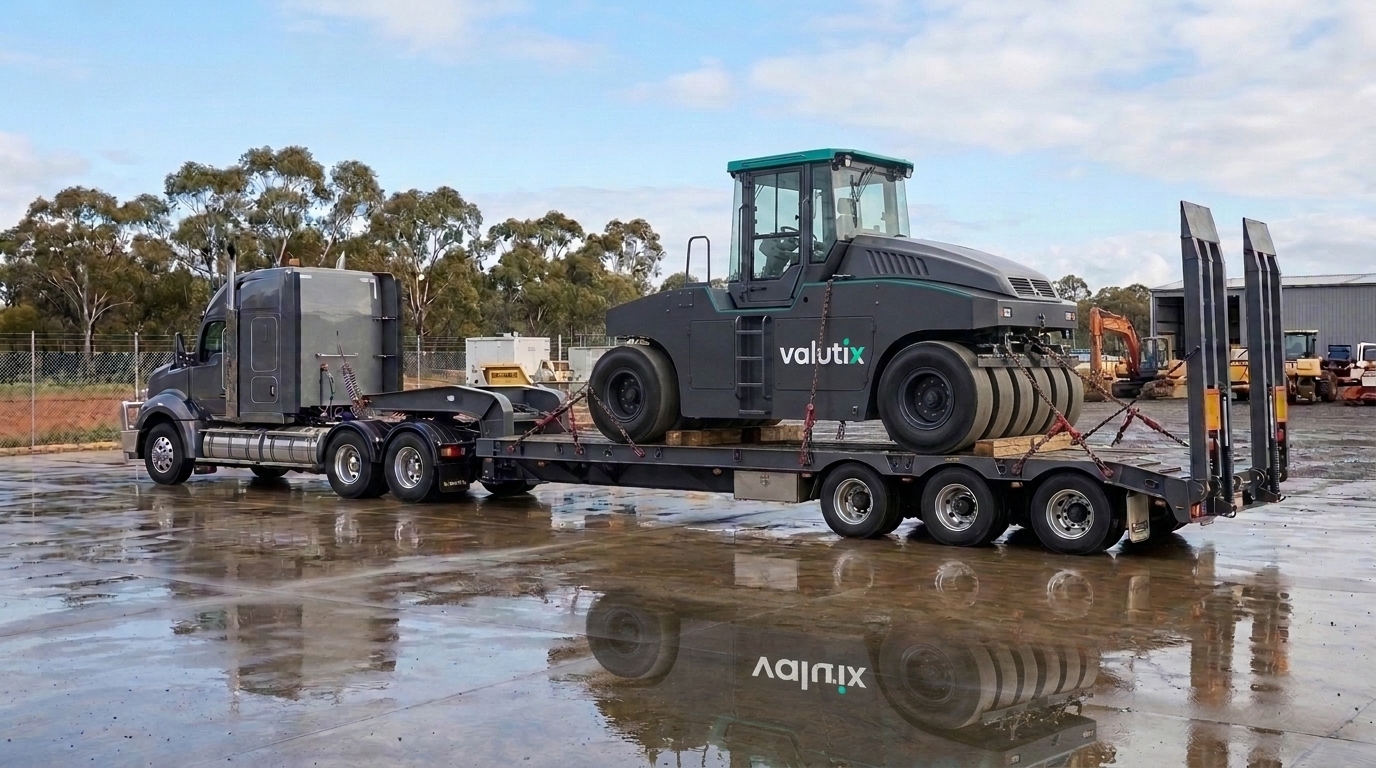
| 02.05 | Transport | Drop-deck low loader float | 2.10 m width and 3.09 m height allow general access highway transit without NHVR oversize permits. Must travel unballasted. |
Dimensions and transport planning
Machine dimensions exclude the transport float trailer. Obtain verified deck height, loaded envelope, axle group weights, route clearance and restraint plans from haulier before mobilisation.
| Code | Dimension | Published value | Planning note |
|---|---|---|---|
| A | Wheelbase | 3,700 mm | Centerline front axle to centerline rear drive axle. Source: https://www.bomag.com / Technical Data PRE 99 400 001 p. 2 |
| B | Overall width | 2,098 mm | Maximum overall machine width across chassis and outer tyre sidewalls. General access boundary. Source: https://www.bomag.com / Technical Data PRE 99 400 001 p. 2 |
| H | Height without cabin / ROPS | 2,840 mm | Height to top of steering console / folding frame. Source: https://www.bomag.com / Technical Data PRE 99 400 001 p. 2 |
| H2 | Height with ROPS cabin | 3,090 mm | Ground line to top of ROPS/FOPS cabin roof beacon / structure. Excludes float deck. Source: https://www.bomag.com / Technical Data PRE 99 400 001 p. 2 |
| K | Ground clearance | 300 mm | Lowest chassis ground clearance under central frame. Source: https://www.bomag.com / Technical Data PRE 99 400 001 p. 2 |
| L | Overall length | 4,940 mm | Bumper to bumper overall length. Source: https://www.bomag.com / Technical Data PRE 99 400 001 p. 2 |
| W | Compaction / working width | 2,042 mm | Standard rolling width covered across 8 compaction tyres. Source: https://www.bomag.com / Technical Data PRE 99 400 001 p. 2 |
| Overlap | Wheel track overlap | 42 mm | Offset overlap between front and rear tyre tracks ensuring complete gapless surface kneading. Source: https://www.bomag.com / Technical Data PRE 99 400 001 p. 2 |
| R1 | Inner track radius | 5,320 mm | Turning radius measured to inside wheel track at full steering articulation. Source: https://www.bomag.com / Technical Data PRE 99 400 001 p. 2 |
| R2 | Outer turning radius (derived) | 7,362 mm | Derived: 5,320 mm inner radius + 2,042 mm working width = 7,362 mm outside turning radius. Source: https://www.bomag.com / Technical Data PRE 99 400 001 p. 2 |
Working range & kinematics
Operational geometry, ballast capacity, ground contact pressures, and steering kinematics for the BOMAG BW 27 RH 20 t pneumatic multi-tyre roller. Ballast media payload and tyre pressure settings govern compaction performance and site manoeuvrability.
| Code | Kinematic range item | Published value |
|---|---|---|
| 1 | Compaction path width | 2,042 mm |
| 2 | Wheel track overlap | 42 mm |
| 3 | Inner turning radius | 5,320 mm |
| 4 | Outer turning radius (derived) | 7,362 mm (Derived: 5,320 mm inner radius + 2,042 mm working width = 7,362 mm) |
| 5 | Chassis ground clearance | 300 mm |
| 6 | Ballast compartment volume | 3.5 m³ |
| 7 | Water sprinkler tank capacity | 400 L |
| 8 | Operating mass range (unballasted to max ballast) | 13,600 kg to 27,000 kg |
| 9 | Mean wheel load range (unballasted to max ballast) | 1,700 kg to 3,375 kg (Derived: 13,600 kg / 8 to 27,000 kg / 8) |
| 10 | Tyre contact pressure range | 200 to 810 kPa (2.0 to 8.1 bar) |
| 11 | Steering articulation angle | ±30 degrees |
| 12 | Maximum travel speed | 20.0 km/h |
Direct cost and market hire prices
Never invent hire rates. In strict accordance with Vaultix estimating governance, all hire rate figures for this 15-25 t pneumatic multi-tyre roller class are recorded as not-yet-quoted placeholders. Enter verified project supplier quotes in the calculator below.
Metro and Remote direct costs
| Basis / AUD ex GST | Metro | Remote |
|---|---|---|
| Direct dry / hr | Not yet quoted (placeholder) | Not yet quoted (placeholder) |
| Direct wet / hr | Not yet quoted (placeholder) | Not yet quoted (placeholder) |
| Roller operator / paid site hr | Not yet quoted (placeholder) | Not yet quoted (placeholder) |
| Delivered diesel / L | 1.94 (reference proxy) | 2.23 (reference proxy) |
| Maintenance, parts and freight | Base allowance | Base plus 25% |
| Roster and camp | Metro working-week roster | 14/7 FIFO, 12-hour days, camp and flights |
Standing decision: Rates for this class have not yet been quoted or audited for vaultix.com.au. To ensure estimating integrity, rates are never estimated from other classes without supplier evidence. Estimators can input their project quotes directly in the instrument below.
Mobilisation, separate one-off cost
| Purchased transport / AUD ex GST | Metro | Remote |
|---|---|---|
| One delivery event | To be quoted by haulier | To be quoted by haulier |
Float mobilisation depends on transport distance, route permits, and float deck availability. Machine dimensions (2.10 m width, 3.09 m height, ~13.4 t unballasted shipping mass) comply with standard Australian general access limits without NHVR oversize permits. Mandatory requirement: All ballast must be completely drained or emptied prior to transport. Allow separate return demobilisation event.
| Source / date | Hire basis | Per hour | Per day | Per week | Conditions |
|---|---|---|---|---|---|
| Awaiting supplier tender verification Status: Unquoted placeholder |
Dry / Wet pending quotes | Not yet quoted | Not yet quoted | Not yet quoted | All hire rate values are unquoted placeholders. Obtain 3 dated project rate cards including CTIS (Central Tyre Inflation System), thermal apron fitment, water sprinkler system, fuel inclusion, and float transport costs. |
First-principles direct hourly cost
| Component | Direct dry AUD/hr | Direct wet AUD/hr |
|---|---|---|
| Ownership: depreciation and interest | Not yet quoted | Not yet quoted |
| Insurance and registration | Not yet quoted | Not yet quoted |
| Maintenance, servicing, tyres and wear parts | Not yet quoted | Not yet quoted |
| Fuel and operating lubricants (12.5 L/hr proxy) | 0.00 | Not yet quoted |
| Roller operator cost per paid site hour | 0.00 | Not yet quoted |
| Direct cost per operating hour | Not yet quoted | Not yet quoted |
Placeholder. Replace with a current supplier quote; no hire rates are invented or assumed.
Productivity and calculator
Hourly Compacted Area m²/hr = (Speed km/h x 1,000 x Rolling Width m x Efficiency) / Passes, with ballast and tyre-pressure settings noted. Single-Pass Rate m²/hr = Speed km/h x 1,000 x Rolling Width m x Efficiency. Linear Advance km/hr = (Speed km/h x Efficiency) / Passes. Mean Wheel Load kg/wheel = (Ballast Mass t x 1,000) / 8 tyres. All operating parameters are Vaultix estimating assumptions.
Activity estimating guides
Vaultix compaction model, 9 November 2026. Joint civil roadworks planning scenarios, not statistical confidence limits.
Low: travel speed x 0.85, rolling width x 0.90, efficiency x 0.80, passes x 1.20. High: travel speed x 1.15 (cap 20.0 km/h), rolling width x 1.00 (2.042 m), efficiency x 1.10 (cap 1.00), passes x 0.85 (min 1).
01Asphalt intermediate / finish rolling
Intermediate and finish asphalt rolling behind steel breakdown roller to knead mix, close surface voids, eliminate microcracks, and achieve 3% to 5% target air voids within the 80°C to 130°C temperature window.
Vaultix assumptions: Speed 6.0 km/h; rolling width 2.042 m; 8 passes; efficiency 75%; ballast 20.0 t (2,500 kg/wheel); tyre pressure 600 kPa (6.0 bar).
Worked example: (6.0 x 1,000 x 2.042 x 0.75) / 8 = 1,149 m²/hr (approx. 9,189 m² in an 8-hour shift). Net advance: 0.56 linear km/hr. Mean wheel load: 2,500 kg at 600 kPa tyre pressure.
Allow for: 8 passes, water sprinkler misting with release agent, heated tyre aprons for cool weather, and synchronized paver pacing.
Pitfalls: Rolling cold asphalt (<80°C) risks decompaction; dry or unheated tyres cause severe hot bitumen pick-up and surface tear.
02Sprayed seal rolling
Rapid rolling immediately behind aggregate spreader to embed cover aggregate into hot bitumen binder before binder skins or cools, re-orienting stone onto its flat face without crushing.
Vaultix assumptions: Speed 7.0 km/h; rolling width 2.042 m; 6 passes; efficiency 80%; ballast 16.0 t (2,000 kg/wheel); tyre pressure 500 kPa (5.0 bar).
Worked example: (7.0 x 1,000 x 2.042 x 0.80) / 6 = 1,906 m²/hr (approx. 15,247 m² in an 8-hour shift). Net advance: 0.93 linear km/hr. Mean wheel load: 2,000 kg at 500 kPa tyre pressure.
Allow for: 4 to 6 full-cover passes per Austroads / state road agency specifications (e.g. MRTS11, TfNSW R106), close tracking behind spreader, and tyre pressure adjusted to 450–550 kPa.
Pitfalls: Delayed rolling after aggregate spread results in poor chip embedment and stone stripping under traffic; excessive wheel load shatters soft aggregate.
03Granular base kneading
Deep kneading and horizontal shear compaction of unbound crushed rock road base (e.g. 150 mm Class 1 / DGB20 / Type 2.1) using ballasted 20-24 t mass and lowered tyre pressure (350-450 kPa) to interlock aggregates and eliminate shear planes.
Vaultix assumptions: Speed 4.5 km/h; rolling width 2.042 m; 8 passes; efficiency 75%; ballast 24.0 t (3,000 kg/wheel); tyre pressure 400 kPa (4.0 bar).
Worked example: (4.5 x 1,000 x 2.042 x 0.75) / 8 = 861 m²/hr (approx. 6,892 m² in an 8-hour shift). Net advance: 0.42 linear km/hr. Mean wheel load: 3,000 kg at 400 kPa tyre pressure.
Allow for: 8 passes, coordination with grader or trimmer spreading, water cart slurry misting, and surface level dipping.
Pitfalls: Rolling over-wet base induces pore pressure and pumping; rolling dry base causes aggregate segregation and ravelling.
04Stabilised pavement finishing
Smooth finish rolling of in-situ cement, lime, or slag stabilized pavement layers (200-250 mm) behind reclaimer/stabiliser and grader final trim to knit together hairline shear fissures and close blade tear marks.
Vaultix assumptions: Speed 5.0 km/h; rolling width 2.042 m; 6 passes; efficiency 72%; ballast 22.0 t (2,750 kg/wheel); tyre pressure 450 kPa (4.5 bar).
Worked example: (5.0 x 1,000 x 2.042 x 0.72) / 6 = 1,225 m²/hr (approx. 9,802 m² in an 8-hour shift). Net advance: 0.60 linear km/hr. Mean wheel load: 2,750 kg at 450 kPa tyre pressure.
Allow for: 4 to 6 passes completed within strict 2-hour hydration window following binder incorporation, water cart curing spray, and nuclear density gauge testing.
Pitfalls: Compacting past binder initial set breaks crystalline cement matrix, causing permanent strength reduction and surface flaking.
05Cold-mix / foamed bitumen layers
Pneumatic tyre kneading of cold emulsion and foamed bitumen stabilized base (FBSB) courses (125-200 mm) applying uniform high contact pressure to expel moisture and orient bitumen droplets around aggregate particles.
Vaultix assumptions: Speed 4.0 km/h; rolling width 2.042 m; 8 passes; efficiency 75%; ballast 22.0 t (2,750 kg/wheel); tyre pressure 450 kPa (4.5 bar).
Worked example: (4.0 x 1,000 x 2.042 x 0.75) / 8 = 766 m²/hr (approx. 6,126 m² in an 8-hour shift). Net advance: 0.38 linear km/hr. Mean wheel load: 2,750 kg at 450 kPa tyre pressure.
Allow for: 8 passes, monitoring moisture evaporation, coordination with recycling train, and heavy ballasting (20-24 t).
Pitfalls: Insufficient pneumatic kneading leads to low early shear strength and post-construction deformation under heavy axle loads.
06Subgrade and sub-base proof rolling
Heavy pneumatic proof rolling across subgrade and sub-base formations using high ballasted mass (24-27 t, >3,000 kg/wheel) and elevated tyre pressure (600-700 kPa) to detect sub-surface deflection, soft spots, and uncompacted zones under statutory test rolling specs.
Vaultix assumptions: Speed 5.0 km/h; rolling width 2.042 m; 4 passes; efficiency 70%; ballast 25.0 t (3,125 kg/wheel); tyre pressure 700 kPa (7.0 bar).
Worked example: (5.0 x 1,000 x 2.042 x 0.70) / 4 = 1,787 m²/hr (approx. 14,294 m² in an 8-hour shift). Net advance: 0.88 linear km/hr. Mean wheel load: 3,125 kg at 700 kPa tyre pressure.
Allow for: 3 to 4 full coverage passes per Austroads / AS 3798 test rolling protocols, geometric overlap tracking, and engineering inspection flagging.
Pitfalls: Proof rolling over-saturated clays causes severe subgrade shearing and rutting; roller must maintain constant slow rolling without abrupt braking or sharp turns.
07Dense-graded asphalt wearing course kneading
High-specification dense-graded asphalt (AC10 / AC14) surfacing and polymer-modified binder (PMB) kneading behind the paver to achieve tight surface texture, eliminate permeability, and meet strict 93-97% density specs without crushing aggregate.
Vaultix assumptions: Speed 5.5 km/h; rolling width 2.042 m; 10 passes; efficiency 75%; ballast 20.0 t (2,500 kg/wheel); tyre pressure 650 kPa (6.5 bar).
Worked example: (5.5 x 1,000 x 2.042 x 0.75) / 10 = 842 m²/hr (approx. 6,739 m² in an 8-hour shift). Net advance: 0.41 linear km/hr. Mean wheel load: 2,500 kg at 650 kPa tyre pressure.
Allow for: 8 to 10 passes, heated tyre aprons in cooler weather, continuous water/soap sprinkler spray, and paver matching.
Pitfalls: Tyre cooling causes polymer binder pick-up and gouging; excessive speed leads to mix shoving and horizontal displacement.
Estimator checks
- Verify ballast media and operating weight: 3.5 m³ ballast compartment allows machine mass to range from 13.6 t unballasted to 27.0 t with dense ballast. 20.0 t is the civil roadworks benchmark.
- Ballast transport rule: Ballast compartment must be completely emptied/drained prior to float transport; transporting ballasted rollers overloads float axles and introduces severe liquid/granular surge hazards.
- Tyre pressure modulation: Compaction efficacy is governed by wheel load and tyre pressure (2.0 to 8.1 bar / 200 to 810 kPa). Low pressure for granular base kneading; high pressure for asphalt and sprayed seal embedment.
- Confirm Central Tyre Inflation System (CTIS): Check if hire unit includes in-cab CTIS (Air-on-the-Run) for on-the-fly pressure adjustments between granular base and asphalt layers.
- Thermal aprons for asphalt paving: When rolling polymer-modified asphalt in cool conditions (<15°C), verify thermal tyre blankets are fitted to retain tyre heat and prevent pick-up.
- Sprinkler system and release agents: Ensure 400 L water sprinkler pump and spray nozzles are operating; use approved biodegradable release agents to prevent hot asphalt pick-up.
- Transport dimensions: 2.10 m width, 3.09 m height, 4.94 m length, and ~13.4 t dry shipping mass operate within general access float limits without oversize permits.
- All hire rate schedules are unquoted placeholders. In accordance with Vaultix estimating principles, never invent hire rates without formal supplier tenders.
- Output is area-governed (m²/hr) and layer volume-governed (m³/hr), not bucket payload. Balance roller coverage with asphalt paver rate, aggregate spreader pace, and water cart delivery.
- No HRWL class required; operator competency confirmed by VOC and RIIMPO317F (Conduct roller operations).
Data basis. Corrected 10 November 2026 against the Bomag BW 24 RH / 27 RH data sheet: maximum ballast is the sheet figure, gear 1 speed is 7.0 km/h, overall width is 2,098 mm. Not verified (not on any sheet found): tyre count and wheel loads, basic machine weight, electrical voltage and engine displacement. The earlier source citation (PRE 99 400 001) could not be traced; the real sheet is PRE 538 xx 010. Reference model: BOMAG BW 27 RH Pneumatic Tyred Roller, OEM sheet PRE 99 400 001. Sourced 9 November 2026. Fuel uses Deutz 100 kW telematics proxy (12.5 L/hr medium duty). Productivity uses Vaultix estimating formulas. Hire rates remain unquoted placeholders pending verified tenders. Sources and assumptions.
Entry / roller-multi-tyre-20t Issue / 2026-11-09
Library navigation
Plant and method index · Discipline work packages · Survey conformance and lot release