Plant / 10 to 14 t single padfoot drum vibratory roller
12-Tonne Padfoot Roller
The benchmark single drum vibratory padfoot compactor for cohesive clays, thick embankment layers, and dam core compaction.
- Padfoot drumMatch the compactor to the fill material and lift.
- Rear tyresTrafficability affects turning and return passes.
- Drum frameTrack effective width and pass overlap.
- Drum width
- 2.13m
- Centrifugal force
- 301kN
AUD ex GST. *Unquoted placeholder. In accordance with Vaultix estimating principles, hire rates are never invented or extrapolated. Obtain current supplier quotations.
Choosing this class of padfoot roller
A 10-14 t class single padfoot drum vibratory roller is the core compaction machine for cohesive and semi-cohesive soils across Australian civil infrastructure, road embankments, and dam construction. Equipped with a standard 2,134 mm (84 in) drum with 140 tamping pads (127 mm height), dual-amplitude vibratory system (2.10 mm / 0.98 mm), and delivering up to 301 kN centrifugal dynamic force, it penetrates, kneads, and shears plastic clay clods to achieve specified density and knit successive lifts. Compaction productivity is modeled by compacted surface area (m²/hr) or compacted volume (m³/hr) governed by travel speed, drum width, required pass count, lift thickness, and site efficiency.
The benchmark single drum vibratory padfoot compactor for cohesive clays, thick embankment layers, and dam core compaction.
10 to 14 t class / 2,134 mm (84 in) padfoot drum / Padfoot roller / Civil estimating guide
- Cohesive and semi-cohesive soil compaction on civil earthworks, subdivisions, and industrial building pads
- Highway, arterial road, and rail embankment bulk fill layer compaction in heavy clay formations
- Compaction of impervious clay cores and cutoff trenches for water retention dams and flood levees (ANCOLD standards)
- Engineered clay capping and impermeable barrier liner compaction for landfill containment cells (permeability k ≤ 1×10⁻⁹ m/s)
- Confined structural backfill compaction adjacent to bridge abutments, box culverts, and retaining walls
- Subgrade improvement and initial compaction of lime- or cement-stabilized plastic clay layers
- Knocking down cohesive fill windrows and leveling rough dump mounds when equipped with optional front leveling blade
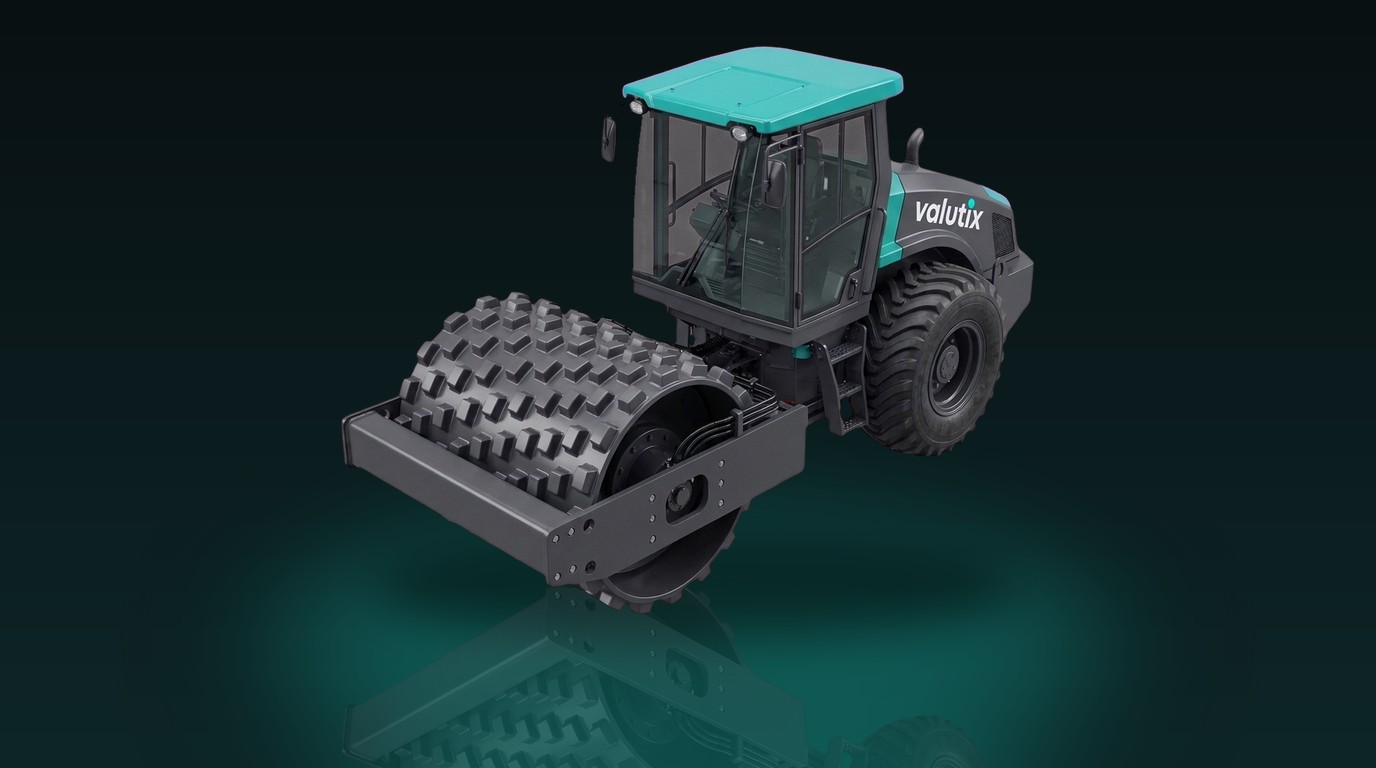
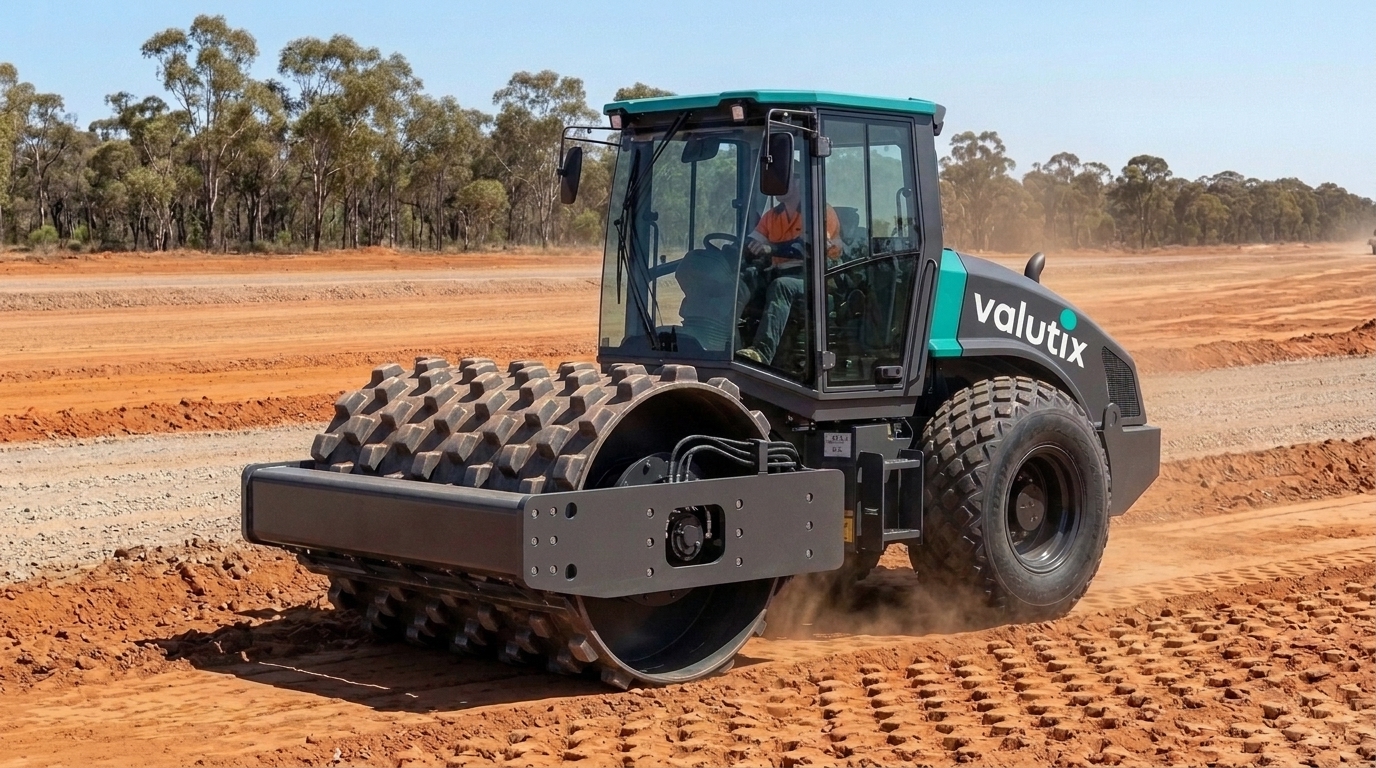
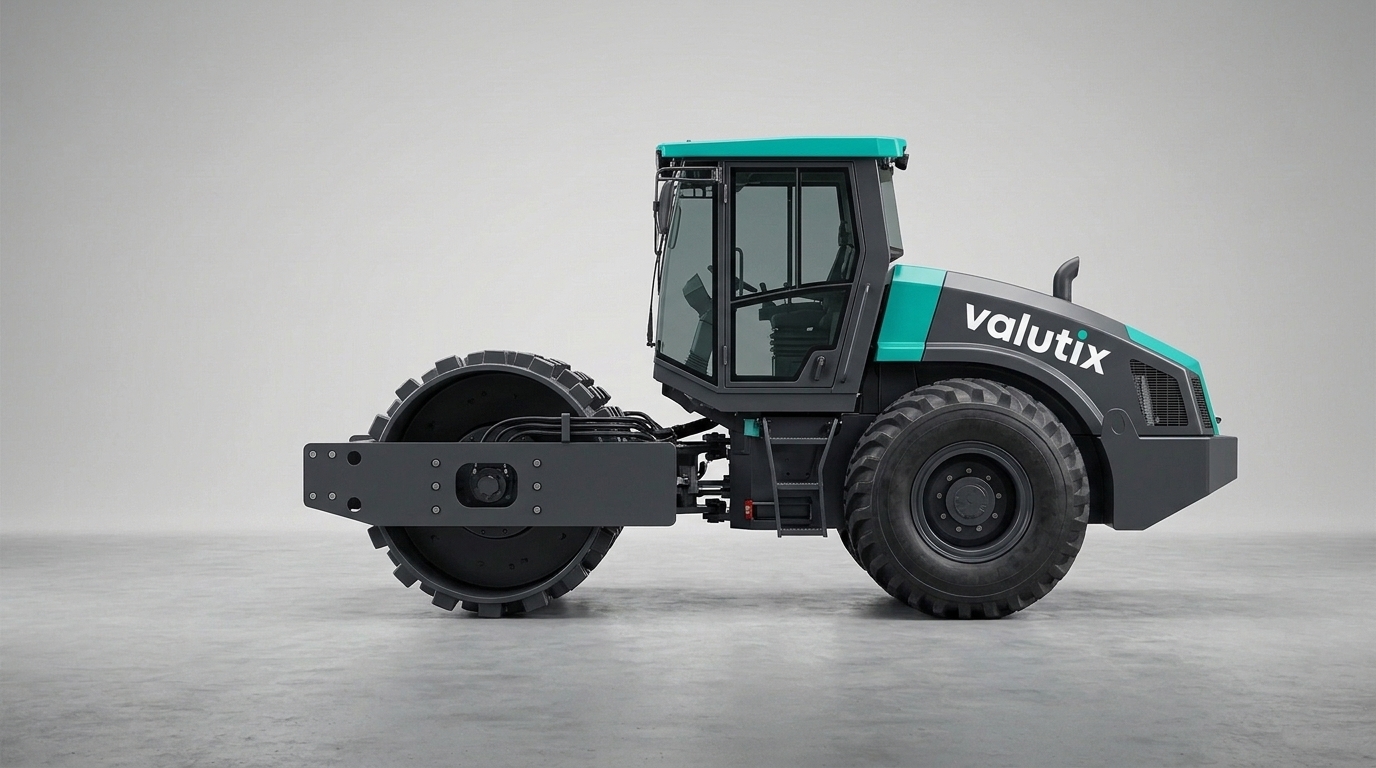
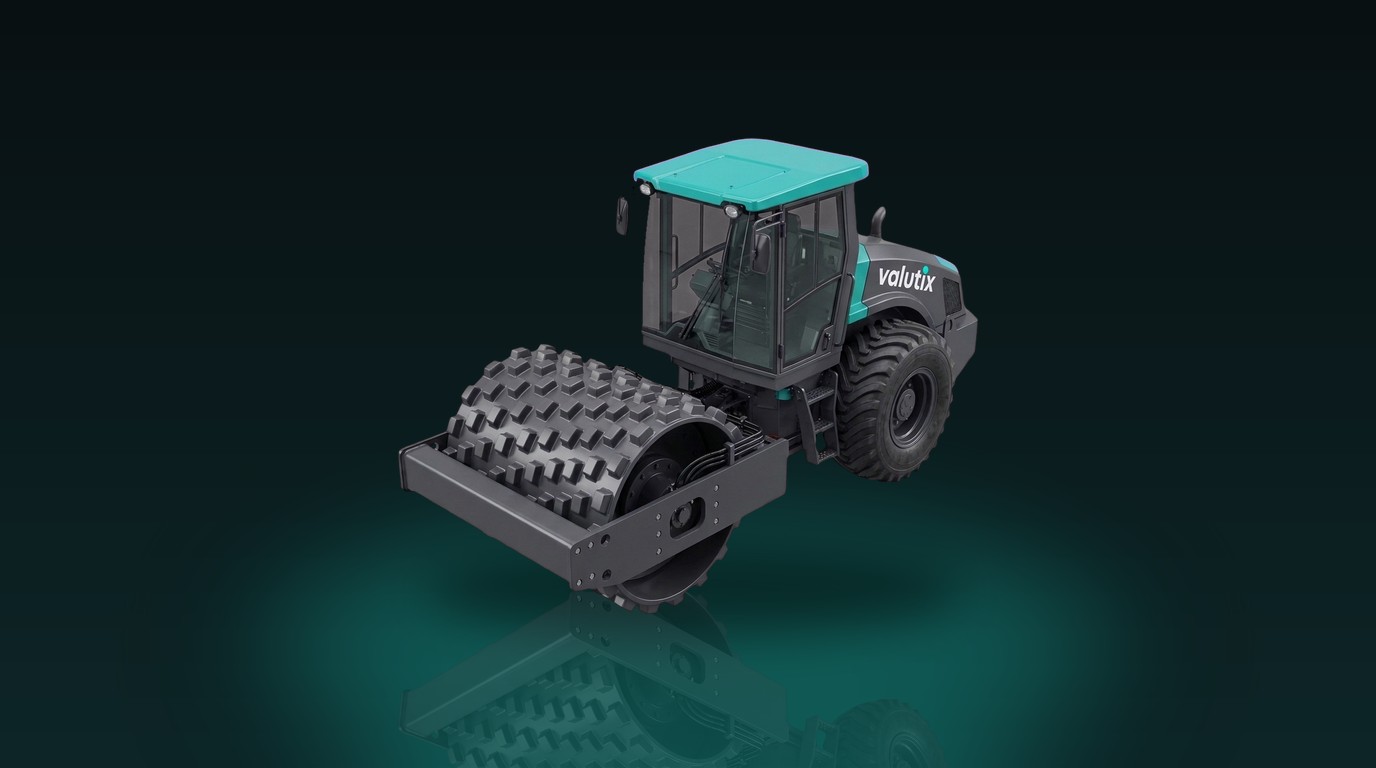
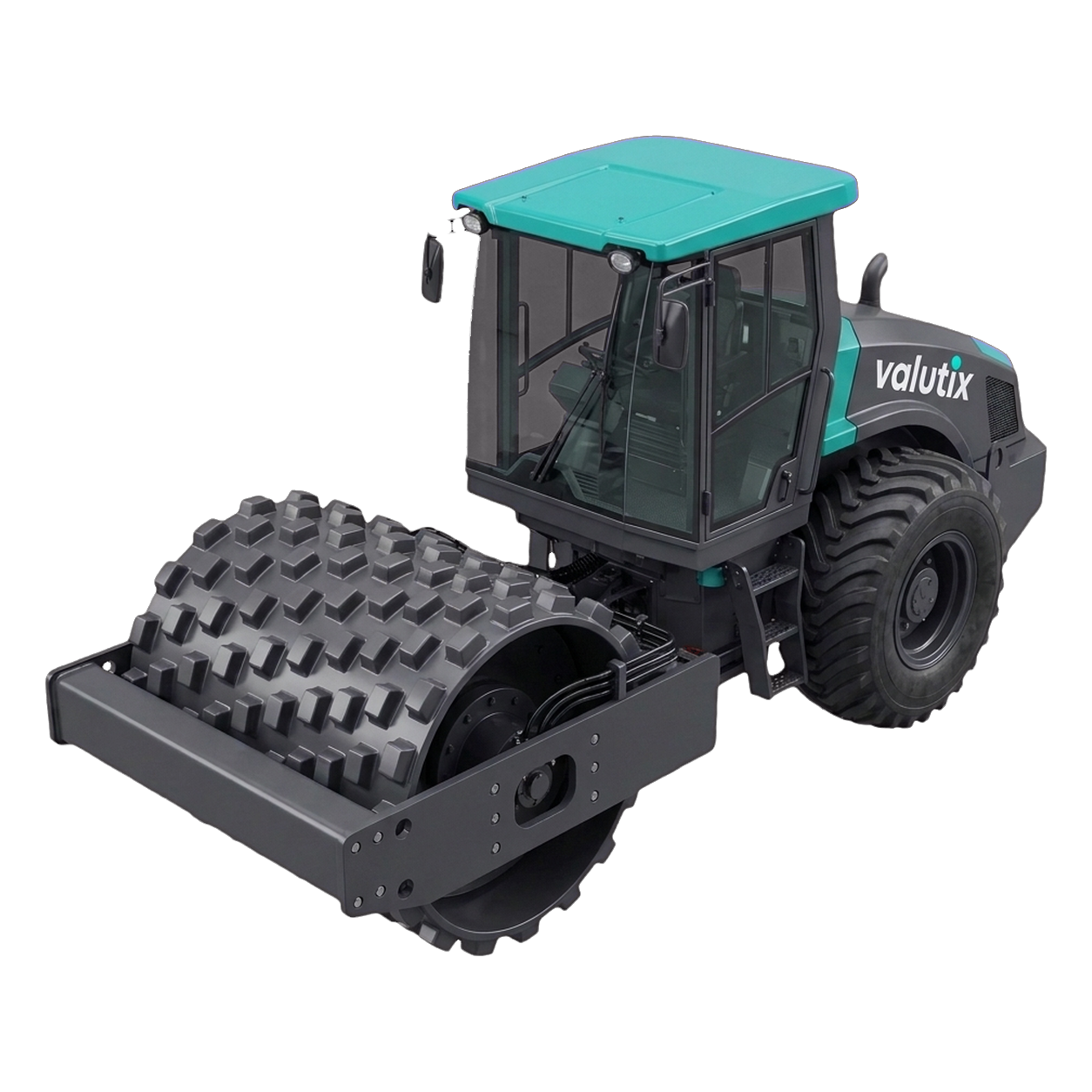
Illustrations featuring the Vaultix civil livery. Machine geometry, articulation, and attachments represent typical Australian civil specifications.
Class planning guide
Published manufacturer specifications for the Caterpillar CP56B / 10-14 t class padfoot drum vibratory roller. Use supplier specifications for exact procurement.
| Ref | Item | Value | Planning note |
|---|---|---|---|
| 01.01 | Operating mass | 11,725 kg (cab) / 6,465 kg (at drum) | Standard operating weight with full fluids, operator, and enclosed ROPS/FOPS cab (55.1% mass on drum). |
| 01.02 | Compaction drum | 2,134 mm width / 140 padfeet (14 chevrons) | Standard 127 mm oval pads with 74.4 cm² face area for deep cohesive lift penetration. |
| 01.03 | Centrifugal force | 301 kN (high) / 141 kN (low) | Dual-amplitude dynamic impact force at 30.5 Hz standard frequency (Eco-mode 27.7 Hz). |
| 01.04 | Engine gross power | 116.5 kW (156.0 hp) | Cat C7.1 (or 117.0 kW Cat C4.4 Tier 4F build). |
| 01.05 | Travel speed | Up to 11.4 km/h | Hydrostatic propel system with dual-pump traction drive (>65% gradeability). |
| 01.06 | Fuel allowance | About 8.5 to 18.0 L/hr | 13.0 L/hr telematics medium duty used in planning; cohesive soil rolling resistance increases burn over smooth drum. |
| 01.07 | Shipping mass | About 11,450 kg (derived) | Derived: 11,725 kg operating weight less 75 kg operator and 90% fuel allowance (~200 kg). Standard float transport. Excludes trailer. Confirm with haulier. |
| Ref | Item | Value | Planning note |
|---|---|---|---|
| 02.01 | Cohesive clay fill | 127 mm oval pads & high amplitude | High contact pressure (7.1-8.5 MPa static) shears clods and knits successive clay lifts. |
| 02.02 | Embankment compaction | 301 kN dynamic force & wide path | 2.13 m drum width delivers rapid bulk compaction across road and rail embankment layers. |
| 02.03 | Dam & levee cores | Strict lift control & low speed | Remoulds cohesive fill to meet ANCOLD impervious core density and permeability criteria. |
| 02.04 | Compaction control | Cat MDP & GNSS pass mapping | Machine Drive Power measures rolling resistance to evaluate clay stiffness without accelerometer false readings. |
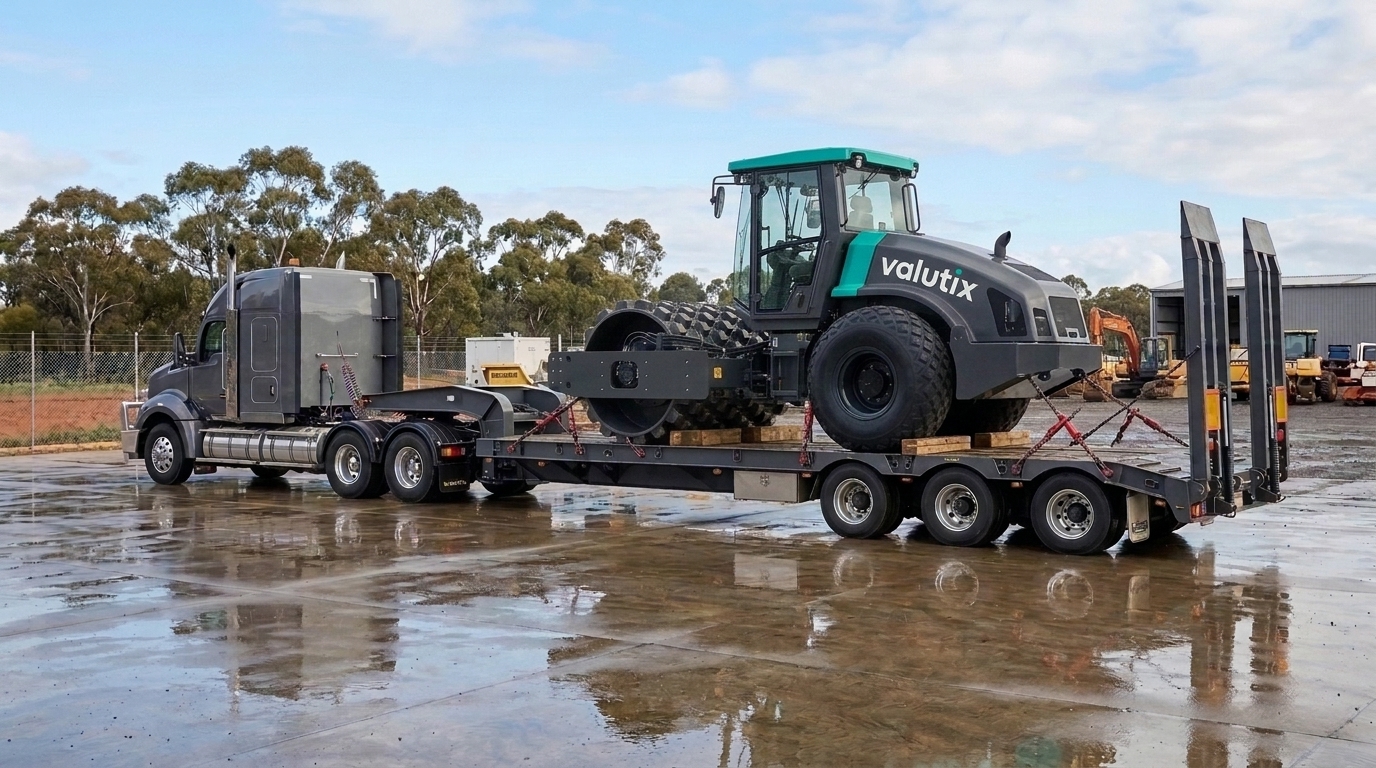
| 02.05 | Transport | Drop-deck low loader float | 2.30 m machine width and 3.11 m height allow general access road transit without oversize permits. |
Dimensions and transport planning
Machine dimensions exclude the transport float trailer. Obtain verified deck height, loaded envelope, axle group weights, route clearance and restraint plans from haulier before mobilisation.
| Code | Dimension | Published value | Planning note |
|---|---|---|---|
| 1 | Overall length (standard, without leveling blade) | 5,860 mm | Bumper to bumper without optional front blade (5,900 mm on Tier 4F). |
| 2 | Overall length with optional leveling blade | 6,400 mm | Length including optional factory front strike-off / leveling blade. |
| 3 | Overall width (standard) | 2,300 mm | Maximum outside width across drum frame / tyres without blade. |
| 4 | Overall width with optional leveling blade | 2,500 mm | Blade width at cutting edges; within standard 2.50 m general access limit. |
| 5 | Drum compaction width | 2,134 mm | Standard 84.0 in padfoot compaction drum width. |
| 6 | Drum shell thickness | 30 mm | Heavy-duty rolled steel drum shell plate beneath welded pad roots (25 mm on Tier 4F build). |
| 7 | Drum diameter (over pads) | 1,534 mm | Outer diameter measured across tips of standard tamping pads (1,549 mm for oval pads on Tier 4F build). |
| 8 | Overall height to top of cab (ROPS/FOPS) | 3,110 mm | Ground line to highest point of ROPS/FOPS cab roof / beacon. Excludes float deck. |
| 9 | Wheelbase | 2,900 mm | Center of drum axle to center of rear wheel drive axle. |
| 10 | Ground clearance under central hitch | 442 mm | Lowest clearance point under central articulation hitch and chassis. |
| 11 | Curb side clearance | 494 mm | Clearance between drum frame side plates and vertical kerb or wall. |
| 12 | Optional leveling blade height | 688 mm | Blade face height on optional front strike-off blade. |
Working range & kinematics
Compaction dynamics, vibratory performance, and steering kinematics for the Cat CP56B 12 t padfoot drum vibratory roller. Dual amplitude settings, tamping pad penetration, and articulation geometry dictate cohesive soil layer compaction capacity and site manoeuvrability.
| Code | Kinematic range item | Published value |
|---|---|---|
| 1 | Drum compaction path width | 2,134 mm |
| 2 | Drum diameter (over pads) | 1,534 mm |
| 3 | Pad penetration depth (pad height) | 127 mm (standard oval pads; optional square pads 100 mm) |
| 4 | Drum shell thickness | 30 mm |
| 5 | Maximum centrifugal compaction force (high amplitude) | 301 kN (67,600 lbf) |
| 6 | Minimum centrifugal compaction force (low amplitude) | 141 kN (31,670 lbf) |
| 7 | Nominal amplitude (high) | 2.10 mm (0.083 in) |
| 8 | Nominal amplitude (low) | 0.98 mm (0.039 in) |
| 9 | Standard vibratory frequency | 30.5 Hz (1,830 vpm) |
| 10 | Eco-mode vibratory frequency | 27.7 Hz (1,664 vpm) |
| 11 | Steering hitch articulation angle | ±34 degrees |
| 12 | Chassis hitch oscillation angle | ±15 degrees |
| 13 | Inside turning radius | 3,680 mm |
| 14 | Outside turning radius (derived) | 5,810 mm (Derived: 3.68 m inside radius + 2.134 m drum width = 5.814 m) |
Direct cost and market hire prices
Never invent hire rates. In strict accordance with Vaultix estimating governance, all hire rate figures for this 10-14 t padfoot roller class are recorded as not-yet-quoted placeholders. Enter verified project supplier quotes in the calculator below.
Metro and Remote direct costs
| Basis / AUD ex GST | Metro | Remote |
|---|---|---|
| Direct dry / hr | Not yet quoted (placeholder) | Not yet quoted (placeholder) |
| Direct wet / hr | Not yet quoted (placeholder) | Not yet quoted (placeholder) |
| Roller operator / paid site hr | Not yet quoted (placeholder) | Not yet quoted (placeholder) |
| Delivered diesel / L | 1.94 (reference proxy) | 2.23 (reference proxy) |
| Maintenance, parts and freight | Base allowance | Base plus 25% |
| Roster and camp | Metro working-week roster | 14/7 FIFO, 12-hour days, camp and flights |
Standing decision: Rates for this class have not yet been quoted or audited for vaultix.com.au. To ensure estimating integrity, rates are never estimated from other classes without supplier evidence. Estimators can input their project quotes directly in the instrument below.
Mobilisation, separate one-off cost
| Purchased transport / AUD ex GST | Metro | Remote |
|---|---|---|
| One delivery event | To be quoted by haulier | To be quoted by haulier |
Float mobilisation depends on transport distance, route permits, and float deck availability. Machine dimensions (2.30 m width, 3.11 m height) comply with standard Australian general access limits without permits. Allow separate return demobilisation event.
| Source / date | Hire basis | Per hour | Per day | Per week | Conditions |
|---|---|---|---|---|---|
| Awaiting supplier tender verification Status: Unquoted placeholder |
Dry / Wet pending quotes | Not yet quoted | Not yet quoted | Not yet quoted | All hire rate values are unquoted placeholders. Obtain 3 dated project rate cards including GPS/intelligent compaction control options (MDP), leveling blade, fuel inclusion, drum wear terms and float costs. |
First-principles direct hourly cost
| Component | Direct dry AUD/hr | Direct wet AUD/hr |
|---|---|---|
| Ownership: depreciation and interest | Not yet quoted | Not yet quoted |
| Insurance and registration | Not yet quoted | Not yet quoted |
| Maintenance, servicing, tyres and drum wear | Not yet quoted | Not yet quoted |
| Fuel and operating lubricants (13.0 L/hr proxy) | 0.00 | Not yet quoted |
| Roller operator cost per paid site hour | 0.00 | Not yet quoted |
| Direct cost per operating hour | Not yet quoted | Not yet quoted |
Placeholder. Replace with a current supplier quote; no hire rates are invented or assumed.
Productivity and calculator
Hourly Compacted Area m²/hr = (Speed km/h x 1,000 x Drum Width m x Efficiency) / Passes. Hourly Compacted Volume m³/hr = Compacted Area m²/hr x Compacted Layer Thickness m (lift thickness limited by 127 mm pad length to ensure inter-lift knitting, with pass counts calibrated for cohesive soil density). Single-Pass Rate m²/hr = Speed km/h x 1,000 x Drum Width m x Efficiency. Linear Advance km/hr = (Speed km/h x Efficiency) / Passes. All speed, pass count, thickness and efficiency factors are Vaultix civil estimating assumptions.
Activity estimating guides
Vaultix estimating standards, 9 November 2026. Joint civil earthworks planning scenarios, not statistical confidence limits.
Low: travel speed x 0.85, drum width x 0.90, efficiency x 0.80, passes x 1.20. High: travel speed x 1.15 (cap 11.4 km/h), drum width x 1.00 (2.134 m drum), efficiency x 1.10 (cap 1.00), passes x 0.85 (min 1).
01Cohesive fill compaction
Bulk compaction of cohesive and clayey fill materials in infrastructure embankments, site fills, and subgrade formations to achieve 95% to 98% Standard Proctor density.
Vaultix assumptions: Speed 3.2 km/h; drum width 2.13 m; 8 passes; efficiency 75%; lift thickness 0.20 m.
Worked example: (3.2 x 1000 x 2.13 x 0.75) / 8 = 639 m²/hr (128 m³/hr), or 5,112 m² (1,022 m³) in an 8-hour shift. Net advance: 0.30 linear km/hr.
Allow for: Allow 6 to 10 passes in high amplitude, controlled rolling speed to prevent clay packing between pads, scraper coordination, and moisture conditioning.
Pitfalls: Rolling speed exceeding 4 km/h causes pads to ride on surface without penetrating; excessive moisture turns clay into slurry that blinds pads.
02Embankment layer compaction
High-volume bulk earthworks embankment layer compaction on wide highway and rail formation runs utilizing 301 kN maximum centrifugal impact force.
Vaultix assumptions: Speed 3.8 km/h; drum width 2.13 m; 7 passes; efficiency 80%; lift thickness 0.25 m.
Worked example: (3.8 x 1000 x 2.13 x 0.80) / 7 = 925 m²/hr (231 m³/hr), or 7,400 m² (1,850 m³) in an 8-hour shift. Net advance: 0.43 linear km/hr.
Allow for: Continuous long rolling runs with minimal turnarounds, high-amplitude penetration, and coordinated scraper/dozer fill spreading.
Pitfalls: Placing lifts thicker than 300 mm prevents pad feet from knitting into underlying layer, resulting in uncompacted shear planes.
03Clay liner / cap compaction
Precision compaction of engineered clay liners and containment caps for landfill cells and water containment to achieve strict hydraulic conductivity criteria (k ≤ 1×10⁻⁹ m/s).
Vaultix assumptions: Speed 2.8 km/h; drum width 2.13 m; 10 passes; efficiency 70%; lift thickness 0.15 m.
Worked example: (2.8 x 1000 x 2.13 x 0.70) / 10 = 417 m²/hr (63 m³/hr), or 3,340 m² (501 m³) in an 8-hour shift. Net advance: 0.20 linear km/hr.
Allow for: Slow deliberate travel speed for thorough clod remoulding, 10 to 14 passes, frequent nuclear gauge testing, and strict edge compaction.
Pitfalls: Inadequate kneading leaves intact clay clods that form preferential hydraulic pathways, resulting in permeability test failure.
04Backfill compaction
Compaction of cohesive backfill in restricted zones around bridge abutments, box culverts, retaining walls, and drainage structures.
Vaultix assumptions: Speed 2.5 km/h; drum width 2.13 m; 8 passes; efficiency 65%; lift thickness 0.15 m.
Worked example: (2.5 x 1000 x 2.13 x 0.65) / 8 = 433 m²/hr (65 m³/hr), or 3,461 m² (519 m³) in an 8-hour shift. Net advance: 0.20 linear km/hr.
Allow for: Frequent direction reversals, spotter coordination near concrete structures, thin 150 mm lifts, and reduced travel speed.
Pitfalls: Operating high-amplitude vibration within 5 m of structures can cause wall displacement, structural surcharge, or pipe damage.
05Dam / levee fill
Compaction of zoned impervious clay core material for water storage dams, flood retention levees, and retention basins to ANCOLD standards.
Vaultix assumptions: Speed 3.0 km/h; drum width 2.13 m; 10 passes; efficiency 75%; lift thickness 0.20 m.
Worked example: (3.0 x 1000 x 2.13 x 0.75) / 10 = 479 m²/hr (96 m³/hr), or 3,834 m² (767 m³) in an 8-hour shift. Net advance: 0.23 linear km/hr.
Allow for: 8 to 12 passes at OMC +1% to +2% to achieve 98% to 100% Standard Proctor density, geotechnical sampling, and batter transition work.
Pitfalls: Compacting on the dry side of optimum moisture prevents proper clay dispersion and creates risk of internal erosion piping under hydrostatic head.
06Subgrade improvement with lime or cement
Initial compaction of heavy clay subgrade treated with lime or cement binder following stabilizer mixing, breaking down nodules from the base upwards.
Vaultix assumptions: Speed 3.5 km/h; drum width 2.13 m; 6 passes; efficiency 72%; lift thickness 0.20 m.
Worked example: (3.5 x 1000 x 2.13 x 0.72) / 6 = 895 m²/hr (179 m³/hr), or 7,157 m² (1,431 m³) in an 8-hour shift. Net advance: 0.42 linear km/hr.
Allow for: Synchronization with binder spreader and stabilizer reclaimer train, rapid rolling within binder hydration window, and subsequent smooth drum finish.
Pitfalls: Delaying compaction beyond chemical binder initial set time destroys cementitious bonds and severely degrades final subgrade bearing capacity.
Estimator checks
- Compaction drum width: Standard 2,134 mm (84 in) padfoot drum with 140 tamping pads; allow 200 mm to 250 mm overlap between adjacent passes in cohesive clay to eliminate uncompacted strips.
- Pad length and lift thickness control: Standard 127 mm (5.0 in) oval pads govern compacted lift thickness (typically 150 mm to 250 mm). The loose lift must allow the pads to penetrate through and knit with the upper zone of the prior lift.
- Intelligent compaction (Machine Drive Power): In cohesive soils where accelerometer-based CMV is unreliable, verify if machine is equipped with Cat MDP (Machine Drive Power) sensors and GNSS pass-count mapping to track rolling resistance.
- Clay buildup and scraper maintenance: Daily inspection and adjustment of dual heavy-duty steel scrapers is critical; clay packing between pads (pad blinding) degrades tamping penetration and unbalances the drum.
- Emissions specification: Confirm whether hire unit is equipped with standard Tier 3 Cat C7.1 engine (116.5 kW, no DEF required) or Tier 4 Final Cat C4.4 engine (117.0 kW, requires 19 L DEF tank and ULSD).
- Optional leveling blade: Check if 2.50 m factory push blade (+620 kg mass) is fitted; allows spreading loose dumps but increases drum axle weight by ~880 kg.
- Transport dimensions: Machine width is 2.30 m (or 2.50 m with leveling blade) and height is 3.11 m. Loaded on a 900 mm drop-deck float, overall height is ~4.01 m, well within standard 4.30 m general access limits without permits.
- Shipping mass: Derived shipping mass is approximately 11,450 kg dry (~11,725 kg operating weight less operator and 90% fuel). Standard 3-axle or 4-axle float is suitable.
- Dynamic vibration hazards: High-amplitude vibration (301 kN centrifugal force) creates significant ground shock waves; disable vibration within 5 m of underground pipes, culverts, or bridge abutments.
- All hire rate schedules are unquoted placeholders. In accordance with Vaultix estimating principles, never invent hire rates without formal supplier tenders.
- Output is area-governed (m²/hr) and layer volume-governed (m³/hr), not bucket payload. Balance roller coverage with earthmoving dump spreads and water cart delivery.
- No HRWL class required; operator competency confirmed by VOC and RIIMPO317F (Conduct roller operations).
Data basis. Corrected 10 November 2026 after an independent check against the Cat sheets: the net power (98.1 kW) and DEF tank (19 L) belong to the Tier 4 Final Cat C4.4 build, not the Cat C7.1 Tier 3 build, which publishes gross power only and has no DEF. Drum diameter and shell thickness differ between the Tier 3, Tier 4i and Tier 4 Final sheets. Which build Australia receives is not stated. Reference model: Caterpillar CP56B Padfoot Drum Vibratory Soil Compactor, OEM sheets QEHQ2461-01 and QEHQ1557-05. Sourced 9 November 2026. Fuel uses OEM Performance Handbook telematics proxy (13.0 L/hr medium duty). Productivity uses Vaultix estimating formulas. Hire rates remain unquoted placeholders pending verified tenders. Sources and assumptions.
Entry / roller-padfoot-12t Issue / 2026-11-09
Library navigation
Plant and method index · Discipline work packages · Survey conformance and lot release