Temporary works / Protection and edge
Crash decks, screens and hoarding
Protection and edge temporary works comprise engineered barriers, overhead crash decks, perimeter safety screens, hoardings, and catch fans designed to isolate construction activities from the public, live traffic, and operating rail corridors while safeguarding workers against falls and falling objects. Under Australian WHS regulations, PCBUs bear a statutory duty to eliminate or minimise falling object and fall hazards using passive engineering controls where elimination is not practicable. For civil estimators and construction planners, these safety-critical installations require first-principles allowances for out-of-hours rail track possessions, heavy crane mobilisation, high-capacity gantry structures, hydraulic screen climbing cycles, and statutory engineering certifications.
- Working deckTrack which lifts are available for the relevant trade.
- Protection fanCheck the installed protection interface at the public route.
- Standards and basesRecord support, inspection and handback for the bay.
What it is
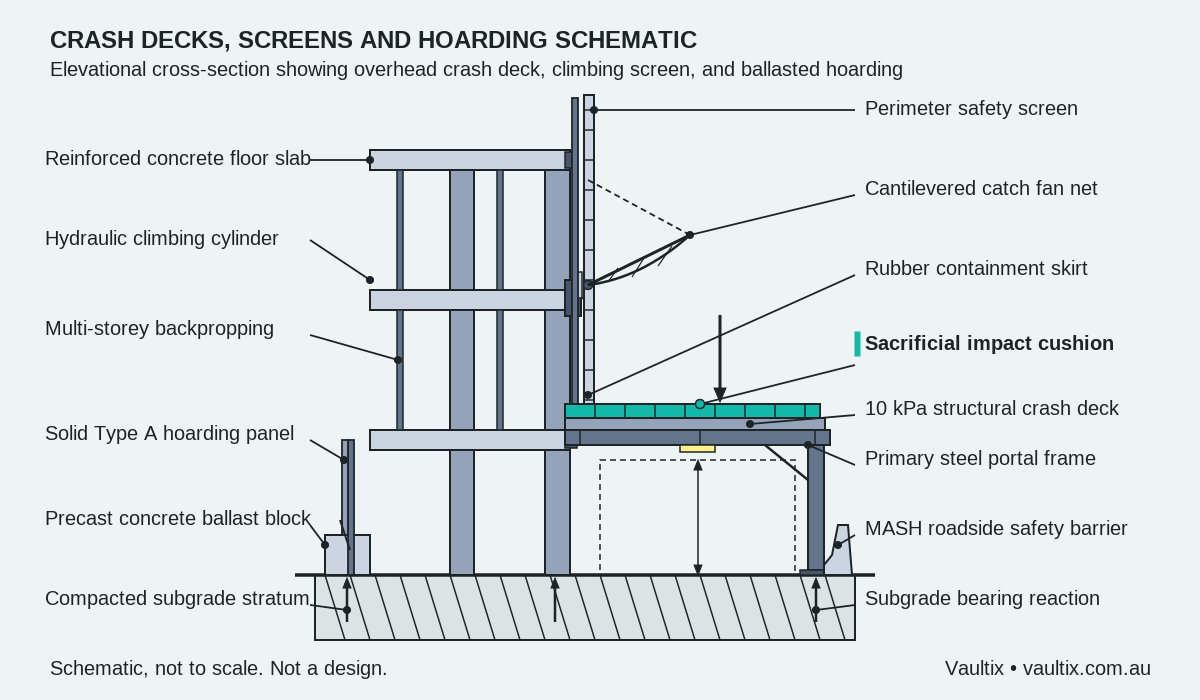
Protection and edge temporary works comprise engineered physical barriers, overhead crash decks, perimeter safety screens, solid hoardings, and cantilevered catch fans deployed across civil infrastructure and building projects. They isolate active construction works from public footpaths, live road carriageways, and operating rail corridors, while protecting workforce personnel from falls from height and dropped materials. Under Australian model WHS regulations, duty holders must implement passive engineering controls to prevent falling objects and falls where elimination is not practicable. Systems range from heavy structural steel crash decks spanning rail lines or highways to crane-handled or hydraulic climbing perimeter screens enclosing multi-storey concrete forms, solid Type A ground hoardings, 10 kPa rated Type B overhead pedestrian gantries, and cantilevered safety net fans.
Common types
| Type | What distinguishes it | Typical use |
|---|---|---|
| Heavy-Duty Rail Crash Decks | Heavy structural steel grillages spanning operating tracks, decked with hardwood baulks or steel plate with sacrificial impact cushions. Designed to preserve rail kinematic clearance envelopes, maintain 1500 V DC electrical clearances, and erect/strip within scheduled track possessions (LPA/TOA). | Bridge demolition, station modifications, and heavy crane lifts spanning active passenger and freight rail corridors. |
| Road Protection Decks & Canopies | Heavy structural steel portal frames spanning live carriageways with timber or steel decking and solid side hoardings. Engineered to protect road users, maintain statutory vehicle clearances, and protect support legs with MASH roadside barriers. | Bridge deck replacement, precast Super-T girder erection, and concrete pours spanning active highways and arterial roads. |
| Perimeter Safety Screens | Modular vertical steel trusses enclosing two to four slab levels, clad with steel sheet, perforated aluminium, or heavy mesh. Either crane-handled or self-climbed via hydraulic cylinders along slab-mounted guide rails, eliminating external scaffolding. | Multi-storey and high-rise concrete construction to enclose working decks, catch falling debris, and provide edge fall protection. |
| Type A Hoardings (Ground Perimeter Hoardings) | Continuous solid timber or sheet steel fences typically 2.0 m to 2.4 m high. Ballasted with precast concrete counterweights to resist AS/NZS 1170.2 wind overturning without penetrating buried urban services. | Site boundary segregation at ground level along civil compounds and building perimeters where overhead work hazards are absent. |
| Type B Hoardings (Overhead Pedestrian Gantries) | Heavy structural steel portal frames spanning footpaths and carrying an overhead protective deck engineered to a 10 kPa live load. Capable of supporting site accommodation sheds or material storage (capped at 40% unless certified), with integrated lighting and barriers. | Urban pedestrian protection adjoining multi-storey building construction, facade restoration, or demolition sites. |
| Cantilevered Catch Fans (Safety Net Fans) | Engineered steel outrigger arms projecting 3.0 m to 4.5 m from slab edges or scaffolding. Equipped with dual-layer System T polypropylene nets with fine debris mesh that fold vertically against the facade for crane clearance. | High-rise facade installation, glazing works, and perimeter edge operations to arrest falling personnel and dropped hand tools. |
| Scaffold-Mounted Catch Platforms | Close-decked timber or steel platforms installed directly within modular scaffolding bays beneath active working levels in accordance with AS/NZS 1576.1:2019. Tied down against wind uplift to catch dropped materials without allowing access or storage. | Intermediate debris containment directly below bricklaying, masonry, facade rendering, or cladding works on scaffolded perimeters. |
When it is used
- Demolishing bridge superstructures and beam elements over active road carriageways or electrified railway lines.
- Erecting precast concrete Super-T girders, steel trusses, or pouring concrete bridge decks spanning live transit corridors.
- Constructing high-rise concrete frames where perimeter safety screens enclose formwork decks and protect trailing floor levels.
- Protecting pedestrian footpaths in dense urban commercial precincts where public walkways must remain open beneath Type B gantries.
- Executing structural building demolition on zero-lot boundaries adjoining public roadways and neighbouring properties.
- Installing curtain wall panels, external glazing, and architectural cladding using cantilevered catch fans to arrest dropped items.
- Working within or immediately adjacent to operating railway corridors requiring physical barriers against 1500 V DC traction wiring.
Do not use heavy crash decks where total road or rail corridor closures and detours are granted, as full isolation eliminates overhead collision and dropped object hazards. Standard mesh fencing should replace solid hoardings on greenfield sites with boundary setbacks exceeding debris fall trajectories, and MEWPs with ground exclusion zones should be used for short-duration facade maintenance. Avoid solid unanchored hoardings in severe coastal wind zones prone to overturning without permeable relief, and never mount perimeter screens to green or structurally inadequate slabs without certified backpropping.
Components and how it works
- Primary steel framing. Universal beams, columns, hollow sections, and high-tensile bolts forming the structural portal frames, rail crash grillages, and overhead gantry bents.
- Impact decking and cushions. Hardwood baulks, structural steel plate, and sacrificial timber or elastomeric cushions engineered to dissipate impact energy from dropped materials without breaching transit envelopes.
- Screen cladding and guides. Vertical soldier frames, profiled sheet steel, perforated aluminium panels, and heavy-duty rubber slab skirts that seal gaps against dropped tools and concrete slurry.
- Hydraulic climbing units. Slab-mounted guide rails, double-acting hydraulic cylinders, electric-hydraulic power packs, and mechanical safety pawls enabling self-climbing cycles without crane hook time.
- Catch fan hardware. Cantilevered steel outrigger arms, structural hinge pins, slab anchor shoes, and dual-layer UV-stabilised polypropylene safety nets fitted with fine debris liners.
- Hoarding panels and counterweights. Exterior-grade plywood or profiled steel cladding, vertical steel posts, and precast concrete ballast blocks designed to resist AS/NZS 1170.2 wind actions.
- Public safety fit-out. Underside vandal-resistant LED gantry lighting, MASH-tested roadside safety barriers, impact crash cushions, and clearance monitoring sensors ensuring safe public and vehicle passage.
Typical installation and removal sequence follows seven steps: 1. Complete Temporary Works Design Brief (TWDB) structural engineering, wind analysis to AS/NZS 1170.2, and secure municipal, road authority, or rail corridor permits. 2. Establish corridor isolation via road traffic control or scheduled rail track possessions (LPA/TOA) with traction power de-energisation. 3. Prepare foundations by positioning precast concrete ballast blocks, drilling slab anchors, and placing MASH roadside barriers. 4. Erect primary structural steel columns, portal frames, cross-bracing, or screen guide rails using mobile cranes. 5. Install deck cassettes, hardwood impact cushions, climbing screen panels, or catch fan nets, and tie down against wind uplift. 6. Fit containment skirts, hoarding sheeting, guardrails, and gantry lighting, followed by an RPEQ or CPEng inspection and issuance of a Handover Certificate. 7. Decommission after overhead works conclude by clearing loose debris, isolating utilities, re-establishing corridor possessions, dismantling screens and decks by crane, and removing ballast to reinstate the site.
Australian standards and rules
Checked 10 November 2026. Each document was looked up in catalogue and regulator listings; the text of the standards was not read. Rows marked Not verified were not found or could not be checked. Confirm the current edition before relying on any document. Figures quoted on this page, such as loads, tolerances, heights, depths and inspection intervals, are typical values and are unverified unless a row cites the rule.
| Document | What it covers for this item | Status |
|---|---|---|
| AS 4687.1 / .2 / .3:2022 (Temporary fencing and hoardings) | Structural design criteria, wind actions, and specifications for temporary fencing, Type A solid hoardings, and Type B overhead gantries. | Confirmed |
| AS/NZS 4994.1:2023 / .4:2018 (Temporary edge protection) | General requirements, testing methods, and perimeter protection screens mounted to concrete building structures. | Confirmed |
| AS/NZS 1576.1:2019 (Scaffolding — General requirements) | Catch platforms, cantilevered safety net fans, and protective awnings integrated with scaffolding. | Confirmed |
| AS/NZS 1170.0:2002 / .1:2002 / .2:2021 (Structural design actions) | General structural principles, permanent and imposed actions, and aerodynamic wind load calculations on hoardings and screens. | Not verified |
| AS 2601:2025 (The demolition of structures) | Public protection measures, protective overhead structures, and heavy crash awnings during structural demolition. | Confirmed |
| AS 5100.2:2017 (Bridge design — Design loads) | Collision load models for errant vehicles, minimum road clearances, and bridge superstructure protection screens. | Confirmed |
| BS EN 1263-1:2014 / BS EN 1263-2:2014 (Temporary works equipment — Safety nets) | Dynamic energy absorption requirements, safety net fan positioning rules, and annual mesh tensile testing protocols. | Confirmed |
| Model Code of Practice: Managing the risk of falls at workplaces (Safe Work Australia) | Hierarchy of fall controls, perimeter edge protection, catch platforms, and passive fall prevention systems. | Not verified |
| Model Code of Practice: Construction work (Safe Work Australia) | Statutory duties for falling object mitigation, high-risk construction work thresholds, and mandatory SWMS requirements. | Not verified |
| Code of Practice: Overhead protective structures (SafeWork NSW, commenced December 2025) | Design standards, minimum 10 kPa deck live load ratings, and inspection protocols for overhead gantries and crash decks. | Confirmed |
| Code of Practice: Formwork (SafeWork NSW) | Formwork perimeter safety screens, vertical containment, and hydraulic self-climbing operational rules. | Confirmed |
| Guidelines for Hoardings and Scaffolding (City of Sydney) | Performance criteria for Type A solid hoardings, Type B overhead gantries, 10 kPa deck loading, public lighting, and footpath barrier design. | Confirmed |
| TfNSW Standards: T HR CI 12030 ST, T HR EL 08001 ST, TS 03291, TD 00050:2024 (Transport for NSW) | Rail corridor clearance envelopes, train kinematic encroachment limits, crash grillage design, traction electrical isolation, and road barriers. | Not verified |
Check the current edition before relying on any document. Temporary works need a competent person's design and inspection; this page is not a design guide.
Estimating considerations
- Out-of-hours corridor possessions. Rail crash deck and road canopy erection and removal rely on night shifts, weekend track possessions (LPA/TOA), and road closures, driving significant labour overtime, plant standby, and safeworking coordination allowances.
- Structural capacity and 10 kPa gantry ratings. City councils and road authorities mandate heavy 10 kPa live-load ratings for Type B overhead gantries carrying site sheds or materials, necessitating heavy structural steel members and higher-capacity mobile cranes.
- Perimeter screen cycle times. Floor-to-floor cycle performance depends on whether safety screens are crane-lifted or self-climbed via hydraulic cylinders, with crane hook availability directly controlling the critical path of the concrete structure.
- Equipment ownership and procurement models. Modular hoardings, gantry frames, and catch fans are typically secured on weekly or monthly dry hire for short programs, whereas climbing screens and custom rail crash grillages are purchased or leased on multi-year projects.
- Material reuse and sacrificial components. Primary gantry steel, soldier beams, and screen guide rails offer high multi-project reuse, while bespoke rail crash beams face project-specific amortisation, and timber baulks, plywood faces, rubber skirts, and containment mesh are single-use consumables.
- Engineering design and proof verification. Estimators must allow for Temporary Works Design Brief preparation, finite element structural analysis, wind loading assessments to AS/NZS 1170.2, mandatory Category 3 independent design verification for rail/highway crossings, and RPEQ or CPEng hold-point sign-offs.
- Heavy mobile cranage and support plant. Installing heavy crash deck cassettes and overhead gantry beams over rail corridors or roads requires all-terrain mobile cranes with counterweight floats, Frannas for yard and ballast handling, boom lifts for under-deck bolting, and hydraulic power units.
- Corridor safeworking and traffic management. Protection structures spanning public roads or rail tracks require continuous site safeworking crews, including licensed traffic controllers, truck-mounted attenuators (TMAs), Track Protection Officers (TPOs), and rail traction power isolators.
- Footing and subsurface anchoring constraints. Urban footpaths with buried utilities prohibit ground penetrations, necessitating heavy precast concrete ballast blocks or engineered counterweights rather than chemical ground anchors to resist overturning.
- Wet weather and wind threshold delays. Critical lifting and screen jumping operations are restricted by strict wind speed thresholds (typically 36 km/h to 40 km/h), while solid hoarding surfaces act as wind sails requiring weather delay contingencies and drainage provisions to prevent ponding runoff.
Risks and common failures
- Vehicle impact on support columns. Errant traffic striking temporary gantry legs or crash deck columns, causing structural collapse. Control: Install MASH-tested concrete or steel barriers, impact crash cushions, and overheight laser detection gantries with advance warning signage.
- Wind-induced overturning of solid hoardings. Peak aerodynamic wind pressures exceeding counterweight capacity or shearing anchor bolts, overturning barriers into public areas. Control: Engineer hoardings to AS/NZS 1170.2 site-specific wind loads, use certified precast concrete ballast blocks, and perform proof-load testing on ground anchors.
- Rail kinematic envelope infringement. Structural deflection under dynamic impact or misaligned grillage steel encroaching into active rail transit clearances. Control: Engineer deck stiffness to rail deflection criteria, verify structural clearances prior to commissioning, and install optical monitoring prisms for continuous rail corridor surveillance.
- Electrical arcing from rail catenary. Conductive steelwork erected within statutory electrical approach distances of 1500 V DC overhead rail wiring. Control: Enforce formal traction power isolations, erect non-conductive dielectric flash barriers, and bond all temporary steel framing to substation earths.
- Debris escaping containment boundaries. Small tools, concrete slurry, or fasteners bouncing through slab gaps or over catch fan perimeters. Control: Fit heavy-duty rubber skirts to seal slab-to-screen interfaces, install fine debris containment mesh liners, and verify cantilever catch fans project a minimum of 3.0 m outward.
- Structural overloading of overhead gantry decks. Uncontrolled stacking of masonry, formwork, or site sheds exceeding the certified 10 kPa deck capacity. Control: Install prominent load-limit signage, enforce a strict permit-to-load process under the Temporary Works Coordinator, and cap auxiliary material storage at 40% of deck area unless certified.
- Mechanical binding and pawl failure during screen climbs. Hydraulic cylinder pressure bypass, misaligned guide shoes, or pawl failure causing screen slippage or jamming during jumping. Control: Install dual-locking mechanical safety pawls, conduct pre-climb guide rail inspections, and enforce exclusion zones directly below climbing operations.
- UV degradation of safety catch netting. Prolonged sunlight exposure embrittling synthetic polypropylene netting cords, leading to dynamic failure when catching dropped materials. Control: Maintain traceable test mesh tags, conduct annual laboratory tensile strength testing in accordance with BS EN 1263-1, and retire degraded netting.
Sources and review
| Source | Used for | Status |
|---|---|---|
| AS 4687.1 / .2 / .3:2022: Temporary fencing and hoardings, Standards Australia (store.standards.org.au) | Structural design, wind pathways, and Type A and Type B hoardings. | Confirmed |
| AS/NZS 4994.1:2023 / .4:2018: Temporary edge protection, Standards Australia (store.standards.org.au) | Edge protection and perimeter safety screen requirements. | Confirmed |
| AS/NZS 1576.1:2019: Scaffolding, Part 1, Standards Australia (store.standards.org.au) | Catch platforms, cantilevered fans, and protective awnings. | Confirmed |
| AS/NZS 1170.0 / .1 / .2: Structural design actions, Standards Australia (store.standards.org.au) | Structural limit states, imposed loads, and wind actions. | Not verified |
| AS 2601:2025: The demolition of structures, Standards Australia (store.standards.org.au) | Public protection and catch awnings during demolition. | Confirmed |
| AS 5100.2:2017: Bridge design, Part 2: Design loads, Standards Australia (store.standards.org.au) | Collision actions, road clearances, and bridge protection screens. | Confirmed |
| BS EN 1263-1 / -2:2014: Safety nets, BSI (knowledge.bsigroup.com) | Dynamic energy testing, catch fan reach, and positioning. | Confirmed |
| Model Codes of Practice: Falls, Demolition, Construction, Safe Work Australia (safeworkaustralia.gov.au) | Hierarchy of controls, overhead protection, and SWMS rules. | Not verified |
| Overhead protective structures Code of Practice, SafeWork NSW (safework.nsw.gov.au) | Overhead gantry design, 10 kPa deck rating, and inspection rules. | Confirmed |
| Formwork Code of Practice, SafeWork NSW (safework.nsw.gov.au) | Formwork perimeter safety screens and hydraulic climbing systems. | Confirmed |
| Guidelines for Hoardings and Scaffolding, City of Sydney (cityofsydney.nsw.gov.au) | Type A/B hoarding criteria, 10 kPa live load, and lighting. | Confirmed |
| TfNSW Standards: T HR CI 12030 ST, T HR EL 08001 ST, TS 03291, TD 00050:2024, Transport for NSW (standards.transport.nsw.gov.au) | Rail clearances, electrical isolation, barriers, and bridge screens. | Not verified |
Items marked Not verified are not yet checked against a primary source. Research notes.
Library navigation
Plant and method index · Discipline work packages · Survey conformance and lot release