Temporary works / Groundwater control
Dewatering
Dewatering and groundwater control systems are engineered temporary works that depress groundwater levels, relieve pore water pressures, and intercept seepage to secure dry, stable excavations. For civil estimators and construction planners, unmanaged groundwater presents major programme and cost risks including base heave, slope collapse, equipment bogging, and settlement damage to adjoining assets. Budgeting requires accurate provision for hydrogeological investigation, continuous 24/7 pumping and power, on-site water treatment, statutory extraction and discharge licensing, and certified engineering sign-off.
- WellpointsTrack installed points and working depth by zone.
- Header pipeCheck connections and record commissioning observations.
- Pump and dischargeInclude operating time, monitoring and the agreed discharge arrangement.
What it is
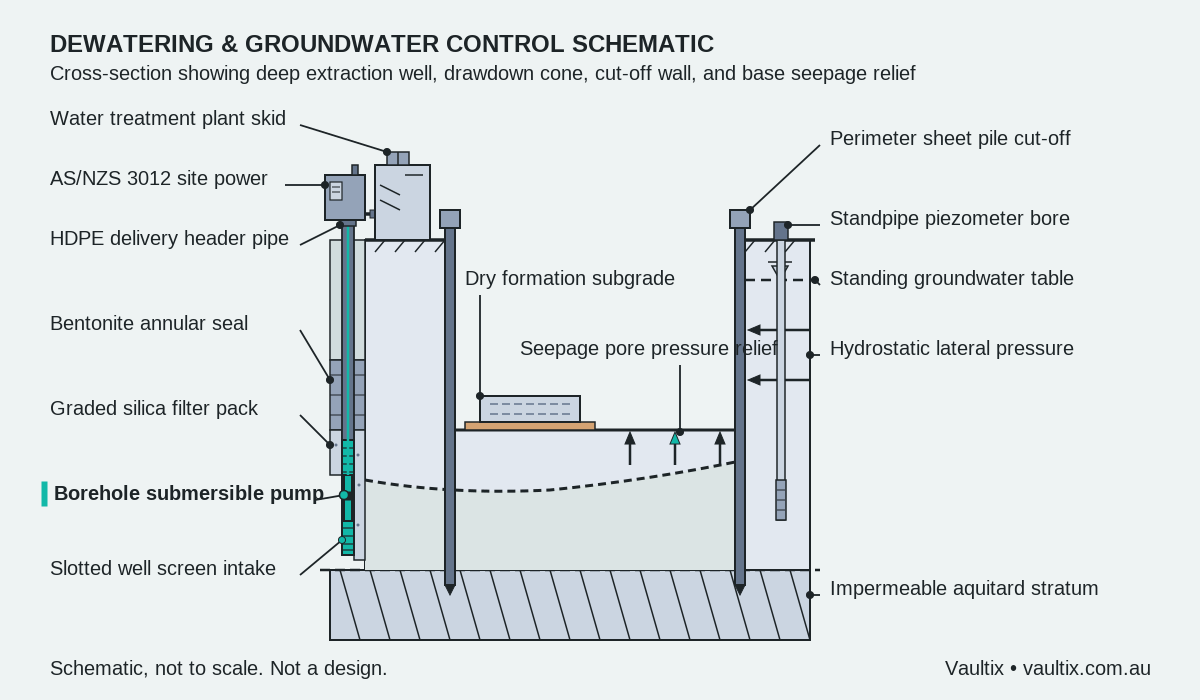
In Australian civil construction, dewatering and groundwater control systems are engineered temporary works deployed to depress groundwater tables, intercept subsurface seepage, and relieve pore water pressures within excavations. Geotechnically, these systems prevent catastrophic base heave, piping, sand boiling, and batter sloughing, while providing dry, trafficable formations for earthmoving plant, structural foundations, and pipelaying. Depending on ground permeability, depth, and aquifer confinement, systems range from open sump pumping and vacuum wellpoint spears to deep drilled borehole wells, ejector arrays, and impermeable physical cut-off walls. Because uncontrolled drawdown can trigger off-site consolidation settlement, oxidise acid sulfate soils, or breach environmental discharge laws, safety-critical dewatering requires formal hydrogeological analysis, a Temporary Works Design Brief, and certified engineering sign-off.
Common types
| Type | What distinguishes it | Typical use |
|---|---|---|
| Sump and trench pumping (Open sump dewatering) | Lowest capital cost. Employs perimeter collector ditches and gravel-lined sumps pumped via electric submersible or diesel trash pumps. Suited to shallow cuts, dense low-permeability soils, sound rock, and surface runoff, but risks slope ravelling, base boiling, and loss of fines in granular soils. | Shallow open excavations, rock cuttings, mass concrete footings, dense low-permeability clays, and surface water runoff management. |
| Wellpoint systems (Spear points) | Closely spaced slotted risers (spears) installed in shallow strata connected to a common header pipe operating under continuous vacuum. Continuous vacuum dewaters and stabilises sandy ground, but atmospheric suction lift limits practical drawdown to 5 m to 6 m per stage, requiring benched multi-stage tiers for deeper cuts. | Pipeline trenching in coastal sands, shallow basement excavations, and unconfined granular alluvium. |
| Deep well systems (Borehole wells) | Drilled boreholes (300 mm to 600 mm diameter) lined with slotted screens, graded silica filter sand packs, and downhole electric submersible pumps. Positive discharge pressure removes suction depth limits; wells sit outside the excavation footprint, keeping work areas clear, but require rotary drilling and engineered filter design. | Deep basements, caissons, shaft sinking, cut-and-cover tunnels, and depressurisation of deep gravel or fractured rock confined aquifers. |
| Ejector (Eductor) systems | Bored wells fitted with bottom venturi nozzles driven by high-pressure water circulated from a surface pump. Generates a downhole vacuum while lifting water from depths exceeding 6 m in low-permeability silts and fine sands where standard submersibles run dry. Requires surface supply pumps and balance tanks. | Fine-grained stratified soils, silts, and laminated fine sands requiring vacuum drainage at depths greater than 6 m. |
| Physical groundwater cut-off walls (Exclusion systems) | Impermeable vertical barriers keyed into an underlying low-permeability aquitard, including diaphragm walls, secant pile walls, sheet pile walls, slurry trenches, and jet grouting. Excludes groundwater rather than pumping regional aquifers, eliminating off-site drawdown and settlement risks, but requires higher capital outlay. | Deep urban basements, caissons, and cut-and-cover excavations adjacent to sensitive heritage buildings, roads, or critical utilities. |
| Artificial recharge and reinjection systems | Perimeter recharge bores, infiltration trenches, or basins located outside the excavation perimeter, connected to dewatering discharge via filtration and pressure manifolds. Reinjects treated water to maintain piezometric heads and prevent settlement, requiring fine pre-filtration to prevent screen clogging and biofouling. | Sensitive built environments and heritage precincts where drawdown outside excavation perimeters must be strictly counteracted. |
When it is used
- Excavations extending below the standing water table for basements, cut-and-cover tunnels, shafts, pump stations, and deep drainage caissons.
- Upward seepage relief to mitigate hydraulic heave, piping, or base boiling where cuts overlie pressurised confined aquifers.
- Batter and slope stabilisation in water-bearing sands and silts to eliminate seepage faces, ravelling, and slope sloughing.
- Preparation of dry, firm formation subgrades required for raft footings, blinding slabs, and structural tanking membranes.
- Linear infrastructure trenching through waterlogged coastal alluvium, river terraces, or estuarine deposits for trunk pipe and service installation.
- Subsurface shaft sinking and portal establishment for tunneling, directional drilling pits, and microtunneling reception chambers.
- Dewatering of backfilled cofferdams and marine caissons during bridge pier and maritime footing construction.
- Ground depressurisation to reduce hydrostatic lateral pressures acting against temporary shoring and retention systems.
Do not use unconfined dewatering pumping in compressible soils (soft clays or peats) near sensitive structures or utilities where drawdown causes consolidation settlement; use impermeable cut-off walls or artificial recharge instead. Avoid pumping in heavily contaminated groundwater plumes containing hydrocarbons, PFAS, or heavy metals where extraction risks drawing plumes into the excavation, or where environmental discharge permits are unobtainable. Dewatering is also inefficient in massive-recharge coastal sands or open gravels where inflow volumes are excessive, or in dense, low-permeability clays below 10⁻⁸ m/s where gravity drainage is negligible and simple sump collection suffices.
Components and how it works
- Extraction bores and spears. Slotted PVC or steel well screens, casing, suction risers, and jetted spear points that collect groundwater from targeted strata while restraining aquifer material.
- Filter packs and annular seals. Graded silica filter sand packed around screens to prevent loss of fines, capped with bentonite pellets and cement grout to prevent surface water ingress.
- Pumping plant. High-vacuum dewatering pumps, multi-stage downhole borehole electric submersibles, and diesel trash pumps tailored to head and flow requirements.
- Pipework and manifolds. Quick-release header pipes, layflat suction lines, flanged high-density polyethylene (HDPE) delivery mains, and isolating non-return valves.
- Power and controls. AS/NZS 3012 compliant distribution switchboards, automated generator changeover switches, secondary backup gensets, and telemetry units.
- Water treatment plant. Settlement basins, lamella clarifiers, automated polymer flocculation skids, and pH adjustment dosing systems to treat effluent prior to release.
- Monitoring instrumentation. Standpipe and vibrating-wire piezometers to monitor groundwater heads, electromagnetic flow meters, and external optical settlement survey pins.
- Physical cut-off elements. Interlocking sheet piles, secant piles, diaphragm wall guide walls, and tremie-placed concrete forming impermeable perimeter barriers.
Typical installation and removal sequence follows six steps: 1. Complete geotechnical investigations (permeability testing per AS 1726), hydrogeological modeling, and secure water abstraction licences and discharge consents. 2. Establish perimeter erosion controls, construct water treatment facilities (settlement basins, clarifiers, and pH adjustment skids), and install piezometer monitoring arrays with baseline survey pins. 3. Install subsurface ground elements—driving cut-off walls, drilling deep wells with silica filter packs and bentonite seals, or jetting wellpoint spears. 4. Connect pipework manifolds to AS/NZS 3012 compliant electrical switchboards, commission pumps, and run step-drawdown trials to verify cone of depression and water quality prior to bulk excavation. 5. Maintain continuous pumping, daily piezometer dips, telemetry tracking, and water treatment throughout substructure works until permanent raft slabs, walls, and backfill resist hydrostatic uplift without pumping. 6. Execute phased shutdown to allow gradual groundwater rebound, retrieve pumps and spears, pressure-grout all boreholes from base to collar per state rules, and demobilise treatment plant.
Australian standards and rules
Checked 10 November 2026. Each document was looked up in catalogue and regulator listings; the text of the standards was not read. Rows marked Not verified were not found or could not be checked. Confirm the current edition before relying on any document. Figures quoted on this page, such as loads, tolerances, heights, depths and inspection intervals, are typical values and are unverified unless a row cites the rule.
| Document | What it covers for this item | Status |
|---|---|---|
| AS 1726:2017 (Geotechnical site investigations) | Site investigations, borehole logging, and soil permeability testing procedures. | Confirmed |
| AS 4678:2002 (Earth-retaining structures) | Retaining and cut-off wall hydrostatic criteria and earth pressure design. | Confirmed |
| AS 2159:2009 (Piling—Design and installation) | Piling design, secant and contiguous wall construction tolerances, and integrity testing. | Confirmed |
| AS/NZS 3012:2019 (Electrical installations—Construction and demolition sites) | Construction site switchboards, RCD protection, and submersible pump testing requirements. | Confirmed |
| AS/NZS 3000:2018 (Electrical installations - Wiring Rules) | Electrical safety, earthing, and pump power distribution rules in wet environments. | Confirmed |
| AS 2865:2009 (Confined spaces) | Safe atmospheric testing, entry, and rescue protocols for deep pump sumps, shafts, and manholes. | Confirmed |
| Model Code of Practice: Excavation work (Safe Work Australia) | Excavation shoring, battering, and collapse prevention from groundwater ingress. | Confirmed |
| Model Code of Practice: Confined spaces (Safe Work Australia) | Risk management and safe working practices for deep excavations and pump chambers. | Confirmed |
| Model Code of Practice: Managing electrical risks in the workplace (Safe Work Australia) | Operating high-voltage and 415 V electrical pump plant in wet site conditions. | Not verified |
| CIRIA C750: Groundwater control: design and practice (2nd Ed.) | Comprehensive engineering design, permeability assessment, and well filter pack design. | Not verified |
| Managing Urban Stormwater: Soils and Construction (Blue Book, Landcom/NSW Govt) | Sediment basin design, flocculation methods, and clean water discharge criteria. | Not verified |
| Best Practice Erosion and Sediment Control (BPESC, IECA Australasia) | Site water treatment, sediment retention, and environmental erosion standards. | Not verified |
| EPA Victoria Publication 1834.2: Civil construction guide | Civil construction dewatering, pollution prevention, and off-site discharge duties. | Confirmed (edition corrected) |
| Treatment and Management of Soil and Water in ASS Landscapes (WA DWER) | Investigation, monitoring, and lime treatment for dewatering in acid sulfate soils. | Confirmed |
| State Water Legislation (NSW WMA 2000, WA RiWI Act 1914, QLD Water Act 2000, VIC Water Act 1989) | Statutory water take licences, bore construction permits, and aquifer interference approvals. | Not verified |
| Environmental Protection Legislation (NSW POEO Act, QLD EP Act, VIC EP Act) | Statutory discharge compliance, prohibition of polluting waters, and licence conditions. | Not verified |
Check the current edition before relying on any document. Temporary works need a competent person's design and inspection; this page is not a design guide.
Estimating considerations
- Soil permeability and anticipated inflow. High-permeability gravels and sands generate substantial sustained discharge volumes requiring higher pump capacities, larger delivery manifolds, and larger sediment basins compared to tight silts.
- Drawdown depth and equipment selection. Shallow cuts under 5 m allow open sumps or single-stage vacuum wellpoints, whereas depths beyond 6 m require tiered benches, borehole deep wells with submersible pumps, or eductor systems.
- Drawdown radius and third-party protection. An expansive cone of depression in compressible ground dictates extensive perimeter monitoring arrays, dilapidation surveys, and potentially costly artificial recharge systems or cut-off walls.
- Water quality treatment and discharge fees. High turbidity demands coagulant and flocculant skids; acid sulfate leachate requires automated hydrated lime dosing; discharge to municipal sewers incurs volumetric trade waste fees, while stormwater discharge requires strict continuous monitoring.
- 24/7 continuous power and redundancy. Safety-critical pumping requires continuous uninterrupted power; estimators must budget for dual synchronised diesel generators with automatic transfer switches (ATS) or dedicated mains utility connections alongside round-the-clock fuel supply.
- Equipment hire duration versus capital purchase. Submersible borehole pumps, vacuum spear units, and clarifiers are typically dry-hired on weekly rates; allowances must cover minimum hire terms, delivery floats, site mobilisation, and off-hire decontamination and descaling.
- Consumable and sacrificial materials. Budgeting full write-off for consumable items that remain in the ground or cannot be salvaged, including slotted PVC casing, well screens, graded silica filter sand, bentonite seals, and pressure-grouting cement.
- Specialist drilling and installation plant. Dedicated subcontractor costs for rotary drilling rigs, CFA piling rigs, or high-pressure jetting pumps required to sink wells and spear points through varying geotechnical strata.
- Engineering, testing, and statutory licensing. Allowances for hydrogeological modeling, RPEQ/CPEng design certification, water authority abstraction licence application fees, discharge permits, baseline dilapidation surveys, and daily NATA water sampling.
- Wet weather surcharges and flood inundation. Major rain events flood excavations and surge water treatment capacity; water authorities frequently shut down sewer trade waste intake during storms, forcing site storage or work stand-downs.
Risks and common failures
- Off-site settlement and structural cracking. Regional drawdown consolidates compressible soils (soft clays or peats) beneath adjacent buildings, roads, and utilities. Control: Mandate perimeter cut-off walls keyed into an impermeable aquitard, install artificial recharge systems, and enforce trigger-action response plans (TARPs) linked to continuous piezometer and optical settlement monitoring.
- Basal heave, piping, and boiling. Upward seepage hydraulic gradients exceed the buoyant weight of soil at the excavation base, causing quicksand conditions and sudden floor blowout. Control: Install deep relief wells to depressurise confined underlying aquifers, extend cut-off walls deeper into impermeable strata, or place an engineered gravel surcharge blanket over the formation.
- Well sanding and loss of ground fines. Inadequate filter sand packs or oversized well screen slots pull fine soil particles through the pumps, eroding subsurface ground and creating subsurface voids. Control: Perform particle size sieve analysis to AS 1726, engineer graded silica filter packs and slot apertures per CIRIA C750, and develop all wells thoroughly via surging and air-lifting prior to commissioning.
- Inundation from power or pump failure. Mains power outages or pump mechanical breakdown cause rapid groundwater rebound, flooding active excavations, drowning plant, and destabilising batters. Control: Install dual synchronised diesel backup generators with automatic transfer switching, dual lead-lag pump configurations, and high-level float alarms connected to 24/7 telemetry diallers.
- Unlawful environmental discharge. Releasing untreated, turbid, acidic, or hydrocarbon-impacted dewatering effluent into stormwater channels or waterways risks statutory prosecution and stop-work notices under environmental protection laws. Control: Install multi-stage water treatment systems (flocculation, lamella clarifiers, and pH neutralisation skids) equipped with fail-safe automated shut-off actuated valves linked to calibrated water quality probes.
- Cut-off wall window leaks. Out-of-verticality in pile drilling, declutched sheet piles, or cold joints in diaphragm walls leave gaps that allow pressurised groundwater and soil fines to breach the excavation. Control: Enforce strict piling verticality tolerances per AS 2159, perform cross-hole sonic logging or thermal integrity profiling, and maintain emergency polyurethane resin injection or external jet-grouting plant on standby.
- Acid sulfate soil oxidation and leachate. Uncontrolled lowering of the water table exposes pyritic soils to oxygen, producing sulfuric acid, dropping water pH, and leaching heavy metals into the excavation. Control: Restrict the zone of dewatering via impermeable cut-offs, phase pumping drawdowns, maintain continuous automated pH monitoring, and establish on-site hydrated lime dosing skids.
- Pump biofouling and screen incrustation. Dissolved iron and carbonate minerals precipitate and biofoul well screens and impellers upon exposure to atmospheric oxygen, drastically reducing extraction efficiency. Control: Select corrosion- and chemical-resistant submersible pumps, maintain pumps submerged below dynamic water levels, and execute scheduled mechanical scrubbing and acid flushing maintenance.
Sources and review
| Source | Used for | Status |
|---|---|---|
| AS 1726:2017 (Geotechnical site investigations), Standards Australia (store.standards.org.au) | Site investigations, borehole logging, and soil permeability testing. | Confirmed |
| AS 4678:2002 (Earth-retaining structures), Standards Australia (store.standards.org.au) | Retaining and cut-off wall hydrostatic criteria and earth pressure design. | Confirmed |
| AS 2159:2009 (Piling—Design and installation), Standards Australia (store.standards.org.au) | Piling design, secant and contiguous wall tolerances, and integrity testing. | Confirmed |
| AS/NZS 3012:2019 (Electrical installations—Construction and demolition sites), Standards Australia (store.standards.org.au) | Site switchboards, RCD testing, and submersible pump electrical safety. | Confirmed |
| AS/NZS 3000:2018 (Electrical installations - Wiring Rules), Standards Australia (store.standards.org.au) | Electrical safety and pump power distribution rules in wet environments. | Confirmed |
| AS 2865:2009 (Confined spaces), Standards Australia (store.standards.org.au) | Safe atmospheric testing, entry, and rescue protocols for deep pump sumps and shafts. | Confirmed |
| Model Code of Practice: Excavation work, Safe Work Australia (safeworkaustralia.gov.au) | Excavation shoring, battering, and collapse prevention from groundwater. | Confirmed |
| Model Code of Practice: Confined spaces, Safe Work Australia (safeworkaustralia.gov.au) | Risk management and safe working practices for deep sumps and pump chambers. | Not verified |
| Model Code of Practice: Managing electrical risks in the workplace, Safe Work Australia (safeworkaustralia.gov.au) | Operating electrical pump plant and switchboards in wet ground. | Not verified |
| CIRIA C750: Groundwater control: design and practice (2nd Ed.), CIRIA (ciria.org) | Comprehensive groundwater control, permeability assessment, and well filter design. | Not verified |
| Managing Urban Stormwater: Soils and Construction (Blue Book), Landcom / NSW Govt (environment.nsw.gov.au) | Sediment basin design, flocculation methods, and clean water discharge criteria. | Not verified |
| Best Practice Erosion and Sediment Control (BPESC), IECA Australasia (austieca.com.au) | Water treatment skids, sediment capture, and erosion control standards. | Not verified |
| EPA Victoria Publication 1834.2: Civil construction guide, EPA Victoria (epa.vic.gov.au) | Civil construction dewatering, pollution prevention, and off-site discharge duties. | Confirmed (edition corrected) |
| Treatment and Management of Soil and Water in ASS Landscapes, WA DWER (wa.gov.au) | Acid sulfate soil dewatering management, monitoring, and lime dosing controls. | Confirmed |
| Water Management Legislation (NSW WMA 2000 / WA RiWI Act 1914 / QLD Water Act 2000 / VIC Water Act 1989), State Water Authorities (waternsw.com.au) | Statutory water take licences, bore construction permits, and aquifer interference rules. | Not verified |
| Environmental Protection Legislation (NSW POEO Act / QLD EP Act / VIC EP Act), State Environmental Authorities (epa.vic.gov.au) | Statutory discharge compliance, water quality thresholds, and licensing. | Not verified |
| Temporary Works — Index (TMP-INDEX-001), Vaultix (vaultix.com.au) | Temporary works group taxonomy, RPEQ design obligations, and hire rate structures. | Not verified |
Items marked Not verified are not yet checked against a primary source. Research notes.
Library navigation
Plant and method index · Discipline work packages · Survey conformance and lot release