Temporary works / Lifting and vertical access
Temporary hoists and crane bases
Temporary hoists, mast climbers, and tower crane bases are safety-critical temporary works that enable vertical transit, façade access, and heavy lifting across multi-level structures. They transfer dynamic dead weight, hook loads, slewing inertia, and overturning storm wind moments into foundation soils or the permanent building frame. For civil estimators and construction planners, their high establishment costs, crane mobilisation, progressive tie cycles, and mandatory engineering certifications represent major programme and cost drivers requiring first-principles build-up.
- Table formRepetition depends on striking, moving and resetting each table.
- Shifting trolleyAllow for travel and handling access between slab bays.
- Floor bayLink survey and concrete records to the released pour area.
What it is
Temporary hoists, mast climbers, and tower crane bases are engineered temporary works that facilitate vertical access, material distribution, and heavy lifting across multi-level structures. Hoists and mast climbing work platforms provide mechanical vertical transport for personnel and materials along modular lattice masts anchored to the building frame. Tower crane bases and structural wall ties support cranes by safely transmitting vertical mass, hook payloads, slewing inertia, and lateral storm wind overturning moments into the ground, piling, or permanent structural elements. Because these systems impose significant cyclical and dynamic reactions onto soils, structural steelwork, and curing concrete, their installation, progressive height climbing, and dismantling demand rigorous structural engineering verification, statutory plant registration, and certified high-risk operations.
Common types
| Type | What distinguishes it | Typical use |
|---|---|---|
| Cantilever Material Hoists (Class HM) | Open platforms cantilevered from a lattice mast, operated strictly from external push-button stations for goods only. Transporting personnel is prohibited. | Moving tools, palletised dry goods, and bulk construction materials without carrying personnel. |
| Rack-and-Pinion Personnel and Materials Hoists (Class HP) | Enclosed single or twin cars driven by motor pinions on a geared mast rack, fitted with internal controls, overspeed centrifugal safety brakes, interlocked landing gates, and roof escape hatches. | Primary vertical transit for personnel, fitout trades, and general building materials on multi-storey projects. |
| Rope-Suspended / Traction Hoists | Winch-driven platforms guided by vertical ropes or rails, without rack-and-pinion masts. | Internal lift shaft installations and industrial refurbishment where rack masts cannot fit. |
| Single-Mast MCWPs | Central mast driving an adjustable work platform with cantilevered side decks. | Façade access on narrow structural bays and lightweight exterior cladding or glazing works. |
| Twin-Mast / Multi-Mast MCWPs | Synchronised drive units across multiple masts supporting an extended continuous deck for heavy payloads. | Masonry, heavy precast or unitised curtain-wall installation, and ergonomic work as an alternative to perimeter scaffolding. |
| Cast-in Gravity Mass Pad | Reinforced concrete gravity pad foundation with cast-in anchor stools transferring overturning moments directly to competent ground. | Free-standing tower cranes on sites with competent ground bearing capacity and space for mass excavation. |
| Piled Foundation with Pile Cap | Reinforced concrete cap seated on bedrock-socketed or friction piles resisting overturning moments and tensile pull-out forces. | Tower crane bases in weak or variable soils where shallow spread footings cannot resist overturning or settlement. |
| Static Ballasted Cross-Base | Steel cruciform frame on outrigger pads weighted with precast concrete ballast blocks, avoiding cast-in stools. | Low-to-medium height tower cranes where cast-in foundations are impractical and footprint space permits a wide base. |
| Structural Steel Grillage / Transfer Deck | Heavy steel structural beams distributing concentrated crane reactions across permanent basement columns, core walls, or transfer slabs. | Dense zero-lot urban sites or podium levels where cranes cannot sit directly on natural ground. |
| Internal Climbing System | Tower crane seated inside vertical shafts on climbing collars and wedging beams, jumping upward floor-by-floor with hydraulic rams. | Super-tall buildings or confined footprints where external freestanding or tied cranes cannot reach or be supported externally. |
| Rigid Mast Strut Ties | Structural steel struts connecting a mast collar to cast-in stools or through-bolted slab plates. | Stabilising tower cranes or high-rise hoists into permanent floor plates once heights exceed freestanding limits. |
When it is used
- Moving personnel and tools vertically on buildings above 3–4 storeys to reduce worker fatigue, prevent fall risks, and maintain site productivity.
- Distributing internal fitout materials, plasterboard, and mechanical equipment floor-by-floor without tying up crane hooks.
- Urban projects with zero-lot-line boundaries where ground-bearing perimeter scaffolding cannot be placed due to roadways or boundary excavations.
- Installation of heavy façade panels, unitised curtain walling, or external masonry exceeding the load capacity of mobile elevating work platforms.
- High-rise structures where tower crane hook heights exceed certified freestanding limits, requiring engineered structural tie-ins.
- Sites requiring high-volume vertical logistics where internal lifts are not yet commissioned or protected for builder use.
- Projects where deep basement excavations or podium slabs demand engineered crane grillage support rather than direct ground bearing.
Do not use fixed hoists or tower cranes on low-rise construction under three storeys, where telehandlers, mobile cranes, and scissor lifts provide faster mobilisation without structural tie engineering. Avoid mast systems on lightweight timber or light-gauge steel frames lacking the structural capacity to resist tie-in reactions without extensive propping to ground. On unpowered sites lacking heavy 415V three-phase electrical supplies, or for short-duration facade inspections, mobile hydraulic access equipment or rope access should be used instead.
Components and how it works
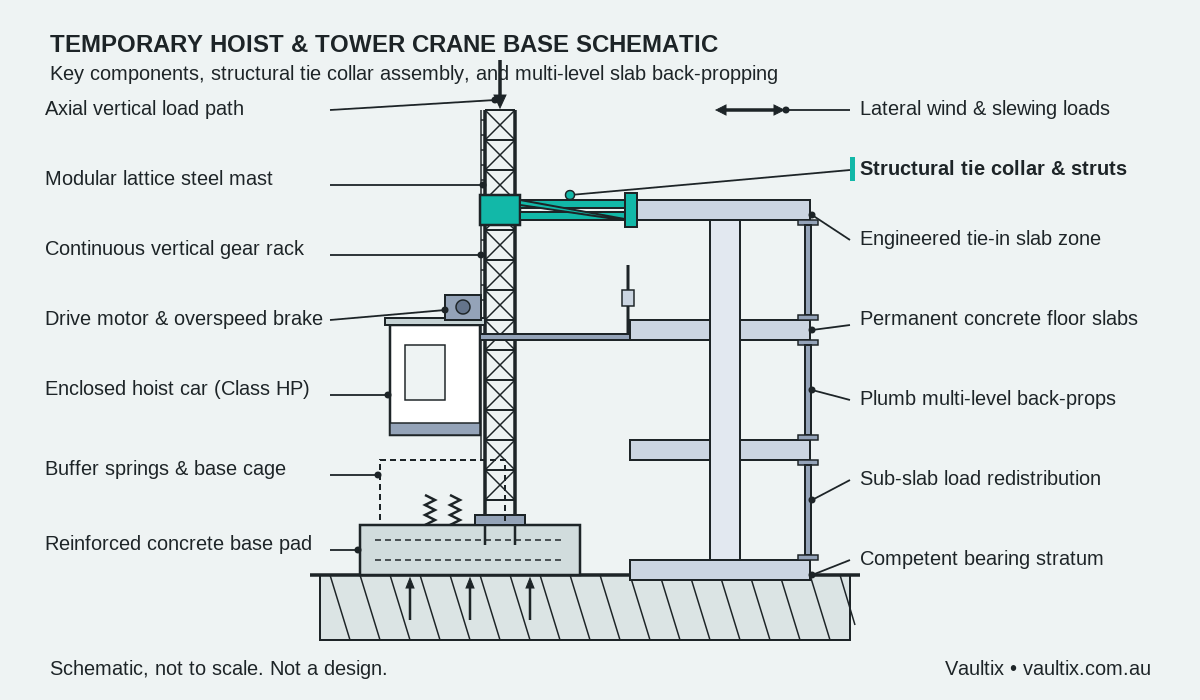
- Base and foundation. Concrete mass footing, pile cap, cruciform chassis, or cast-in stools equipped with buffer springs and an enclosed ground protection cage to absorb impact and support vertical dead loads.
- Mast and rack segments. Modular lattice steel tower sections fitted with guide tubes, bolted joints, and vertical drive racks that transfer vertical and horizontal loads along the travel path.
- Drive and safety mechanics. Electric drive motors, gearboxes, electromagnetic service brakes, limit switches, and centrifugal overspeed governors (drop brakes) that arrest the car mechanically if descent speed is exceeded.
- Car or working deck. Enclosed personnel cage or adjustable platform deck fitted with perimeter kickplates, interlocked bi-fold or vertical gates, and emergency escape hatches.
- Structural ties and wall anchors. Structural steel collars, rigid tie struts, cast-in ferrule plates, and through-bolted slab assemblies transferring lateral wind and dynamic reactions into cured building frames.
- Landing equipment and interlocks. Full-height landing gates with electromechanical interlocks, articulated bridge ramps, and protective threshold canopies preventing access unless the hoist car is docked.
Typical installation and removal sequence follows seven steps: 1. Complete borehole geotechnical review and obtain RPEQ/CPEng foundation design sign-off. 2. Construct base footing or assemble steel grillage with cast-in anchor stools and cure concrete. 3. Erect base mast sections, verify plumbness, torque anchors, and assemble drive car or crane head using mobile cranage. 4. Progressively jump mast segments and install engineered structural wall ties into certified floor plates as the building rises. 5. Fit full-height interlocked landing gates, threshold ramps, and complete mandatory overspeed drop tests and statutory commissioning. 6. Dismantle mast sections section-by-section downward with mobile cranage while maintaining required lower slab back-propping. 7. Demobilise base components, haul via transport floats, and reinstate anchor stool cut-offs or slab penetrations.
Australian standards and rules
Checked 10 November 2026. Each document was looked up in catalogue and regulator listings; the text of the standards was not read. Rows marked Not verified were not found or could not be checked. Confirm the current edition before relying on any document. Figures quoted on this page, such as loads, tolerances, heights, depths and inspection intervals, are typical values and are unverified unless a row cites the rule.
| Document | What it covers for this item | Status |
|---|---|---|
| AS 2550.4:2025 (Cranes, hoists and winches — Safe use, Part 4: Tower cranes including self-erecting tower cranes) | Safe erection, climbing, operation, inspection, maintenance, and dismantling of tower cranes. | Confirmed |
| AS 1418.4-2004 (Cranes, hoists and winches, Part 4: Tower cranes) | Design, manufacturing, and structural stability criteria for tower cranes and climbing frames. | Confirmed |
| AS 2550.7:2024 (Cranes, hoists and winches — Safe use, Part 7: Builders' hoists and associated equipment) | Operational safety, regular inspections, maintenance, and mandatory drop tests for builders' hoists. | Confirmed |
| AS 1418.7:2024 (Cranes, hoists and winches, Part 7: Builders' hoists and associated equipment) | Mechanical drive engineering, overspeed safety devices, and electrical gate interlocks. | Confirmed |
| AS 2550.16:2026 (Cranes, hoists and winches — Safe use, Part 16: Mast climbing work platforms) | Siting, foundation loading, mast tie intervals, and operating rules for MCWPs. | Confirmed (edition to be confirmed: AS 2550.16:2026 found) |
| AS 1418.16-1997 (Cranes (including hoists and winches), Part 16: Mast climbing work platforms) | Design, rated load capacities, and stability rules for single and twin mast climbers. | Confirmed |
| AS 2550.1-2011 (Cranes, hoists and winches — Safe use, Part 1: General requirements) | General operational safety, inspection schedules, and 10-year major structural inspections. | Confirmed |
| AS 3600:2018 (Concrete structures) | Design of reinforced concrete crane gravity pads, pile caps, and slab back-propping capacity. | Confirmed |
| AS 4100:2020 (Steel structures) | Design and structural verification for steel grillages, mast collars, and structural tie struts. | Confirmed |
| AS/NZS 1170.2:2021 (Structural design actions, Part 2: Wind actions) | In-service and out-of-service storm wind overturning moments on crane masts, hoists, and ties. | Not verified |
| Model Code of Practice: Tower cranes (Safe Work Australia) | Siting, foundation engineering, climbing frames, weathervaning, and principal contractor duties. | Confirmed |
| Tower Crane Code of Practice 2017 (Workplace Health and Safety Queensland) | Foundation geotechnical design, independent tie verification, and commissioning controls. | Confirmed |
| CIRIA C761 (Guide to tower crane foundation and tie design) | Engineering guidance for crane gravity pads, pile caps, steel grillages, and mast ties. | Confirmed |
Check the current edition before relying on any document. Temporary works need a competent person's design and inspection; this page is not a design guide.
Estimating considerations
- Building height and landings. Total height and number of landing levels dictate mast bundles, vertical drive racks, structural ties, landing gates, and trailing cable lengths, driving both establishment time and ongoing hire costs.
- Dry vs wet hire arrangements. Civil estimators must confirm whether hoist packages include dedicated licensed Class HP operators or if labour must be budgeted within site preliminaries.
- Custom structural ties and grillages. Cast-in tie stools, bespoke steel tie struts, and transfer grillages are typically project-specific fabricated steel with minimal scrap or salvage value.
- Fleet purchase vs rental amortisation. Standard modular mast towers and hoist cars can be amortised across a continuous multi-project pipeline or rented on monthly hire to reduce upfront capital requirements.
- Heavy mobile craneage for erection and dismantling. Substantial mobile crane capacity and ballast delivery floats are required for initial base setup, mast jumping, and final de-rigging operations.
- Engineering design and certification fees. Budget allowances must cover geotechnical borehole review, foundation design, RPEQ/CPEng tie and slab certifications, and independent structural third-party reviews.
- Electrical infrastructure and power supply. Sites require heavy 415V three-phase high-amperage mains connections, dedicated sub-boards, soft-starters, or dedicated heavy generator sets to avoid voltage drops.
- Statutory permits, registrations, and testing. Cost allowances are required for plant design registration, item registration renewals, council road closures, out-of-hours permits, and mandatory 90-day drop tests.
- Multi-level slab back-propping. Slabs supporting tie-in reactions require back-propping through lower floors until green concrete reaches design structural capacity, directly affecting formwork hire cycles.
- Weather downtime and environmental limits. Programme allowances must accommodate crane wind-off shutdowns when wind speeds exceed rated anemometer thresholds and storm weathervaning precautions.
Risks and common failures
- Foundation bearing failure and overturning. Caused by inadequate soil capacity, unverified fill, or unquantified storm wind moments. Control: Perform location-specific borehole testing, obtain RPEQ-certified foundation engineering, and complete pre-pour structural inspections.
- Slab punching shear and cracking at ties. High cyclical tie reactions transferred into green suspended slabs. Control: Implement engineered temporary back-propping schemes across lower cured slabs and verify slab capacity with an independent structural engineer.
- Personnel fall from landing gates. Bypassed, damaged, or un-interlocked gates leaving open edges when the car is absent. Control: Install failsafe electromechanical interlocks preventing car motion if a gate is open and preventing gate opening if the car is absent, backed by daily pre-start checks.
- Uncontrolled car overspeed drop. Mechanical drive pinion fracture, gearbox failure, or motor brake loss. Control: Fit an independent centrifugal overspeed governor (drop brake) acting directly on the mast rack, with mandatory 90-day drop tests logged in the plant register.
- Crushing and shearing during jumping. Uncontrolled movement or premature unbolting of mast sections during height extensions. Control: Enforce strict manufacturer jumping procedures under the direct supervision of licensed intermediate riggers or scaffolders with drive lockouts in place.
- Tower crane jib collision. Overlapping crane radii or jib contact with adjacent structures in dense urban corridors. Control: Install computerised anti-collision zoning systems, establish airspace agreements, and ensure clear 360-degree free-slew weathervaning paths.
- Dropped objects from height. Loose tools or materials falling through open floor gaps or off platform edges. Control: Install full-height perimeter mesh screens on cars, fit kickplates, erect overhead protective gantries at base entrances, and enforce tool lanyards.
Sources and review
| Source | Used for | Status |
|---|---|---|
| Model Code of Practice: Tower cranes, Safe Work Australia (safeworkaustralia.gov.au) | Siting, foundation requirements, climbing frames, weathervaning, ties, and duties. | Confirmed |
| Tower Crane Code of Practice 2017, Workplace Health and Safety Queensland (worksafe.qld.gov.au) | Geotechnical foundation design, engineer tie verification, and commissioning controls. | Confirmed |
| Model Work Health and Safety Regulations, Safe Work Australia (safeworkaustralia.gov.au) | High Risk Work Licences (CT, CS, HP, HM, SI, RI) and Schedule 5 Plant Registration. | Not verified |
| AS 2550.4:2025 (Cranes, hoists and winches — Safe use: Tower cranes), Standards Australia (store.standards.org.au) | Safe erection, climbing, operation, inspection, and maintenance of tower cranes. | Confirmed |
| AS 1418.4-2004 (Cranes, hoists and winches: Tower cranes), Standards Australia (store.standards.org.au) | Design and structural stability parameters for tower cranes. | Confirmed |
| AS 2550.7:2024 (Safe use: Builders' hoists), Standards Australia (store.standards.org.au) | Operational safety, drop tests, routine maintenance, and inspection of builders' hoists. | Confirmed |
| AS 1418.7:2024 (Builders' hoists and associated equipment), Standards Australia (store.standards.org.au) | Manufacturing, overspeed governor, drive mechanics, and electrical interlocks. | Confirmed |
| AS 2550.16:2026 (Safe use: Mast climbing work platforms), Standards Australia (store.standards.org.au) | Siting, foundation support, tying intervals, and maintenance for MCWPs. | Confirmed (edition to be confirmed: AS 2550.16:2026 found) |
| AS 1418.16-1997 (Mast climbing work platforms), Standards Australia (store.standards.org.au) | Design and rating standards for single- and multi-mast climbing platforms. | Confirmed |
| AS 2550.1-2011 (Cranes, hoists and winches: General requirements), Standards Australia (store.standards.org.au) | Maintenance intervals, testing regimens, and 10-year major inspections. | Confirmed |
| CIRIA C761 (Guide to tower crane foundation and tie design), CIRIA (ciria.org) | Engineering principles for crane bases, pile caps, grillages, and mast ties. | Confirmed |
| Safety Alert: Using material hoists safely, WorkSafe Victoria (worksafe.vic.gov.au) | Mandatory interlocking landing gates and controls for material hoists. | Not verified |
| Tower Cranes – Duties of Principal Contractor, SafeWork NSW (safework.nsw.gov.au) | Principal contractor oversight, plant registration, and handover certifications. | Confirmed |
| Safety Alert: Mast climbing work platform shearing hazard, Workplace Health and Safety Queensland (worksafe.qld.gov.au) | Guarding, isolation, and safe systems of work during jumping of MCWPs. | Not verified |
| Temporary Works — Index (TMP-INDEX-001), Vaultix (vaultix.com.au) | Temporary works taxonomy, cost build-up principles, and RPEQ obligations. | Not verified |
Items marked Not verified are not yet checked against a primary source. Research notes.
Library navigation
Plant and method index · Discipline work packages · Survey conformance and lot release