Temporary works / Ground support
Shotcrete
Shotcrete (sprayed concrete) is mortar or concrete pneumatically projected at high velocity onto a substrate to achieve simultaneous placement and dynamic compaction without conventional formwork. In temporary works and ground engineering, it provides immediate stabilization and sealing for rock cuts, soil nail wall facings, tunnel primary linings, and retention infill panels. For civil estimators and construction planners, costing requires accounting for wet-mix versus dry-mix plant setups, rebound waste allowances, substrate overbreak, liquid accelerator dosing, and mandatory compliance coring rather than standard cast-in-place rates.
- Spray headRecord sprayed area, thickness checks and working time.
- Delivery hoseCoordinate concrete supply and track interruptions.
- Completed liningInspect coverage and retain lot records before advancing.
What it is
Shotcrete is mortar or concrete pneumatically conveyed through a delivery hose and projected at high velocity from a nozzle onto a receiving substrate. Unlike conventional cast concrete requiring rigid formwork shutters and internal vibrators, shotcrete undergoes simultaneous placement and dynamic compaction on impact. High kinetic impact energy consolidates the mix directly against rock, soil, or structural surfaces, achieving full consolidation and intimate bond without external forms. In civil temporary works and ground engineering, shotcrete acts as immediate ground support sealing exposed batters against moisture changes, forms structural facings for soil nail and rock dowel walls, provides early-age primary linings in tunneling to control convergence ahead of permanent works, and spans retention infill panels between soldier or bored piles. Rapid early strength gain is achieved using liquid alkali-free accelerators.
Common types
| Type | What distinguishes it | Typical use |
|---|---|---|
| Wet-mix shotcrete | Concrete batched with water to AS 1379:2026 and delivered by transit agitator; conveyed by positive-displacement pump to nozzle where air and accelerators are injected. Delivers high placement outputs, strictly controlled water-cement ratios, lower rebound waste (typically 5% to 15% on vertical walls), and minimal dust generation. Standard across Australian civil infrastructure. | Standard for major civil infrastructure, road cuttings, rail corridors, retention walls, and underground tunneling. |
| Dry-mix shotcrete (Gunite) | Dry cement and aggregates conveyed pneumatically through hoses in suspension; water added at nozzle immediately prior to discharge. Offers lower output rates and flexible stop-start cycles with long hose reach, but incurs higher rebound waste (often 20% to 40%+ overhead), heavy silica dust, and variable quality dependent on nozzleman water control. | Small-scale structural repairs, railway track maintenance, and restricted access shafts or adits. |
| Steel fibre reinforced shotcrete (SFRS) | Hooked-end steel fibres (typically 30 mm to 60 mm long) batched uniformly into mix matrix. Provides 3D isotropic post-crack toughness and energy absorption (measured in Joules via ASTM C1550 round panel tests). Eliminates manual mesh fixing on unsupported faces, conforms tightly to jagged rock contours, and prevents voids from mesh shadowing. | Underground tunnel primary linings, cavern crowns, and fractured rock slope stabilization. |
| Synthetic macro-fibre reinforced shotcrete | Polyolefin/polypropylene macro-synthetic fibres (typically 40 mm to 65 mm long) dispersed in mix. Delivers post-crack ductility via fibre pull-out mechanics. 100% corrosion-resistant and reduces equipment and delivery line wear relative to steel fibres. | Coastal cut batters, aggressive saline groundwater zones, acid sulfate soils, and temporary slope stabilization. |
| Welded wire mesh reinforcement (Steel fabric) | Welded steel wire mesh sheets (conforming to AS/NZS 4671:2019, such as SL72 to SL102) pinned to substrate with anchor pins and bar chairs. Provides defined two-way flexural capacity, but requires manual fixing labour on unsupported faces and introduces void and shadowing risks behind wires if spraying angles deviate. | Soil nail wall facings, retention infill panels between soldier piles, and structural remedial overlays. |
| Mechanised / robotic spray rigs | Articulated telescopic booms mounted on 4WD or crawler carriers with 360-degree nozzle manipulation, controlled via tele-remote or from an enclosed, air-filtered, ROPS/FOPS cabin. Delivers high placement outputs, consistent 90-degree nozzle alignment, uniform layer thickness, and isolates workers from rockfall, rebound, and silica dust exposure. | Tunnels, deep shafts, portal headwalls, and tall civil highway excavation batters. |
| Handheld manual nozzles | High-pressure delivery hose manipulated manually by a certified nozzleman and hose-tail assistant. Offers high manoeuvrability in restricted spaces, but limited by physical operator fatigue, lower placement outputs, and direct worker exposure to rebound, noise, and airborne silica dust. | Restricted basement pits, underpinning works, trench shoring infill, and localized remedial patching. |
When it is used
- Soil nail wall facings: Stabilising steep soil and weathered rock cut batters for road widenings, rail corridors, and urban basement pits in staged top-down excavation lifts.
- Rock slope stabilization: Sealing fractured rock batters, fault zones, and highway cuttings against water infiltration and wedge unraveling, often anchored with pattern rock bolts.
- Underground tunnel support: Primary lining installation immediately following roadheader or drill-and-blast excavation rounds to control rock convergence ahead of permanent works.
- Shaft sinking and portal headwalls: Lining vertical ventilation shafts, TBM launch shafts, and portal retention structures.
- Retention infill panels: Placing structural infill between soldier piles or contiguous bored piles where irregular soil profiles require retention.
- Immediate ground support and sealing: Preventing slaking, weathering, and unraveling of moisture-sensitive shales and exposed claystone batters immediately upon excavation.
- Structural remediation and overlays: Repairing deteriorated concrete bridge piers, culverts, retaining walls, and maritime seawalls without full formwork installation.
Do not use shotcrete against active running water inflows, as groundwater washes out unhardened cement paste before set; active inflows must first be controlled via pre-grouting, relief drains, or weep pipes. Avoid shotcrete where high-tolerance Class 1 or 2 architectural finishes (AS 3610.1) are specified or within congested rebar cages where bar spacing is under three times maximum aggregate size, as cast-in-place concrete or precast cladding should be used instead. Shotcrete spraying must also be suspended on open, unshielded sites during high ambient winds exceeding 25 km/h to 30 km/h or for flat horizontal slabs where conventional laser-screeded flatwork is more economical.
Components and how it works
- Concrete base mix. Batched concrete complying with AS 1379:2026, comprising cementitious binders (AS 3972-2010), graded aggregates (maximum 10 mm), and pozzolans such as microsilica or fly ash for density and pumpability.
- Chemical admixtures. High-range water reducers (AS 1478.1-2000), hydration stabilizers, and liquid alkali-free accelerators injected at the nozzle to induce rapid set and high early compressive strength.
- Reinforcing elements. Hooked-end steel fibres, macro-synthetic polyolefin fibres, or welded wire fabric (AS/NZS 4671:2019) fixed with anchor pins and bar chairs to carry tensile and flexural stresses.
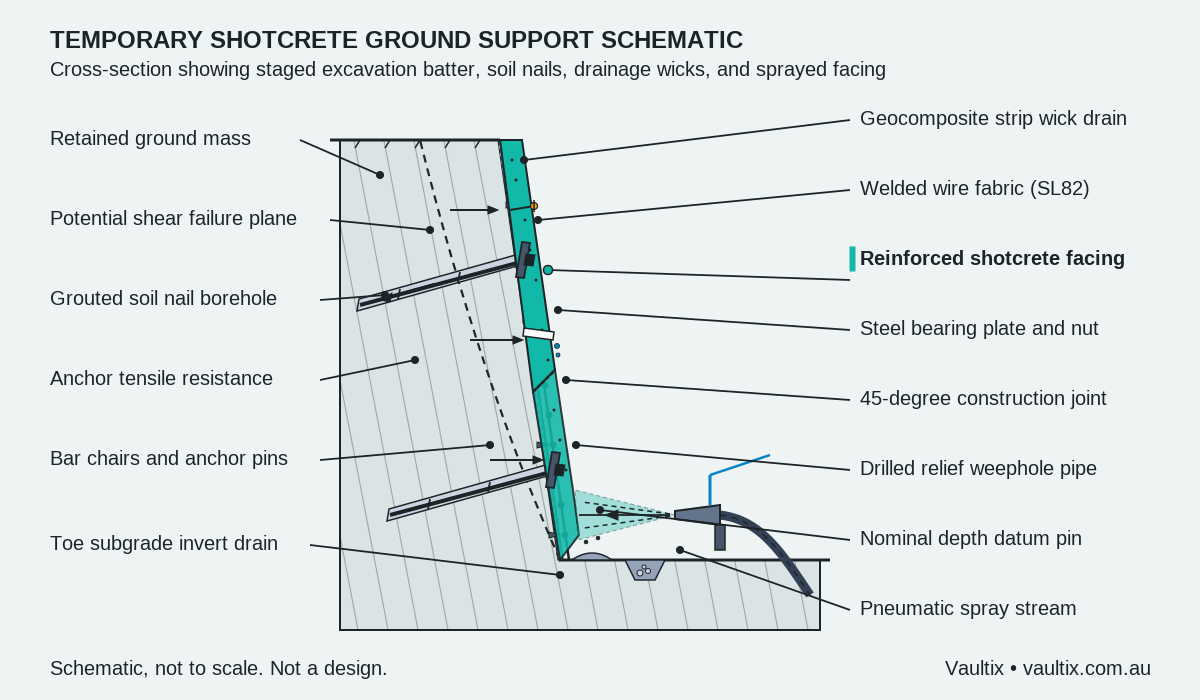
- Subsurface drainage elements. Geocomposite vertical strip wick drains, perforated collection pipes, and drilled weepholes installed against the substrate to relieve hydrostatic water pressures behind the shell.
- Pumping and placement plant. Positive-displacement concrete line pumps, heavy-duty delivery hoses (50 mm to 65 mm ID), air compressors delivering 6 to 8 bar air, and specialized nozzles with accelerator injection chambers.
- Guides and gauges. Screed guide wires, datum pins, or depth test nails installed across the face to ensure minimum design layer thickness is achieved.
- Compliance testing hardware. Box moulds for compressive strength coring, ASTM C1550 round panel moulds for flexural toughness testing, and slump testing equipment.
Typical installation and removal sequence follows six steps: 1. Excavate ground in staged benches (1.5 m to 2.5 m lifts), scale loose rock or soil, wash down substrate, and install vertical strip wick drains and drilled weepholes to relieve groundwater pressure. 2. Fix welded wire mesh reinforcement using chairs and pins to ensure design cover, or batch structural steel/synthetic fibres into the ready-mix truck, and establish depth guide wires. 3. Calibrate accelerator dosing equipment to concrete pump output and shoot pre-pour test panels to verify early strength and energy absorption compliance. 4. Spray shotcrete with the nozzle held perpendicular (90 degrees) to the face from bottom upward, encasing reinforcement without voids while continuously blowing or raking away rebound. 5. Taper construction joints to 45 degrees, apply specified surface finish, and apply continuous curing compound (AS 3799) or water misting immediately upon final set. 6. Upon completion of permanent supporting structures, audit load transfer, de-tension temporary anchors, mechanically break down or saw-cut the temporary shotcrete shell from top down, and haul segregated rubble to crushing recycling facilities.
Australian standards and rules
Checked 10 November 2026. Each document was looked up in catalogue and regulator listings; the text of the standards was not read. Rows marked Not verified were not found or could not be checked. Confirm the current edition before relying on any document. Figures quoted on this page, such as loads, tolerances, heights, depths and inspection intervals, are typical values and are unverified unless a row cites the rule.
| Document | What it covers for this item | Status |
|---|---|---|
| AS 1379:2026 (Specification and supply of concrete) | Base mix batching, material supply tolerances, consistency, and transit delivery of concrete. | Confirmed |
| AS 1012.14:2018 (Methods of testing concrete, Method 14: Method for securing and testing cores from hardened concrete for compressive strength and mass per unit volume) | Procedures for cutting, preparing, and testing cylindrical cores from test panels and in-situ shotcrete for compressive strength and density. | Confirmed |
| AS/NZS 4671:2019 (Steel for the reinforcement of concrete) | Material properties, standard grades, and tolerances for welded steel wire mesh sheets used in shotcrete facings. | Confirmed |
| AS 3600:2018 (Concrete structures) | General concrete structural criteria, durability provisions, minimum concrete cover, and crack control principles. | Confirmed |
| AS 1478.1-2000 (Chemical admixtures for concrete, mortar and grout, Part 1: Admixtures for concrete) | Performance criteria and chemical classification for water-reducing agents, accelerators, and plasticizers. | Confirmed |
| AS 3972-2010 (General purpose and blended cements) | Portland and blended hydraulic cement compliance, slag, and fly ash requirements for shotcrete mixes. | Confirmed |
| ASTM C1550-20 (Standard Test Method for Flexural Toughness of Fiber-Reinforced Concrete (Using Centrally Loaded Round Panel)) | Round panel (800 mm diameter) test method measuring post-crack flexural toughness and energy absorption in Joules for fibre reinforced shotcrete. | Edition to be confirmed (C1550-26 listed) |
| EN 14488-5:2006 (Testing sprayed concrete - Part 5: Determination of energy absorption capacity of fibre reinforced slab specimens) | Square panel energy absorption test standard evaluating post-cracking behaviour of sprayed concrete. | Not verified |
| CIA Z5:2010 (Shotcrete in Australia | Industry reference practice covering wet-mix and dry-mix processes, mix designs, nozzle manipulation, rebound control, and quality assurance. | Confirmed |
| Austroads Technical Specification ATS 5328 (Sprayed Concrete) | Harmonized road agency specification governing sprayed concrete constituents, daily pre-construction test panels, spraying tolerances, and curing. | Confirmed |
| TfNSW QA Specification B82 (Shotcrete Work) | Specification for structural shotcrete, road tunnel primary linings, nozzle operator certification, and durability criteria. | Not verified |
| TfNSW QA Specification R68 (Shotcrete Work Without Steel Fibres) | Specification for civil geotechnical slope stabilization, cut-batter sealing, and soil nail wall shotcrete facings. | Not found |
| Queensland TMR Specification MRTS272 (Shotcrete for Aboveground Applications) | Queensland transport specification for aboveground shotcrete, contractor trials, pre-qualification panels, and finish standards. | Confirmed |
| SafeWork NSW Code of Practice: Tunnels and shafts in construction (2026) | Statutory requirements for underground sprayed concrete ground support, mechanical spraying rigs, ventilation, and air monitoring. | Not found (draft only) |
| Safe Work Australia Model Code: Managing risks of respirable crystalline silica in the workplace | WHS mandatory controls for eliminating or minimising airborne silica exposure during shotcreting, air monitoring, and prohibition of dry sweeping. | Confirmed |
Check the current edition before relying on any document. Temporary works need a competent person's design and inspection; this page is not a design guide.
Estimating considerations
- Rebound allowance and waste factor. Rebound material falls to the ground and cannot be re-used; batched order volumes must incorporate neat design volume multiplied by rebound loss factors (typically higher overhead than on vertical faces) plus over-break allowances.
- Substrate roughness and overbreak. Irregular jagged rock profiles or uneven earth excavations demand substantial concrete volume exceeding neat theoretical design lines to guarantee minimum specified shell thickness.
- Application orientation and position. Overhead spraying in tunnel crowns or portal brows incurs higher accelerator dosage and lower hourly placement rates compared to downhand or vertical wall shooting.
- Chemical accelerator dosing rates. Liquid alkali-free accelerators are batched as a percentage of binder weight; dosage increases significantly during cold weather or where early re-entry ground support strength is mandated.
- Reinforcement selection and handling. Macro-synthetic or steel fibres batched directly into transit agitators eliminate manual mesh fixing labour, crane handling, and face fixing delays, but increase ready-mix supply unit rates.
- Staged benching and excavation coordination. Soil nail wall shotcreting productivity is chained to bench excavation progress, drill rig cycle times, anchor installation, and grout cure hold points before lower tiers can be shot.
- Plant hire duration versus capital ownership. Specialized mechanised robotic spray rigs are typically wet- or dry-hired on short projects or capital-leased on major multi-year tunnel contracts, requiring mobilization, demobilization, and pipeline consumable wear allowances.
- Testing, coring, and QA hold points. Estimators must allow for fabricating, curing, transporting, coring, and NATA laboratory testing of daily test panels and round panels (AS 1012.14 and ASTM C1550) alongside mandatory engineer sign-offs.
- Weather delays and environmental protection. Outdoor spraying must cease during rainfall to avoid unhardened paste washout; high winds cause accelerator drift and airborne silica; and site drainage requires dedicated water treatment systems to neutralize alkaline runoff.
- Corridor containment and overspray management. Works adjacent to public roads, rail lines, or private assets require physical hoarding, crash barriers, poly sheeting containment, and night-shift traffic management to prevent vehicle damage from overspray.
Risks and common failures
- Shadowing and voids behind steel. Dense reinforcement bars or mesh sheets intercept the spray stream, creating uncompacted sand pockets and hollow cavities behind steel. Control: Maintain perpendicular 90-degree nozzle alignment at correct stand-off, enforce minimum bar clearance equal to three times maximum aggregate size, and replace congested mesh with structural fibres where permitted.
- Rebound entrapment. Fallen aggregate and coarse rebound accumulate on horizontal benches, ledges, or footing corners and are inadvertently sprayed over, creating weak structural shear planes. Control: Sequence spraying from the bottom upward, manipulate nozzle angle to blow rebound clear, and station a dedicated air blowpipe operator to clear surfaces ahead of the stream.
- Inter-layer delamination. Spraying subsequent layers over dry, glossy, or dusty previous passes results in debonding between passes. Control: Green-cut or water-blast hardened passes to expose aggregate, taper construction joints to a 45-degree angle, and adhere strictly to maximum inter-pass time limits.
- Hydrostatic shell blowout. Continuous impermeable shotcrete facings seal water-bearing rock joints or soil aquifers, allowing hydrostatic pore pressures to accumulate until the shell shears or pops off. Control: Install continuous vertical geocomposite strip wicks, drilled relief weepholes, and perforated collection pipes against the face before spraying, clearing all outlet pipes immediately after shooting.
- High-pressure hose whipping and burst. Aggregate blockages or kinked lines create sudden pressure surges, risking violent hose coupling separation. Control: Install certified safety whip-check cables and locking pins at every joint, establish exclusion zones around delivery pumps and lines, and safely bleed pressure before opening pipes.
- Respirable crystalline silica (RCS) dust inhalation. High-velocity pneumatic projection generates airborne silica dust plumes from cement and aggregates, risking chronic silicosis. Control: Prioritize wet-mix processes over dry gunite, employ mechanised rigs with sealed air-conditioned cabins, mandate fit-tested P2/P3 respirators, and strictly prohibit dry sweeping of rebound.
- Chemical accelerator burns. Highly active liquid accelerators cause chemical alkali or acid skin and eye burns upon contact. Control: Mandate non-caustic alkali-free accelerators, enforce full-face shields, chemical goggles, and nitrile gauntlets, and maintain plumbed emergency eye-wash stations at the work face.
- Plastic shrinkage cracking. High cement contents and rapid accelerator hydration combined with sun or wind exposure cause rapid moisture loss and extensive surface map-cracking. Control: Incorporate pozzolanic microsilica or fly ash into mix designs, calibrate accelerator dosing rates accurately, and apply continuous curing compound (AS 3799) or water misting immediately upon final set.
Sources and review
| Source | Used for | Status |
|---|---|---|
| AS 1379:2026 (Specification and supply of concrete), Standards Australia (store.standards.org.au) | Base mix production, batching, delivery tolerances, and supply of plastic concrete. | Confirmed |
| AS 1012.14:2018 (Methods of testing concrete, Method 14: Method for securing and testing cores from hardened concrete for compressive strength and mass per unit volume), Standards Australia (store.standards.org.au) | Coring procedures and compressive strength / density testing of hardened shotcrete panels and in-situ structures. | Confirmed |
| AS/NZS 4671:2019 (Steel for the reinforcement of concrete), Standards Australia (store.standards.org.au) | Chemical composition, mechanical properties, and tolerances for welded wire fabric mesh reinforcement. | Confirmed |
| AS 3600:2018 (Concrete structures), Standards Australia (store.standards.org.au) | General concrete structural design principles, cover, crack width control, and durability provisions. | Confirmed |
| AS 1478.1-2000 (Chemical admixtures for concrete, mortar and grout, Part 1: Admixtures for concrete), Standards Australia (store.standards.org.au) | Chemical admixtures, plasticizers, retarders, and accelerator specifications for concrete. | Confirmed |
| AS 3972-2010 (General purpose and blended cements), Standards Australia (store.standards.org.au) | Cementitious binder properties, Portland cement, and slag/fly ash blended cement compliance. | Confirmed |
| ASTM C1550-20 (Standard Test Method for Flexural Toughness of Fiber-Reinforced Concrete (Using Centrally Loaded Round Panel)), ASTM International (astm.org) | Flexural toughness testing, post-crack energy absorption (Joules) on centrally loaded round panels (800 mm dia) for SFRS. | Edition to be confirmed (C1550-26 listed) |
| EN 14488-5:2006 (Testing sprayed concrete - Part 5: Determination of energy absorption capacity of fibre reinforced slab specimens), BSI (knowledge.bsigroup.com) | European square panel energy absorption testing standard for sprayed concrete toughness compliance. | Not verified |
| CIA Z5:2010 (Shotcrete in Australiaconcreteinstitute.com.au) | The de facto Australian code covering wet/dry processes, mix design, equipment, nozzle operation, and testing. | Confirmed |
| ATS 5328 (Sprayed Concrete), Austroads (austroads.com.au) | Unified transport specification for sprayed concrete supply, test panels, application, finishing, and testing. | Confirmed |
| TfNSW B82 (Shotcrete Work), Transport for NSW (standards.transport.nsw.gov.au) | Structural shotcrete, road tunnel primary linings, durability criteria, and nozzle operator certification. | Not verified |
| TfNSW R68 (Shotcrete Work Without Steel Fibres), Transport for NSW (standards.transport.nsw.gov.au) | Geotechnical slope stabilization and soil nail wall shotcrete facing specifications. | Not found |
| MRTS272 (Shotcrete for Aboveground Applications), QLD TMR (tmr.qld.gov.au) | Materials, trial panels, nozzleman trials, and finishing criteria for Queensland infrastructure shotcrete. | Confirmed |
| EFNARC Nozzle Operator Certification Scheme, EFNARC (efnarc.org) | International competency and certification scheme for mechanized and manual shotcrete nozzlemen. | Not verified |
| SafeWork NSW Code of Practice: Tunnels and shafts in construction (2026), SafeWork NSW (safework.nsw.gov.au) | Underground shotcrete application rules, ventilation, mechanized spraying, and occupational hygiene. | Not found (draft only) |
| Model Code of Practice: Managing risks of respirable crystalline silica in the workplace, Safe Work Australia (safeworkaustralia.gov.au) | High-risk crystalline silica work controls, air monitoring, fit-tested RPE, and prohibition of dry sweeping. | Confirmed |
| Temporary Works — Index (TMP-INDEX-001), Vaultix (vaultix.com.au) | Temporary works taxonomy, ground support classifications, and RPEQ certification obligations. | Not verified |
Items marked Not verified are not yet checked against a primary source. Research notes.
Library navigation
Plant and method index · Discipline work packages · Survey conformance and lot release