Temporary works / Ground and access
Temporary bridges and crossings
Temporary bridges, culverts, and causeways provide engineered vehicular and pedestrian access across waterways, active transport corridors, and deep excavations without forming part of the permanent structure. They carry either public detour traffic under road authority highway loading standards or internal site plant, including articulated dump trucks and heavy piling rigs. For civil estimators and construction planners, these safety-critical structures involve major crane mobilisation, geotechnical and hydraulic engineering sign-offs, environmental compliance, and progressive removal allowances that require first-principles cost build-ups.
- ApproachesVerify trafficable levels and the released access route.
- Bridge deckTrack installation, inspection and approved loading status.
- AbutmentsSurvey support positions and record the bearing interface.
What it is
Temporary bridges, culverts, and causeways are engineered temporary works providing vehicular and pedestrian access across obstacles without forming part of the permanent structure. They span waterways, active railway corridors, live highways, deep excavations, and sensitive environmental zones. These structures serve two distinct regimes: public detours carrying road traffic around bridge replacements under road authority standards with SM1600 loading, and internal site haul routes carrying heavy plant such as articulated dump trucks, concrete agitators, excavators, and crane floats. Under Australian WHS regulations, temporary crossings are safety-critical installations requiring a formal Temporary Works Design Brief, geotechnical bearing investigation, hydraulic afflux modelling, independent design verification, and RPEQ certification before commissioning.
Common types
| Type | What distinguishes it | Typical use |
|---|---|---|
| Modular Steel Truss / Panel Bridges (Bailey and Mabey Systems) | Prefabricated lattice panels pinned with high-tensile pins, connected by transoms, sway bracing, and steel or timber decks. Assembled without falsework in the gap, launched via cantilever nose or placed by crane, and transportable on standard road trailers. | Spans up to 60 metres or more across waterways, active railway corridors, live highways, and deep excavations. |
| Modular Steel Girder / Beam Bridges & Flatcar Decks | Steel plate girders, universal beams, or decommissioned railway flatcars supporting timber or steel decks. Features shallow structural depth to reduce ramp heights and allows rapid single-lift placement by mobile crane. | Short-to-medium spans of 6 to 24 metres over trenches, utility corridors, and narrow drainage channels. |
| Temporary Precast Concrete Box Culverts (RCBC) | Precast concrete crown and base units or monolithic box cells installed on crushed aggregate bedding. Delivers high axle capacity under shallow cover and conveys continuous base flows beneath the roadway. | Low-lying creek crossings and haul road stream bypasses requiring high axle load resistance. |
| Temporary Corrugated Metal Pipes (CSP / CMP) & Nestable Pipes | Flexible helical or bolted corrugated steel pipes relying on granular soil-structure arching. Requires balanced backfill compaction and verified minimum cover to prevent pipe deformation or collapse. | Economical crossings across ephemeral drainage gullies, shallow stream diversions, and temporary site tracks. |
| Rock Causeways and Stabilised Fords (Vented and Unvented) | Low-level rock roadbed lined with geotextile, crushed rock, and downstream riprap protection. Designed to be overtopped during flood events without structural loss; vented types incorporate low-flow pipes or culvert units. | Ephemeral or slow-flowing shallow waterway crossings where temporary flood inundation is acceptable and fish passage is maintained. |
When it is used
- Providing temporary public highway detours and side tracks around bridge replacement or road realignment works.
- Establishing internal heavy haul routes across creeks and rivers without tracking mud or running plant through live water.
- Crossing sensitive riparian corridors and wetlands where temporary earth bunds violate statutory environmental laws or block fish movement.
- Clear-spanning active railway corridors, motorways, or trunk pipelines without intermediate ground-bearing falsework.
- Spanning basement perimeter shoring, diaphragm walls, and deep open trenches to maintain continuous circular haul loops.
- Transporting heavy plant, including crawler cranes, piling rigs, drill rigs, and concrete agitators, across variable or uncompacted ground.
- Maintaining uninterrupted site logistical access during in-ground culvert and bridge substructure construction phases.
Do not use temporary bridges across dry ephemeral gullies where simple at-grade gravel tracks or stabilised haul roads suffice. Avoid low-clearance temporary crossings in constrained flood channels where hydraulic backwater afflux threatens adjacent properties or risks bridge washout. For operational durations exceeding five years, modular hire bridges are generally uneconomic compared to permanent bridge designs, and soft alluvial streambeds should be avoided unless driven piling is engineered.
Components and how it works
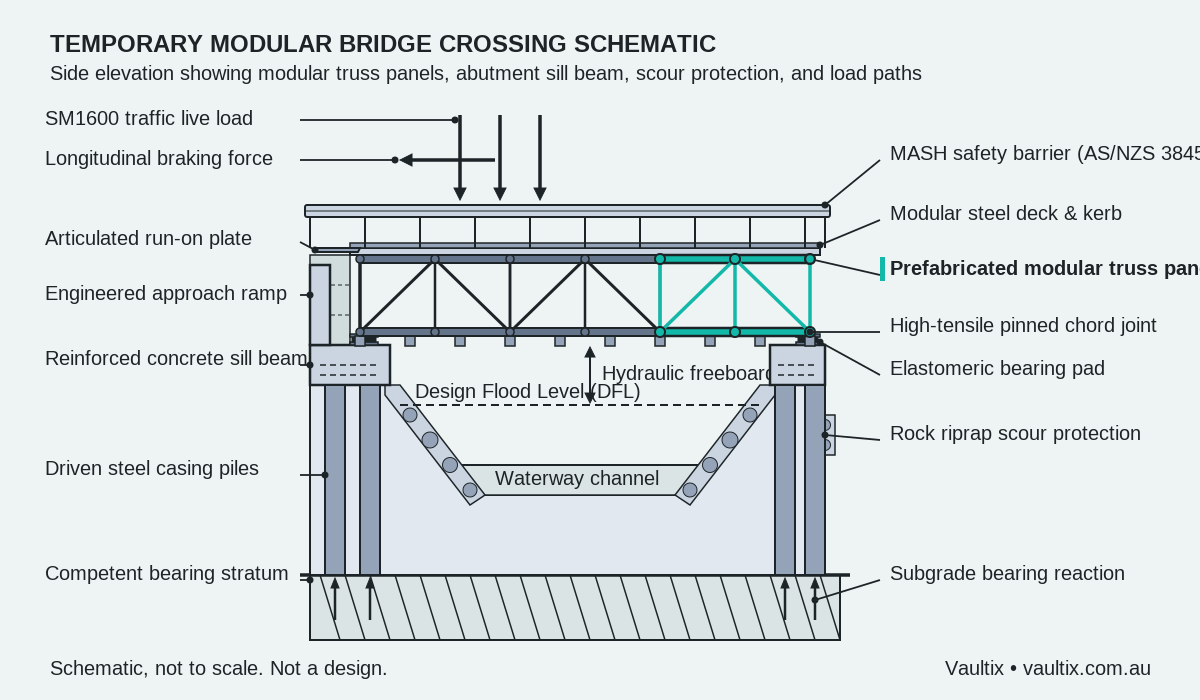
- Abutments and foundations. Driven steel casing piles, cast-in or precast concrete sill beams, or timber crane mats placed on engineered granular fill to transfer vertical loads, braking forces, and overturning reactions into competent ground.
- Bearings and end posts. Elastomeric bearing pads or articulated steel rocker bearings that accommodate superstructure rotational deflections, temperature expansion, and traffic vibrations.
- Modular superstructure. Prefabricated steel lattice truss panels, high-tensile chord pins, transoms, longitudinal stringers, and sway bracing forming the primary spanning bridge structure.
- Decking and kerbing. Anti-skid modular steel deck panels or heavy timber decking fitted with bolted steel kerb channels to delineate traffic paths and protect trusses.
- Launching gear. Skeletal cantilever launching nose, plain and rocking roller assemblies, hydraulic jacks, winches, and tail kentledge counterweights enabling cantilever launch without in-gap falsework.
- Safety barriers and transitions. MASH-tested temporary road safety barriers (AS/NZS 3845.1), approach guardrail transitions, pedestrian handrails, kickplates, and anti-throw mesh screens.
- Culvert and causeway elements. Precast reinforced concrete box units, corrugated metal pipes, geotextile filtration fabric, bedding aggregate, and rock riprap scour protection aprons.
Typical installation and removal sequence follows seven steps: 1. Complete geotechnical boreholes, hydraulic afflux modelling, TWDB preparation, RPEQ/CPEng certification, and statutory waterway barrier permits. 2. Establish environmental controls, including sediment fencing, turbidity curtains, and clean-water bypass pumps. 3. Construct abutments by excavating to competent bearing, driving steel piles or setting concrete sill beams, and placing elastomeric bearing pads. 4. Erect the superstructure using cantilever launching with a skeletal nose and roller stations, or place pre-assembled bridge bays directly using mobile cranes (or bed precast culverts on crushed aggregate). 5. Fix deck panels, bolt down kerbs, install crash-tested barriers with approach transitions, and construct engineered road ramps. 6. Perform bolt torque audits, baseline deflection surveys, and issue the statutory Temporary Works Handover Certificate prior to opening. 7. Decommission by diverting traffic, stripping barriers and decking, crane-lifting or winching spans back onto transport floats, extracting substructure piles or sills, and reinstating natural waterway contours with revegetation.
Australian standards and rules
Checked 10 November 2026. Each document was looked up in catalogue and regulator listings; the text of the standards was not read. Rows marked Not verified were not found or could not be checked. Confirm the current edition before relying on any document. Figures quoted on this page, such as loads, tolerances, heights, depths and inspection intervals, are typical values and are unverified unless a row cites the rule.
| Document | What it covers for this item | Status |
|---|---|---|
| AS 5100.1:2017 (Bridge design — Scope and general principles) | General bridge design scope, safety in design principles, and design life criteria. | Confirmed |
| AS 5100.2:2017 (Bridge design — Design loads) | SM1600 traffic live load models, dynamic load allowance, pedestrian loads, and collision forces. | Confirmed |
| AS 5100.3:2017 (Bridge design — Foundation and soil-supporting structures) | Geotechnical design of bridge abutments, driven pile foundations, and scour protection limits. | Confirmed |
| AS/NZS 5100.6:2017 (Bridge design — Steel and composite construction) | Structural design criteria for modular truss panels, high-tensile chord pins, transoms, and bracing. | Confirmed |
| AS 1597.1/2 (Precast reinforced concrete box culverts) | Manufacturing specifications, design loadings, and installation criteria for precast box culverts. | Confirmed |
| AS/NZS 2041.1/2 (Buried corrugated metal structures) | Design and site installation requirements for flexible buried corrugated metal pipes and soil arching. | Confirmed |
| AS 1742.3:2019 (Manual of uniform traffic control devices — Traffic control for works on roads) | Temporary road detour signing, delineation, tapers, and speed controls. | Confirmed |
| AS/NZS 3845.1:2015 (Road safety barrier systems and devices — Road safety barrier systems) | Crash testing, containment levels, and transition details for temporary road safety barriers. | Confirmed |
| AS 1657:2018 (Fixed platforms, walkways, stairways and ladders) | Pedestrian walkway loading, anti-slip decking, kickplates, and guardrail requirements. | Confirmed |
| Austroads Guide to Bridge Technology (AGBT) (Part 6: Construction; Part 8: Hydraulics) | Temporary works planning, falsework principles, waterway openings, backwater afflux, and bridge removal. | Not verified |
| Technical Note TN199: Guidance for the design of temporary roads (QLD TMR) | Geometric alignment, sight distances, cross-sections, and detour road parameters. | Confirmed |
| TS 03401.2 (Specification G10): Temporary Traffic Management (TfNSW) | Quality management and detour road safety specifications for public traffic. | Not found |
| Managing Urban Stormwater: Soils and Construction ("Blue Book") (Landcom / NSW Govt) | Erosion and sediment control specifications for temporary stream crossings (SD 5-1). | Not verified |
| Best Practice Erosion and Sediment Control (BPESC) (IECA Australasia) | Clean water diversions, temporary crossing protection, and riparian channel rehabilitation. | Not verified |
| Accepted development: Waterway barrier works (QLD DAF) | Statutory fish passage criteria and temporary culvert invert rules. | Not verified |
| Policy and guidelines for fish habitat conservation and management (NSW DPI Fisheries) | Fish habitat conservation, culvert embedment, and waterway barrier approvals. | Not verified |
Check the current edition before relying on any document. Temporary works need a competent person's design and inspection; this page is not a design guide.
Estimating considerations
- Span length and structural configuration. Longer spans exceeding single-tier panel lengths require double-storey trusses, chord reinforcement, or intermediate piers, increasing component delivery volume, crane capacity, and assembly labour.
- Equipment ownership and hire models. Modular bridge inventory is typically secured on weekly or monthly dry-hire arrangements with minimum commitment terms and return freight, whereas precast culverts and earthworks riprap are bought outright.
- Component reuse and sacrificial items. Truss panels, transoms, chord pins, and steel deck units achieve high reuse across projects, while leveling grout, timber packing, cast-in anchors, geotextile fabric, and asphalt road seals are sacrificial.
- Off-hire reconditioning and refurbishment. Project budgets must include allowances for post-use cleaning, ultrasonic non-destructive testing of high-tensile chord pins, shotblasting, repainting, and repairs before returning components to the yard.
- Engineering design and certification fees. Estimators must price geotechnical boreholes, hydraulic afflux modelling, structural Temporary Works Design Briefs, Category 3 independent proof engineering, and RPEQ/CPEng sign-offs.
- Heavy mobile cranage and specialised launch plant. Superstructure placement requires all-terrain mobile cranes with counterweight floats for lift-in bays, or specialised hydraulic jacks, rollers, and kentledge ballast for cantilever launching.
- Substructure and abutment preparation. Soft or alluvial bank soils require driven steel casing piles, sheet piling, or concrete sill beams on engineered fill rather than simple timber crane mats.
- Specialised labour and rigging crews. Pinned assembly and cantilever launching demand licensed doggers, intermediate or advanced riggers, and mobile crane operators working under a designated Temporary Works Coordinator.
- Wet weather standby and environmental controls. In-stream works require budget allowances for turbidity curtains, sediment basin maintenance, continuous bypass pumping, and seasonal dry-weather windows to avoid flood standby delays.
- Decommissioning, extraction, and channel rehabilitation. Complete removal costs include barrier unbolting, truss de-launching or crane removal, pile extraction via vibratory hammer, culvert removal, and full riparian bank revegetation.
Risks and common failures
- Abutment scour and undermining. High-velocity flood flows erode natural soils beneath bridge sill beams or footings, causing loss of bearing support. Control: Install heavy rock riprap over geotextile underlay, socket piles into competent bedrock, and maintain certified hydraulic freeboard above peak design flow levels.
- Cantilever launch sag and rollover. Insufficient launching nose length, incorrect tail counterweight ballast, or binding rollers lead to tipping or structural failure during cantilever launch. Control: Implement an RPEQ-certified launching plan verifying bending moments and tip deflections, verify tail kentledge ballast, and maintain continuous roller alignment.
- Non-standard construction plant overloading. Unauthorised transit of heavy crawler cranes, piling rigs, or overloaded earthmoving plant exceeding bridge capacity. Control: Prominently post load-limit signage, install physical height and width restrictors, and enforce a permit-to-cross sign-off managed by the Temporary Works Coordinator.
- Hydraulic damming and structure washout. Floating timber debris and storm debris choke culvert cells or low bridge soffits, causing floodwaters to back up and wash out approaches. Control: Design waterway openings for site-specific storm ARI events, provide adequate soffit clearance, install upstream debris deflectors, and carry out immediate post-event debris removal.
- Vehicle penetration and barrier plunge. Errant public or haul vehicles penetrate unanchored or undersized bridge side barriers and plunge into waterways or excavations. Control: Install crash-tested MASH-compliant temporary road safety barriers (AS/NZS 3845.1) bolted to bridge stringers or anchored to approach pavements with approved transition guardrails.
- Statutory fisheries non-compliance and prosecution. Perched culverts, high water velocities, or unvented rock causeways block native fish migration, resulting in environmental regulatory fines and project stop-work orders. Control: Embed culvert inverts below the natural streambed, provide low-velocity flow paths, and secure formal waterway barrier permits prior to commencing in-stream works.
- Abutment settlement and approach bump. Inadequate compaction of structural fill behind rigid bridge sill beams causes differential settlement and severe step transitions. Control: Place and compact select granular fill in thin 150 mm layers behind abutments, verify compaction with density testing, and install articulated steel run-on transition plates.
- Component damage during dismantling. Rough extraction of pinned joints using excavator buckets or impact tools distorts structural panel chords and ruins pins. Control: Follow strict decommissioning safe work method statements, utilize purpose-built hydraulic pin extraction tools, and complete joint non-destructive testing before returning components to the yard.
Sources and review
| Source | Used for | Status |
|---|---|---|
| AS 5100.1:2017 (Bridge design: Scope), Standards Australia (store.standards.org.au) | Scope, principles, and safety in design. | Confirmed |
| AS 5100.2:2017 (Bridge design: Loads), Standards Australia (store.standards.org.au) | SM1600 traffic live load models. | Confirmed |
| AS 5100.3:2017 (Bridge design: Foundations), Standards Australia (store.standards.org.au) | Bearing capacity and scour protection. | Confirmed |
| AS/NZS 5100.6:2017 (Bridge design: Steel), Standards Australia (store.standards.org.au) | Trusses, pins, transoms, and bracing. | Confirmed |
| AS 1597.1/2 (Box culverts), Standards Australia (store.standards.org.au) | Precast box culvert manufacturing and design. | Confirmed |
| AS/NZS 2041.1/2 (Corrugated metal pipes), Standards Australia (store.standards.org.au) | Buried metal structure design and installation. | Confirmed |
| AS 1742.3:2019 (Traffic control at works), Standards Australia (store.standards.org.au) | Detour signs, speeds, and tapers. | Confirmed |
| AS/NZS 3845.1:2015 (Safety barriers), Standards Australia (store.standards.org.au) | Road safety barrier crash testing. | Confirmed |
| AS 1657:2018 (Walkways and platforms), Standards Australia (store.standards.org.au) | Pedestrian walkways and handrails. | Confirmed |
| AGBT Part 6: Construction, Austroads (austroads.com.au) | Temporary works and bridge removal. | Not verified |
| AGBT Part 8: Hydraulics, Austroads (austroads.com.au) | Waterway opening, afflux, and scour. | Not verified |
| Technical Note TN199: Temporary roads, QLD TMR (tmr.qld.gov.au) | Geometric criteria for temporary roads. | Confirmed |
| TS 03401.2 (Spec G10): Traffic Control, Transport for NSW (transport.nsw.gov.au) | Detour traffic management QA specs. | Not found |
| Managing Urban Stormwater ("Blue Book"), Landcom / NSW Govt (environment.nsw.gov.au) | Temporary waterway crossings (SD 5-1). | Not verified |
| Best Practice Erosion & Sediment Control, IECA Australasia (austieca.com.au) | Clean water bypass and stream repair. | Not verified |
| Accepted development: Waterway barriers, QLD DAF (daf.qld.gov.au) | Fish passage statutory criteria. | Not verified |
| Fish habitat conservation and management, NSW DPI Fisheries (dpi.nsw.gov.au) | Culvert invert embedment rules. | Not verified |
| Temporary Works — Index (TMP-INDEX-001), Vaultix (vaultix.com.au) | Temporary works taxonomy and RPEQ obligations. | Not verified |
Items marked Not verified are not yet checked against a primary source. Research notes.
Library navigation
Plant and method index · Discipline work packages · Survey conformance and lot release