Temporary works / Ground and access
Working platforms and temporary roads
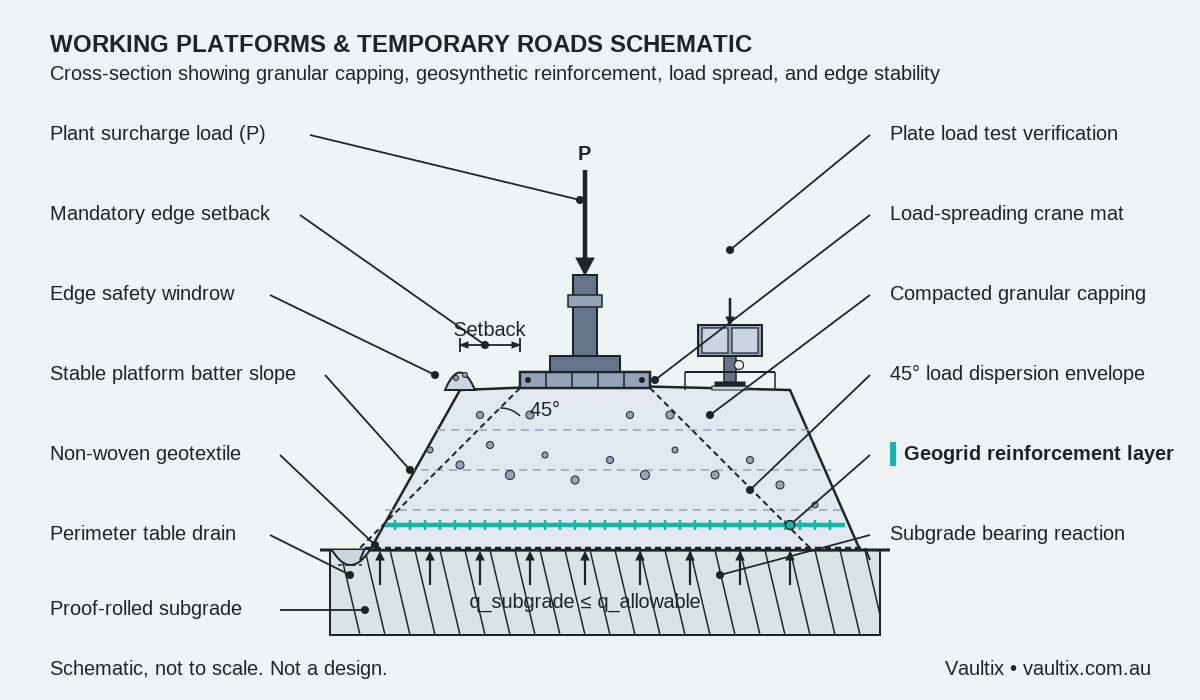
Working platforms and temporary roads are engineered, ground-supported temporary works that spread high plant loads from crawler cranes, piling rigs, mobile crane outriggers, and haul fleets across underlying subgrades. They control settlement and tilt, relieve ground bearing pressures, and maintain all-weather trafficability across variable terrain. For civil estimators and construction planners, these safety-critical installations require first-principles allowances for geotechnical investigation, granular capping or geosynthetic reinforcement, heavy spreader mats, compaction testing hold points, and statutory engineering sign-offs.
- Plant platformConfirm the operating footprint and access release.
- Granular layerReconcile placed material, thickness and compaction records.
- Subgrade interfaceRecord foundation condition before covering it.
What it is
Working platforms and temporary roads are engineered, ground-supported temporary structures designed to distribute concentrated construction plant loads safely into underlying subgrades. They establish stable, level, and trafficable foundations for high-risk equipment, including crawler cranes, continuous flight auger or bored piling rigs, mobile crane outriggers, concrete boom pumps, and heavy haul fleets. Functionally, these systems prevent ground bearing failure, restrict differential settlement to maintain crane levelness and rig mast verticality within safe limits, and preserve all-weather trafficking without progressive rutting or subgrade shearing. Under Australian work health and safety regulations, platforms supporting heavy plant represent safety-critical temporary works requiring a formal Temporary Works Design Brief, geotechnical site investigation, certified design by an RPEQ or CPEng where mandated, independent verification, compaction testing, and a formal Working Platform Certificate before trafficking.
Common types
| Type | What distinguishes it | Typical use |
|---|---|---|
| Granular Working Platforms (Capping, Piling Mats, and Crawler Pads) | Well-graded crushed rock or crushed recycled concrete compacted in controlled lifts over prepared subgrades. Sized for continuous track movements and slewing actions, with thickness governed by aggregate internal friction and punching shear transfer per BRE BR 470 and TWf2024:03. Requires perimeter edge setbacks and positive surface drainage. | Tracked crawler crane paths, continuous flight auger (CFA) and bored piling rig mats, and heavy dynamic plant operating areas. |
| Crane Outrigger Pads and Dedicated Hardstands | Compacted granular subbases paired with stiff load-spreading mats (hardwood baulks, steel mats, or polymer pads) under outrigger floats. Sized for concentrated point loads exceeding hundreds of kilonewtons, governed by pad flexural rigidity and subgrade shear capacity per CICA-GN-0013 and AS 2550.5. Requires uniform bedding away from uncompacted trenches or batter edges. | Mobile and all-terrain crane setups for structural steel erection, precast tilt-up placement, and bridge girder installation. |
| Geosynthetic-Reinforced Platforms (Geotextiles and Geogrids) | Granular aggregate reinforced with polymeric geogrids and underlaid with non-woven separation geotextiles. Geogrids provide lateral confinement and aggregate interlock, reducing required capping thickness over soft ground. Geotextiles prevent subgrade slurry pumping into aggregate voids under cyclic loading. | Platforms and crane pads over very soft or cohesive subgrades (CBR < 3%) and high-water-table formations. |
| Timber Bog Mats and Hardwood Crane Mats | Dense Australian hardwood timbers (Ironbark, Spotted Gum, Jarrah) bolted with steel tie rods. Deployed directly onto trimmed subgrades to traverse soft terrain or protect existing pavements, with load spread governed by timber bending strength across the grain. Requires regular inspection for rot, split timbers, and crushing. | Short-term crawler crane traversal, temporary pipeline right-of-way crossings, and pavement surface protection. |
| Fabricated Steel Crane Mats and Heavy Road Plates | Welded structural steel box beams, universal beams with flange plates, or heavy plates (typically 25 mm to 50 mm thick). Delivers superior flexural stiffness, spreading extreme outrigger reactions with minimal deflection. Highly durable and reusable, but heavy tare weight requires craneage to handle. | High-capacity mobile crane outrigger pads, heavy dual-lift positions, and bridging shallow buried utility services. |
| Temporary Haul Roads on Soft Ground | Stripped subgrades with separation geotextile, optional geogrid reinforcement, and compacted unsealed granular base per Austroads AGPT06 and AGPT04G. Designed for cyclic axle passes from haul fleets, governed by subgrade strain, rutting limits, and stone loss. Requires 3% to 4% crowned crossfalls and table drains. | Arterial site haulage routes carrying articulated dump trucks, road-registered tip trucks, concrete agitators, and heavy plant floats. |
| Chemically Stabilised Subgrades and In-Situ Platforms | In-situ soils blended with lime or cement binders using road reclaimer plant. Increases in-situ soil bearing strength and reduces clay plasticity, cutting imported aggregate volumes. Sensitive to curing temperatures and moisture; unsealed surfaces require protection against tracked plant chipping. | Large-footprint laydown yards, extended haul corridors, and moisture-sensitive clay subgrades with low native CBR. |
When it is used
- Supporting crawler crane assembly, tracking, and heavy lifting where boom geometry and counterweights produce high eccentric track pressures.
- Providing stable working pads for CFA, bored, and driven piling rigs subject to dynamic mast movements and casing extraction forces.
- Spreading concentrated point loads under mobile crane outrigger floats during precast tilt-up, structural steel, or bridge girder erection.
- Constructing unsealed heavy haul routes over soft alluvium, saturated clays, or uncontrolled site fill for continuous truck movements.
- Bridging heavy construction plant trafficking across shallow buried services, culverts, and utility trenches to prevent underground damage.
- Forming stable rockfill causeways and access fingers across tidal mudflats or waterway edges for marine piling and revetment works.
- Mitigating subgrade shear failure, rutting, and mud pumping across low-CBR formations during wet weather earthworks.
Do not construct deep granular platforms over competent bedrock where allowable bearing capacity far exceeds plant pressures; simple timber packers or thin levelling courses suffice. Avoid shallow ground-supported platforms over deep peat deposits or subsurface voids without deep ground improvement, and never apply ground platform rules to suspended slabs without engineered structural back-propping under AS 3610 or AS 5100. Ground platforms should also be avoided in unmanaged contaminated land where excavation triggers liabilities, or in active tidal zones where unconfined aggregate scours away.
Components and how it works
- Prepared subgrade. Stripped natural ground, proof-rolled in-situ soil, or select fill that forms the foundational bearing horizon.
- Geosynthetic separation layer. Non-woven needle-punched geotextile to AS 3706 preventing subgrade slurry pumping into aggregate voids under cyclic plant loads.
- Geosynthetic reinforcement layer. Biaxial or multiaxial polymeric geogrids providing aggregate interlock and lateral confinement over soft subgrades.
- Granular platform aggregate. Well-graded crushed rock or crushed recycled concrete placed and compacted to provide shear strength and load distribution.
- Load-spreading mats. Fabricated steel crane mats, dense hardwood bog mats, or synthetic outrigger pads that distribute high point reactions.
- Drainage infrastructure. Surface crossfalls (2% to 4%), perimeter table drains, and sediment sumps shedding rainwater to prevent subgrade moisture softening.
- Edge delineation and windrows. Compacted gravel perimeter windrows, edge marker pegs, and load limitation signage maintaining mandatory plant setbacks.
- Verification testing apparatus. Nuclear Density Gauges, Dynamic Cone Penetrometers, and Plate Load Test rigs verifying in-situ density and bearing capacity.
Typical installation and removal sequence follows seven steps: 1. Complete geotechnical boreholes and DCP testing, compile plant load cases, and execute RPEQ/CPEng platform designs per BRE BR 470, TWf2024:03, or CICA-GN-0013. 2. Strip topsoil, proof-roll subgrade with a heavy roller, and excavate localized soft pockets for backfilling or binder stabilisation. 3. Lay non-woven separation geotextile and polymeric geogrid reinforcement with specified roll overlaps. 4. End-dump granular crushed rock or recycled concrete, spreading in 150 mm to 300 mm loose lifts using low-ground-pressure plant. 5. Moisture-condition and compact with vibratory smooth drum rollers to AS 3798 criteria, forming 2% to 4% shedding crossfalls to perimeter drains. 6. Execute compaction and Plate Load Testing, hold trafficking until the engineer executes the Working Platform Certificate, and position crane mats per the lift plan. 7. Decommission following plant demobilisation by retrieving spreader mats, excavating and stockpiling clean capping aggregate for road base reuse, peeling sacrificial geotextiles, and re-compacting subgrades to civil specifications.
Australian standards and rules
Checked 10 November 2026. Each document was looked up in catalogue and regulator listings; the text of the standards was not read. Rows marked Not verified were not found or could not be checked. Confirm the current edition before relying on any document. Figures quoted on this page, such as loads, tolerances, heights, depths and inspection intervals, are typical values and are unverified unless a row cites the rule.
| Document | What it covers for this item | Status |
|---|---|---|
| AS 2550.1-2011 (Cranes—Safe use, Part 1: General requirements) | Crane siting, ground assessment, outrigger packing, and plant stability rules. | Confirmed |
| AS 2550.5:2016 (Cranes—Safe use, Part 5: Mobile cranes) | Mobile crane outrigger contact pressures, ground verification, levelness, and setup. | Confirmed |
| AS 3798-2007 (Guidelines on earthworks for commercial and residential developments) | Commercial earthworks, fill placement, compaction criteria, and proof-rolling verification. | Confirmed |
| AS 1726:2017 (Geotechnical site investigations) | Geotechnical borehole logging, soil classification, DCP profiling, and subgrade strength. | Confirmed |
| AS 2159:2009 (Piling—Design and installation) | Foundation piling design and ground-supported platform provisions for piling rigs. | Confirmed |
| AS/NZS 1170.0:2002 (Structural design actions, Part 0: General principles) | Temporary load combinations, limit state design principles, and stability criteria. | Not verified |
| AS 3706.1:2012 (Geotextiles—Test methods, Method 1: General requirements) | Geotextile physical testing, separation criteria, and filtration specifications. | Confirmed (scope wording to be corrected) |
| Model Code of Practice: Managing the risks of plant in the workplace (Safe Work Australia) | Statutory PCBU obligations for ground stability and safe plant operation. | Not verified |
| General guide for cranes (Safe Work Australia) | Guidance for crane outrigger packing, timber mats, and ground support checks. | Confirmed |
| Mobile crane Code of Practice 2024 (Workplace Health and Safety Queensland) | Prescriptive crane siting, geotechnical assessments, and platform safety rules. | Confirmed |
| CICA-GN-0013 (Crane Stability and Ground Pressure) | Outrigger reaction calculation, mat flexural sizing, and allowable ground pressures. | Confirmed |
| Austroads AGPT04G-09 (Guide to Pavement Technology Part 4G: Geotextiles and Geogrids) | Subgrade separation, geogrid aggregate interlock, and filtration design. | Confirmed |
| Austroads AGPT06-09 (Guide to Pavement Technology Part 6: Unsealed Pavements) | Temporary unsealed haul road design, axle passes, and granular thickness. | Confirmed |
| BRE BR 470 (Working platforms for tracked plant) | Punching shear analysis and granular platform design for crawler cranes and piling rigs. | Confirmed |
| TWf2024:03 (Working Platforms — Design of granular working platforms) | Granular platform design guidance, safety factors, and edge setback rules. | Not found |
| CIRIA C703 (Crane stability on site) | Foundation support principles, outrigger pad sizing, and track loading checks. | Confirmed |
Check the current edition before relying on any document. Temporary works need a competent person's design and inspection; this page is not a design guide.
Estimating considerations
- Subgrade bearing strength and capping volume. Low subgrade CBR requires deeper granular capping excavation or multiple geogrid layers, significantly increasing imported aggregate volumes.
- Equipment ownership and mat procurement. Polyethylene pads are standard crane carrier kit; heavy steel crane mats and timber bog mats are priced on weekly dry-hire or amortised across recurring projects.
- Material reuse and aggregate recovery. Well-graded crushed rock or crushed recycled concrete can be excavated and stockpiled for permanent road subbase, while geotextiles and geogrids are 100% sacrificial consumables.
- Design, engineering, and proof-engineering. Allowances must cover geotechnical site investigations (boreholes, DCPs, test pits), RPEQ/CPEng design briefs, and mandatory independent third-party verification for high-risk lifts.
- Compaction testing and inspection hold points. Programme allowances must account for nuclear density gauge testing, proof-roll audits, plate load testing, and engineering execution of the Working Platform Certificate before plant access.
- Earthmoving plant and placement fleet. Spreading and compaction require low-ground-pressure dozers, motor graders, 12 t to 18 t vibratory smooth drum rollers, and water carts for optimum moisture conditioning.
- Edge setbacks and batter windrows. Mandatory 1.0 m to 2.0 m perimeter edge setbacks and 45-degree load-spread envelopes increase bulk platform footprint beyond net crane operating envelopes.
- Wet weather management and crossfalls. Maintaining 2% to 4% shedding crossfalls, continuous table drains, and smooth-drum sealing prevents subgrade softening, though rain delays require scarifying and re-compaction allowances.
- Heavy handling and mat cranage. Thick steel mats and hardwood baulks exceed manual handling limits and require pick-and-carry cranes (Frannas) or telehandlers for offloading, placement, and final retrieval.
- Decommissioning and subgrade reinstatement. Post-lift allowances must cover mat cleaning, off-hire reconditioning, aggregate stripping, geotextile disposal, and subgrade scarification to permanent earthworks specifications.
Risks and common failures
- Outrigger punching shear failure. Concentrated outrigger point load exceeds ground bearing capacity, causing sudden pad punch-through and crane overturning. Control: Engineer spreader pads per CICA-GN-0013 and AS 2550.5; verify ground capacity via plate load testing and inspect pad bedding.
- Platform edge batter slope collapse. Operating cranes or heavy haul plant close to unconfined edges triggers circular shear failure of the embankment slope. Control: Enforce mandatory 1.0 m to 2.0 m perimeter setbacks and 45-degree load-spread lines; construct perimeter gravel windrows to physically restrict plant positioning.
- Subgrade moisture softening. Rainwater ponds on unsealed platform surfaces and penetrates fill, softening cohesive subgrades and lowering bearing capacity. Control: Grade 2% to 4% shedding crossfalls into perimeter table drains; seal with smooth drum rollers before rainfall and re-inspect before trafficking.
- Subgrade mud pumping. Omission or tearing of separation geotextiles allows clay slurries to migrate up into granular aggregate voids under repetitive trafficking. Control: Install heavy non-woven needle-punched geotextiles (AS 3706) with specified roll overlaps beneath all granular fill.
- Inadequate compaction and excessive settlement. Fill placed in overly thick lifts settles unevenly under cyclic tracking, exceeding crane levelness tolerances (> 1% slope) or piling mast limits. Control: Place fill in 150 mm to 300 mm loose lifts; verify compaction to AS 3798 with nuclear density testing prior to certificate sign-off.
- Punch-through into buried utility services. Heavy wheel or outrigger loads collapse shallow stormwater pipes, electrical conduits, or uncompacted trench backfill. Control: Complete BYDA utility searches, electronic locating, and potholing; install engineered steel bridging plates across service corridors.
- Spreader mat structural failure. Rotten, split, or undersized timber mats fracture in bending under maximum crane outrigger reactions. Control: Structurally design mats for peak bending and shear; inspect timbers prior to placement and immediately condemn damaged or decayed baulks.
- Unauthorised platform trenching. Utility subcontractors cut trenches through certified platforms, leaving uncompacted soft spots that undermine plant stability. Control: Enforce a strict Temporary Works Permit to Dig system; mandate controlled backfill, re-compaction testing, and engineering re-certification.
Sources and review
| Source | Used for | Status |
|---|---|---|
| AS 2550.1-2011 (Safe use of cranes), Standards Australia (store.standards.org.au) | Crane siting, outrigger packing, and stability. | Confirmed |
| AS 2550.5:2016 (Mobile cranes), Standards Australia (store.standards.org.au) | Outrigger reactions, levelness, and ground verification. | Confirmed |
| AS 3798-2007 (Earthworks), Standards Australia (store.standards.org.au) | Compaction testing and proof-rolling criteria. | Confirmed |
| AS 1726:2017 (Geotechnical investigation), Standards Australia (store.standards.org.au) | Soil classification and subgrade testing. | Confirmed |
| AS 2159:2009 (Piling), Standards Australia (store.standards.org.au) | Piling rig platform requirements. | Confirmed |
| AS/NZS 1170.0:2002 (Structural actions), Standards Australia (store.standards.org.au) | Structural design and temporary load combinations. | Not verified |
| AS 3706.1:2012 (Geotextiles), Standards Australia (store.standards.org.au) | Separation and filtration geotextile specifications. | Confirmed (scope wording to be corrected) |
| Model Code: Plant in Workplace, Safe Work Australia (safeworkaustralia.gov.au) | Statutory PCBU duties for plant stability. | Not verified |
| General Guide for Cranes, Safe Work Australia (safeworkaustralia.gov.au) | Principles for crane setup and blocking. | Confirmed |
| Mobile Crane Code of Practice 2024, WHS Queensland (worksafe.qld.gov.au) | Ground assessment and crane stability in QLD. | Confirmed |
| CICA-GN-0013, CICA & CANZ (cica.com.au) | Outrigger loads and mat sizing methods. | Confirmed |
| TWf2024:03, Temporary Works Forum (twforum.org.uk) | Granular working platform design guide. | Not found |
| BRE BR 470, BRE / FPS (brebookshop.com) | Standardised calculation for granular piling mats. | Confirmed |
| CIRIA C703, CIRIA (ciria.org) | Crane foundation support and stability principles. | Confirmed |
| Austroads AGPT04G-09, Austroads (austroads.gov.au) | Geotextile and geogrid pavement specification. | Confirmed |
| Austroads AGPT06-09, Austroads (austroads.gov.au) | Design standards for temporary unsealed roads. | Confirmed |
Items marked Not verified are not yet checked against a primary source. Research notes.
Library navigation
Plant and method index · Discipline work packages · Survey conformance and lot release